The range, honestly
A dental practice website in 2026 costs anywhere from a few hundred to tens of thousands, and the spread is not mostly about quality. It is about who builds it, how much of the work the practice does itself, and what the site is expected to do. Here are the bands we see, what each buys, and where a typical single-site practice should land.
The free option, and what it costs you
Squarespace, Wix or a template on a dental-specific builder, set up by someone at the practice over a few evenings.
You get: a presentable site with your details, a contact form, possibly an embedded booking link, on a template shared with many other practices.
You do not get: a site that loads fast on a phone, structured content for search (treatment pages Google can rank), integration with your practice management system, or anyone to call when it breaks. The monthly subscription continues for the life of the site.
Right for: a brand-new practice with no budget yet, as a placeholder for the first year.
A template site
A local web designer or a dental marketing company installs a WordPress theme or a builder template, swaps in your logo, colours, photos and copy, and connects a booking link.
You get: something that looks like yours, faster than DIY, usually with basic SEO fields filled in and a training session.
You do not get, usually: speed (templates are heavy), proper treatment pages with structured data, conversion tracking, or ownership clarity. Check who holds the domain and hosting. Many practices in this band are on a builder theme that fails Google's speed thresholds and never find out.
Right for: a practice that needs a competent presence and is not relying on the site for new patients.
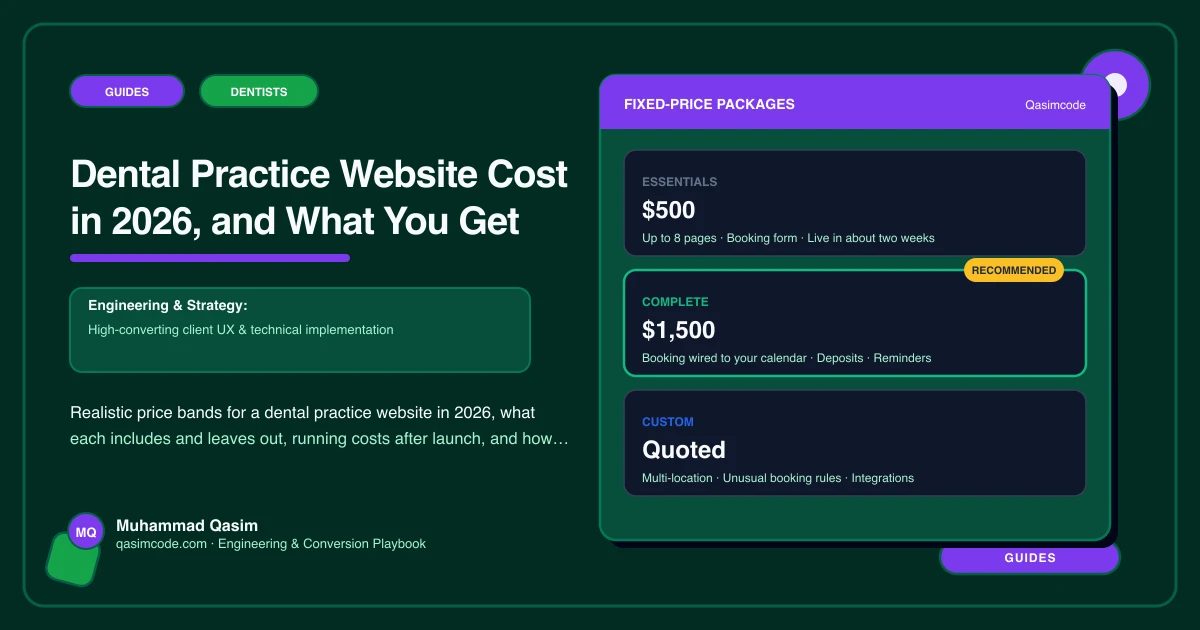
What we build: Essentials at $500, Complete at $1,500
A studio that builds for booking-led businesses, working from a fixed scope: your pages, your treatments as structured content, your team, online booking integrated with your practice software or booking tool, a fast build that passes Core Web Vitals on mobile, structured data for a dental practice, conversion tracking, and a documented handover with everything in your name.
You get: a site designed to turn searchers into booked patients and measured on whether it does. Treatment pages that can rank for "invisalign [town]" and "emergency dentist [town]". A booking flow tested on a phone. A monthly report that says how many enquiries came from where.
You do not get: copywriting and photography unless included (ask), ongoing marketing, or SEO campaigns beyond the on-page foundation.
Right for: most established single-site practices. This is where the return on the site is highest relative to cost, because the site is built to produce patients rather than to exist.
When it goes past that: Custom, quoted after a call — multi-site groups and custom platforms
Practice groups with several locations, bespoke patient portals, deep integration with practice management systems, membership plan sign-up, or a full brand project including strategy, copy and photography.
Right for: groups, and practices where the website is a central part of a larger marketing investment.
What is not in the build price
- Hosting: $20 to $50 a month for managed WordPress, or often free for a framework-built site, in your name.
- Domain: a small annual fee.
- Booking system: if you use a standalone tool rather than your practice software's portal, its subscription.
- Maintenance: updates, backups, security, monitoring and small changes. A care plan is typically a modest monthly fee; without one, expect to pay hourly when something breaks, which it will.
- Photography: a half day with a local photographer is the best money a practice spends on its site. Stock photos of models in dental chairs are recognisable and cost trust.
- Copywriting, if you would rather not write your own treatment pages.
Budget for these alongside the build so the total is not a surprise.
How to judge a quote
Ask for the scope in writing: which pages, which treatments as structured content, which booking integration, what speed target, what tracking, what is handed over and in whose name. Compare quotes on scope, not on the number. A $3,000 quote with no speed target and hosting in the agency's name is more expensive than a $6,000 one that passes Core Web Vitals, tracks enquiries and gives you the keys.
Then ask each provider for a dental site they built and its Core Web Vitals report from Search Console. A provider who cannot show you a fast dental site has not built one.
What we charge
Our dental practice sites sit in that standard, at a fixed price with a published scope: treatment pages built as structured content, booking integrated and tested, speed and structured data included, tracking set up, everything in your name, and a care plan available afterwards. The scope is on the dentist page, and a quote is a fifteen-minute call. If you are a template or a booking-platform page and the site is not bringing patients, the question is not whether that standard costs more; it is what the current site is costing you in patients who went to the faster practice down the road.