Best at what
Lists of "best dental websites" are usually lists of attractive ones. Attractive is fine and it is not the job. The best dental practice website is the one that turns the most searchers into booked patients for its practice, and the sites that do that share a set of traits that have little to do with how they look and a great deal to do with how they work on a phone.
Here are the nine, drawn from the dental sites we have built and audited that measurably fill diaries.
1. Booking is one tap from anywhere
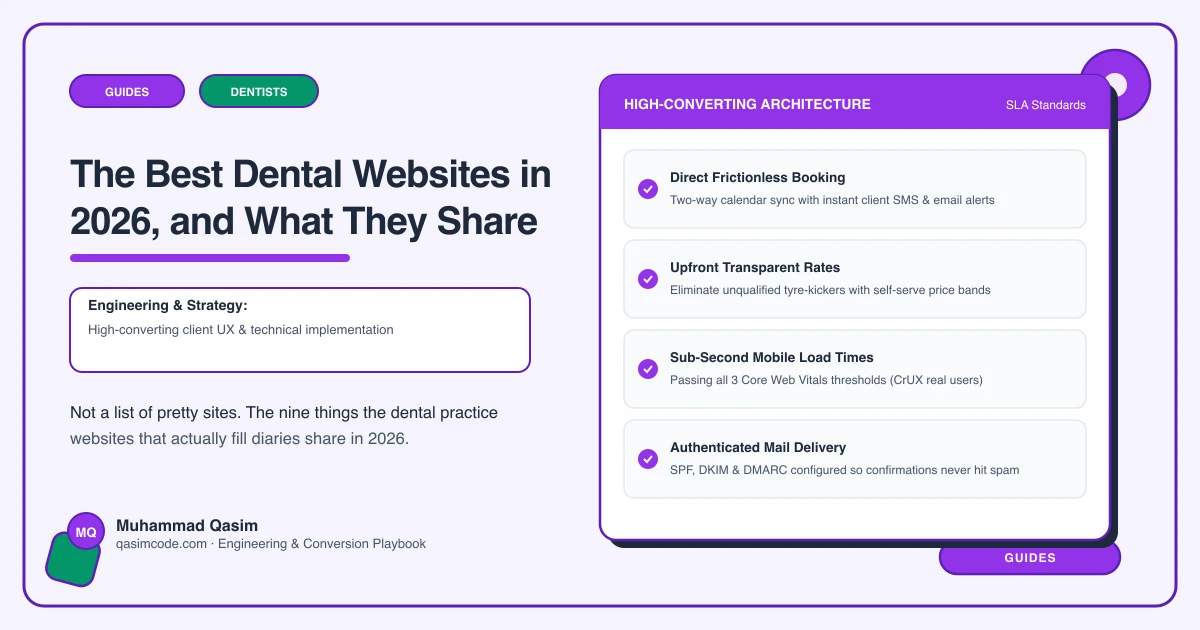
A Book button in the header on every page, visible on a phone without scrolling, going straight to live availability in the practice's booking system. Not a contact form. Not "call to book". The best sites treat booking as the primary action and everything else as support for it.
2. It appears in under two seconds on a phone
Every one of them passes Google's Core Web Vitals on mobile. The hero image is sized and prioritised, the scripts are few, the hosting is good. A patient in pain on mobile data sees the page before they can reconsider.
3. A page per treatment, written for the patient
Not a Treatments page with a bulleted list. A page for implants, one for Invisalign, one for hygiene, one for emergency care, each answering: what is it, who is it for, what does it involve, how long, what does it cost or how does pricing work, who does it here, what do patients ask. These pages are what rank for "implants [town]" and what convince the person who lands on them.
4. Prices, or at least starting prices
Check-up, hygiene, filling, crown, whitening, implant "from". A fees page the practice manager can update in a field. Membership plan pricing if there is one. The best sites have stopped hiding prices because patients simply go to the site that shows them.
5. Real faces with registration numbers
Every clinician photographed in the practice, with a short bio, qualifications and registration number, and a Book-with-this-dentist button. The reception team too. The building, the surgeries, the waiting room, photographed as they are. No stock models. Trust is the majority of dental conversion, and faces are how it is earned.
6. Emergency care handled specifically
A dedicated emergency page, linked from the home page, saying what counts as an emergency, what to do now, how to reach the practice today, and the emergency fee. Emergency searches are high-intent and time-critical, and the best sites are built to catch them.
7. Reviews where the patient is deciding
Google reviews pulled onto the site, with space reserved so they do not shift the layout, placed near the booking call to action on treatment pages. Not a wall of testimonials on a separate page nobody visits.
8. Structured data and clean technical SEO
The practice marked up as a dental business with address, hours, phone and services; each treatment page marked up as a service with its price; FAQ markup where there are FAQs; unique titles and descriptions; a sitemap; Search Console monitored. Invisible to patients, decisive for whether the treatment pages rank.
9. Tracking that tells the practice what happened
Booking clicks, calls, form submissions and completed bookings counted by page and source, so the practice knows the implant page brought eleven consultations last month and the ad campaign brought two. The best sites are the ones their owners can see working.
What they do not have in common
- A particular look. Some are minimal, some warm, some clinical. The traits above are compatible with any visual style.
- A particular platform. WordPress with a good theme, or a framework build, both appear. Page-builder sites rarely do, because of item 2.
- Large budgets. Most are mid four figures. The expensive ones are not better at the nine.
- Lots of pages. Nine to fifteen is typical. Depth on the treatments that matter beats breadth.
Checking yours
On your phone, on mobile data, in a private window:
- Count taps to a live booking slot. One is the target.
- Time the load. Under two seconds.
- Search Google for your top treatment plus your town. Are you on page one with a treatment page?
- Find your prices. Can a stranger?
- Find the dentists' registration numbers.
- Find the emergency page in one tap.
- Ask your practice manager how many bookings the website produced last month. If the answer is "I don't know", item 9 is missing.
A site that passes all seven is one of the best, whatever it looks like. Most practice sites we review pass two or three.
Where this sits
The nine traits above are the specification for the dental practice sites we build, and the checklist a diagnosis runs an existing one against. The visual design is chosen afterwards, to suit the practice, on top of a structure that is already doing the work.