The question behind the question
"Template or custom" sounds like a design question. For a dental practice it is an arithmetic question: which option produces enough extra new patients to cover its extra cost, and how soon? A new patient at a private practice is worth a meaningful sum over their first two years. The website's job is to produce them, and the two options produce them at different rates.
What a template is, here
A theme or builder layout designed for dentists in general, bought or licensed, with your logo, colours, photos and text swapped in. Dental marketing companies sell these as packages; local designers install them from theme marketplaces. The structure, the page types and the way content is stored are fixed by the template.
Cost: low thousands, sometimes bundled into a monthly marketing fee.
Strengths: fast to launch, familiar dental layout, someone else has thought about the page list.
Weaknesses that matter for patients: templates are heavy, so they are slow on phones; treatments are usually pages of prose rather than structured records, so each has to be built and maintained by hand; booking is a link out, not an integrated flow; the same template is on hundreds of other practices' sites, so it does not look like you; and the ownership of hosting and domain is often with the vendor.
What a custom build is, here
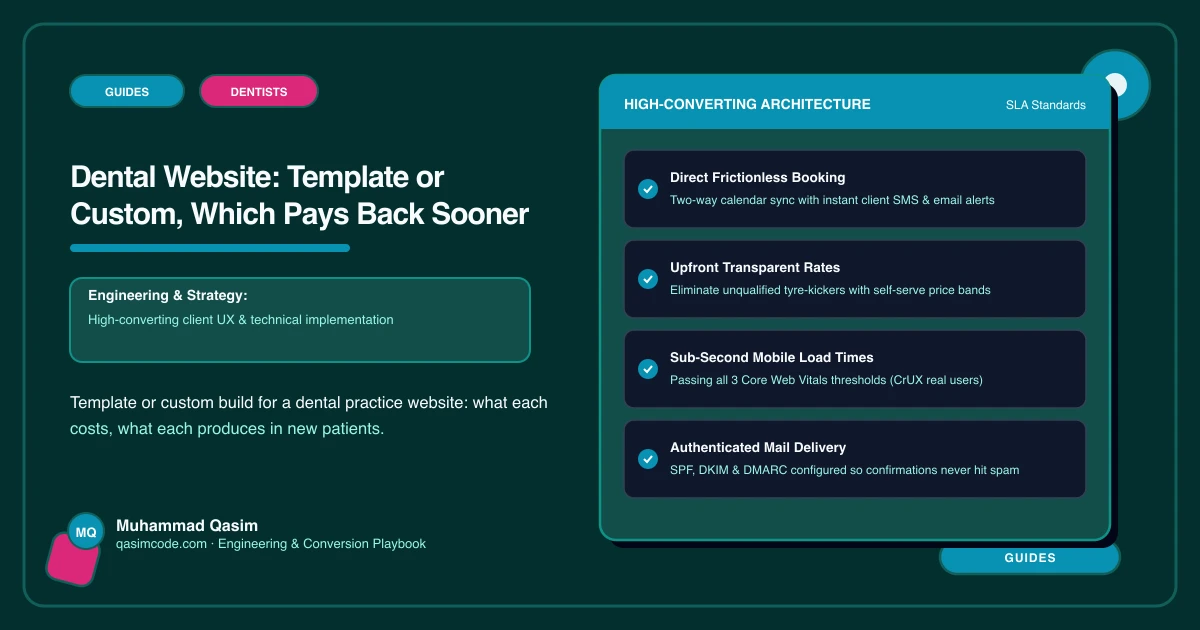
A site designed around your practice: your treatments as structured content with fields for price, duration, clinician and FAQs; your team as records with registration numbers; your booking system embedded and configured; built to pass Google's speed thresholds on a phone; structured data for a dental practice; conversion tracking; everything in your name.
Cost: mid four figures to low five, fixed.
Strengths: faster, ranks per treatment, books in one tap, editable by the practice manager without breaking, and measurable.
Weaknesses: costs more up front; takes two to four weeks rather than days; needs a studio that has built dental sites before.
Where the extra patients come from
Three places, each measurable:
Speed. A template site at four seconds on a phone loses a share of visitors before the page appears. A custom site at under two does not. On a practice getting 500 mobile visits a month from search, that is tens of visitors a month who now see the Book button.
Treatment pages that rank. "Invisalign [town]", "dental implants [town]", "emergency dentist [town]" are the searches with intent. A template with one Treatments page ranks for none of them. A custom site with a structured page per treatment can rank for several within months, each bringing patients who searched for exactly that.
A booking path that converts. One tap to a live diary, treatment pre-selected, confirmation immediate, versus a link to a portal with fourteen fields. The conversion rate difference on the visitors who reach the button is large.
The arithmetic
Take a practice with a template site getting 600 visits a month, converting 2 percent to enquiries, of which half become patients: six new patients a month from the site.
A custom site that is faster, ranks for three treatment terms and books in one tap might plausibly reach 900 visits at 4 percent, half becoming patients: eighteen a month. The exact numbers vary by market; the shape does not.
Twelve extra patients a month at a conservative first-year value covers the price difference between template and custom within the first few months. After that the difference is margin, every month, for the life of the site.
Even at a third of that uplift, the custom build pays back inside the first year.
When the template is right anyway
- A new practice with no patients yet and a tight budget. A template gets you a presence; plan the custom build for year two when the diary and the cash flow exist.
- A practice that is full and not taking new patients. The site's job is information, not acquisition; a template does that.
- A practice about to be sold or merged. Do not build for a future you will not own.
- An associate-heavy practice where the brand is the group's. The group's site may be the right home.
When the template is a false economy
- The practice depends on new patient flow and is in a competitive area.
- The current site fails Core Web Vitals and the practice is spending on ads that land on it.
- Reception spends time on enquiries the site should have answered: prices, what a treatment involves, whether you do emergencies.
- The site is on a vendor's hosting and you are paying monthly for a template you do not own.
Deciding in one meeting
Three numbers: monthly visits, monthly enquiries or bookings from the site, and the value of a new patient to the practice. If the site's conversion is under 2 percent or the speed is over three seconds on a phone, a custom build at the right price pays back in months. If the site converts well and loads fast, keep it and spend the money on photography and content.
Our dental practice sites are custom builds at a fixed price, with the treatment pages, booking integration and speed built in, because that is the version that pays back. The template is cheaper on the invoice and more expensive in the diary.