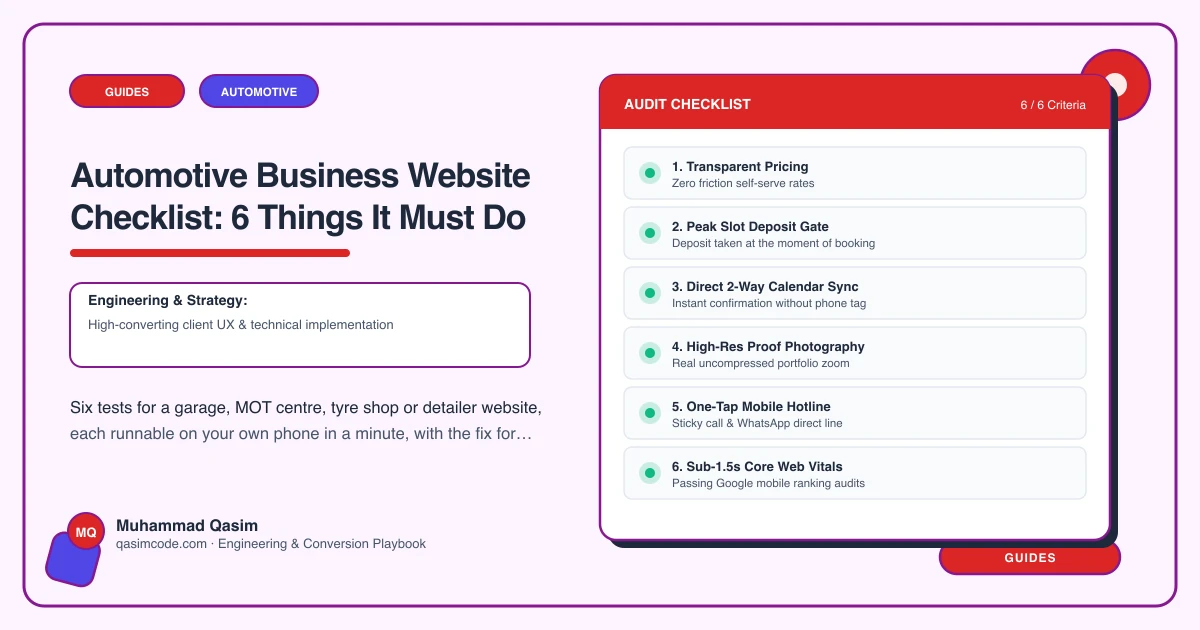
Six tests, ten minutes
An automotive business website has six jobs. Each has a one-minute test on your own phone, ideally from the car park with poor signal, because that is where drivers book. The first three are the path from a driver's phone to a slot in your diary; if any fails, fix it before anything else.
1. Book the car in with the registration
Test: open the site on your phone. Without scrolling, is there a Book button? Tap it. Does it ask for a registration and offer services and slots?
Pass: one tap into your software's booking (Autoflow, Garage Hive, Shopmonkey, Tekmetric, Workshop Software or a booking layer) with registration lookup, landing in your diary.
Fail: "call to book"; a contact form; a link to the software's hosted page where the driver has to find you again.
Fix: the booking embedded or deep-linked from a Book button in the header on every page, service pre-selected from the page it was tapped on.
2. State the price
Test: find the price of a full service for your own car, and the test fee. Time it.
Pass: a Services and prices page with fixed prices for services by engine size, tests, brakes, tyres fitted, air con and a diagnostics fee, found within a minute, editable by you.
Fail: "call for a quote"; a single "from" price; prices in a PDF.
Fix: a price menu as records on the site, matching your software's menu, with a line on what is included.
3. Appear in under two seconds
Test: private window, mobile data. Load the home page and the MOT and testing page. Count.
Pass: under two seconds; Core Web Vitals Good on mobile in Search Console.
Fail: blank, then a slider of the forecourt; Poor in Search Console.
Fix: images sized and compressed, hero prioritised, slider removed, scripts trimmed, decent hosting.
4. Take a fault with photos
Test: pretend the car is making a noise. Find where you would report it. Count the fields. Try to attach a photo from your camera. Submit. Time how long until it reaches a phone.
Pass: a fault form with registration, symptom, when it happens, photos and a call-back slot, reaching your software or a phone within a minute, and a bookable diagnosis slot with the fee stated.
Fail: a general contact form with no photo upload; an inbox checked at closing time.
Fix: the fault form built and wired, with a same-day call-back promise stated on the form.
5. Prove you are the honest garage
Test: find an accreditation or trade body logo and click through to the scheme. Find a photo of a real person who works there, with a name. Find the sentence that says no work happens beyond the quote without your approval.
Pass: all three within a minute; About and accreditations with the workshop, the team and the logos linked; a plain how-we-quote page; Google reviews near the Book button.
Fail: "fully qualified and insured" with no scheme; stock photos; no quoting page.
Fix: half a day of photography, the logos linked, the quoting page written from the questions the desk hears, reviews embedded.
6. Know what it produced, and bring the car back
Test: ask whoever runs the desk how many bookings, fault forms and calls came from the website last month, by page. Then ask whether last year's test customers got a reminder.
Pass: the numbers are known by page; reminders go out from the software with a one-tap rebook link.
Fail: "a few, I think"; reminders switched off or generic.
Fix: Book click, fault form and call events by page; the software's reminders switched on, branded, timed to the due date, linking back to the site.
Sub-types
The tests translate. A detailer passes test 1 with a Booksy or Urable button and test 2 with a package table by vehicle size. A tyre shop passes test 2 with fitted prices including valve, balance and disposal. A driving school passes with a price per hour and a Book button per instructor.
Scoring
Six of six: the site is working; add service pages for the next searches and keep the workshop photos coming. Four or five: fix the failures, no rebuild. Three or fewer with 1, 2 or 3 failing: the site is losing cars every week to the garage that told the driver the price, and the fixes cost less than one of them.
Where this sits
This is the launch checklist for every automotive business website we build and the first ten minutes of a diagnosis on an existing one. Most garage sites fail at least four, and the price menu is the fix that changes the phone calls fastest.