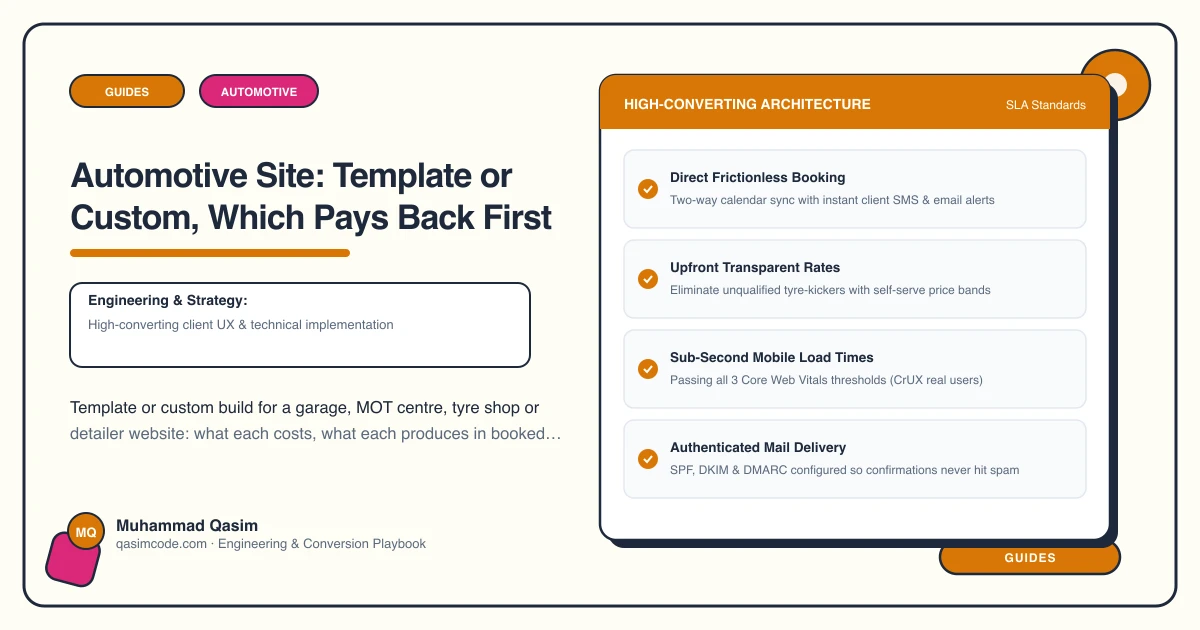
Booked cars, not looks
For a garage, the website question is how many cars it books in. One full service plus the brake job found during it covers a lot of website, and a driver who books a test with you once tends to come back every year. If a custom site books a few more cars a month than a template, it has paid its extra cost fast and keeps paying. If it does not, the template was fine. Here is how to tell which you are.
The template
A garage theme or builder layout with your logo, some photos of the workshop and a contact form, perhaps with a "book now" link to your software's hosted page.
Cost: hundreds to low thousands.
Good at: existing; being found for your business name.
Weak at: ranking for "MOT [town]", "car service [town]" and "tyres [town]" as separate searches (one Services page cannot); speed on a phone in a car park; booking with the registration looked up rather than typed; fixed prices laid out where a driver compares; a fault form that takes photos; accreditations displayed and linked; and a page on how you quote, which is the thing the driver is afraid of.
The custom build
Built around how drivers choose a garage. Book online with registration lookup from Autoflow, Garage Hive, Shopmonkey, Tekmetric or Workshop Software. Services and prices as a menu you edit. Separate MOT and testing, Repairs and diagnostics and Tyres pages that each rank. A fault form with photos and a call-back slot. About and accreditations with real workshop and team photos and logos linked to the schemes. Google reviews near every Book button. Reminders from your software. Under two seconds on a phone. Structured data, tracking, everything in your name.
Cost: mid four figures, fixed.
Good at: appearing for each service in your town, removing the overcharging fear before the driver arrives, booking the car in without a call, and reporting which page produced the booking.
Weak at: the invoice, and two to three weeks of build.
Where the extra cars come from
Service pages. "MOT", "full service", "brake pads", "clutch", "air con recharge", "tyres" are separate searches with separate intent. A page each, with the price, ranks and converts. A bullet list does not.
Prices on the page. A driver comparing three garages books the one that told them the price. The template says "call for a quote". The custom site says the number, by engine size, next to a Book button.
Booking with registration. Typing a plate is easier than choosing a make, model and year from menus. Fewer drivers abandon, and the booking arrives with the right vehicle attached.
The fault form. The driver with a noise cannot book a fixed-price job. A template offers a contact form. A custom site offers photos, symptoms and a call-back slot, so the first conversation is useful and the diagnosis slot gets booked.
Trust. Accreditations linked, real faces, the quoting page, reviews near the button. This is the reason an independent wins against a chain with a bigger sign.
Speed. Drivers book from the car park with one bar of signal. A template at five seconds is a template nobody sees.
The arithmetic
Suppose a garage with a template site gets 300 visits a month and converts 3 percent to a booking or fault enquiry: nine, perhaps six cars.
Suppose a custom site ranking for five services in the town, fast, with prices, registration booking and a fault form, reaches 700 visits at 7 percent: forty-nine, perhaps thirty cars. Even at a third of that uplift, the additional cars in the first two or three months exceed the price difference between template and custom for most garages, and the difference recurs monthly. Every test booked is a reminder sent next year.
When a template, or no site, is right
- A single-bay workshop full from regulars with no wish to grow. Google Business Profile and the software's booking page may be enough.
- A specialist working only for the trade, never for the public.
- A business about to be sold or wound down.
When the template is a leak
- Drivers phone to ask what a service costs, because the site does not say.
- You do tests and are not on page one for "MOT [town]" or the equivalent scheme where you are.
- Booking means a phone call while the ramps are busy.
- Fault enquiries arrive as "it's making a noise" on voicemail with nothing to go on.
- Your site takes over three seconds on a phone.
- The site came bundled with a marketing contract and you are not sure who owns the domain.
Deciding
Three numbers: monthly visits, monthly bookings and fault forms from the site, and the average value of a car through the workshop. If the site is under 3 percent conversion or over three seconds, or you rank for fewer services than you offer, a custom build pays back in a handful of cars. If it is fast and converting, keep it and add the prices and the fault form.
Our automotive business websites are custom builds at a fixed price, with registration booking, the price menu, the fault form and speed included, because that is the version that books cars. The template costs less to buy and more in the drivers who booked with the garage that told them the price.