Best means the first session gets booked
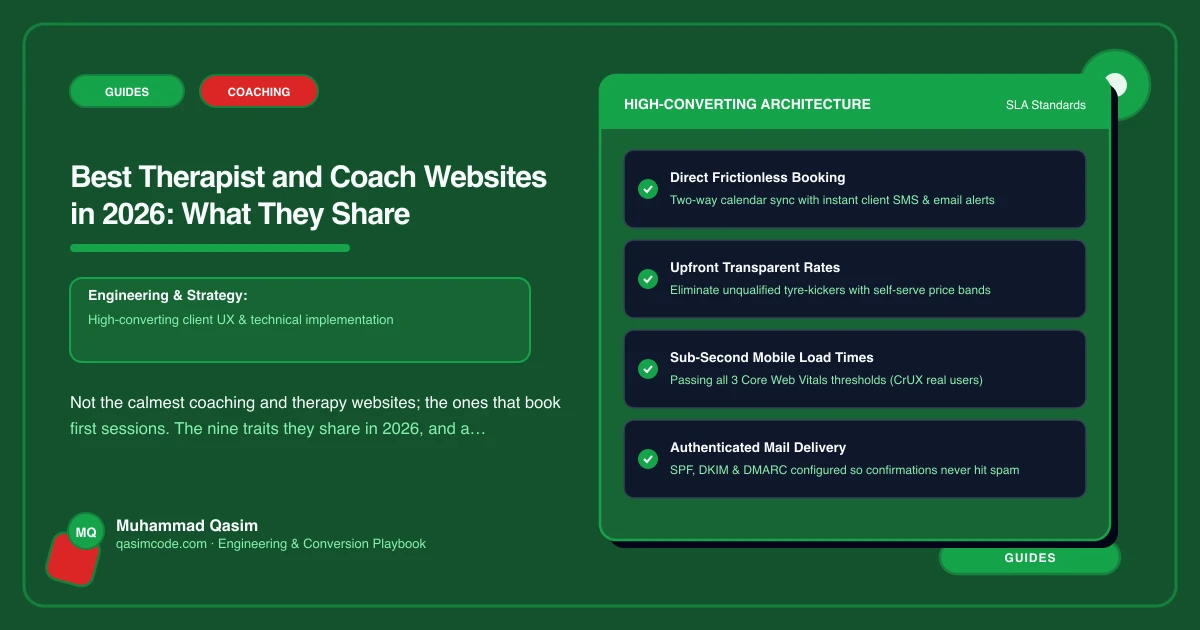
The best therapist or coach website is the one that turns a stranger's search, usually late at night on a phone, into a booked discovery call or first session with the right client. The coaching, hypnotherapy, holistic therapy and doula sites we have built and audited that measurably do this share nine traits. None is a stock photo of a stone stacked on a stone.
1. A page per situation, in the client's words
Not "Services". "Career change in your forties." "Fear of flying." "Sleep for a baby who wakes every hour." "Preparing for a first birth." Each page says who it is for, what the situation feels like, what changes and how the practitioner works with it. These rank for the specific searches and are the reason a client feels seen.
2. Prices on the page
Session fee, package price, what is included, how long, cancellation policy. Beside every Book button, not behind a call. The client who can afford it books; the one who cannot does not waste an hour of both your time.
3. Credentials that can be checked
Accreditation body and level, training and hours, professional memberships, insurance, supervision where relevant, each with a plain line on what it covers and a link to the register where one exists. On the About page in full, and a line on every service page.
4. A what-happens page
How a first session works, how long, what it feels like, that the client stays in control, what happens after. For a hypnotherapist it is the most read page. For a doula it is what you do and do not do, and how you work alongside midwives. For a relationship therapist it includes how to raise it with a partner.
5. Booking embedded, with intake
The discovery call or first session booked through Acuity, Calendly, Paperbell, CoachAccountable or Practice Better, embedded on the site rather than linked away, with a short intake form in the tool's flow, payment where the first session is paid, and the video link sent automatically.
6. Online and in-person explained
The platform, what the client needs, how the link arrives. The room, the address, parking, what to expect on arrival. Time zones handled for online practices.
7. Copy within the rules
No cures, no guarantees, no medical claims by non-clinicians. What the practitioner helps with, in careful language, and honest expectations about what typically changes. Testimonials only where the professional body and country permit them. The best sites read as more trustworthy because of this, not less.
8. A real person
Your photo, taken by someone who knows what they are doing, in the room where you work or somewhere that looks like you. Your story, briefly, including why you do this. Not a stock image of a sunrise.
9. Measured by page
Booking clicks and completed bookings tracked by page, so the practitioner knows the career change page produced four discovery calls and the fear of flying page produced two paid first sessions last month. The best sites are the ones their owners can see paying.
What they do not share
- A look. Warm and hand-drawn; clinical and calm; bold and direct. All work when the structure is right.
- A platform. Good WordPress themes and framework builds both appear; heavy builder templates rarely, because of speed.
- Big budgets. Most are mid four figures.
- Many pages beyond the situation pages and the eight that every practice needs: Home, Who I work with, How it works, Prices, Book a session, About, Blog or resources, Contact.
Check yours
On your phone, mobile data, private window:
- Does the home page name a situation you work with, in words a client would use?
- Can you find a price in under thirty seconds?
- Find your accreditation and click through to the register.
- Is there a page saying what happens in a first session?
- Tap Book. Does it open on the site, with a form and a price, or on a bare calendar somewhere else?
- Read your home page as a regulator would. Is there a sentence you would have to defend?
- How many bookings did the site produce last month, and from which pages?
Seven passes is one of the best. Most coaching sites we review pass two.
Where this sits
The nine traits are the specification for the coaching practice websites we build, with sub-pages for hypnotherapists, sleep consultants, doulas and the rest, and the checklist a diagnosis runs an existing site against. The look is chosen after, to suit the practitioner, on a structure that is already booking first sessions.