Eight kinds of page
A coaching or therapy website needs eight kinds of page. One of them, Who I work with, is a template repeated for each situation or issue you work with, so the site may have fifteen pages, all built from records. Here is each kind, what it must contain, and how to build in stages.
1. Home
Above the fold on a phone: who you help and what changes, in one specific sentence in the client's words, not "helping you live your best life". Then a Book a session button and the starting price. Below: the situations or issues you work with, each linking to its page; credentials in a bar with linked numbers; how it works in three steps; a photo of you, a real one; online and in-person in a line; the price again; one or two testimonials where your country and body allow them; and the Book button again. No slider, no stock photography.
2. Who I work with (one page each)
A page per situation or issue: the client's situation described in their words, what usually brings people to you, what changes and what does not, how many sessions people typically have, the relevant price, a short credentials line, the honest evidence position where the work is health-adjacent, and a Book button with the right appointment type pre-selected. Five to twelve of these, from a template on records. For a life coach they are situations (a career change, a divorce); for a hypnotherapist they are issues, written within the advertising rules; for a business coach they are stages and problems.
3. How it works
What happens from booking to the end of the work: the first session or discovery call and what it is for, session length, what a session is like, how often, how long people typically work with you, online and in-person setup (platform, what the client needs, the room), between-session contact, how it ends. For hypnotherapists this is the what-happens-in-a-session page, the most read page on the site. For doulas it explains what a doula does and does not do and how booking works around a due date.
4. Prices
Single session with length; the first session if different; packages with sessions, duration, inclusions and total; concessions if offered; whether tax is included; payment and deposits; cancellation policy; a Book button under each. Rendered from the same records that put the price on every who-I-work-with page.
5. Book a session
One line saying what the first step is, the booking embed (Acuity, Calendly, Paperbell, CoachAccountable or Practice Better, or the practice-management tool you already use), and a contact route for anyone who wants to ask first. Nothing else on the page. Every Book button on the site lands here with the appointment type pre-selected, and the tool redirects to a thank-you page on your domain afterwards.
6. About
Your story, briefly and honestly: why this work, your own experience where relevant. The credentials section in full: accreditation body and level, training with school and hours, memberships and what they require, supervision, insurance, continuing education, each with a link where a register exists. The scope line: what your qualification lets you do and what it does not. A real photo. Where you practise.
7. Blog or resources
Only if someone will write. Pieces that answer the questions clients type: "what happens in a hypnotherapy session", "how many coaching sessions do I need", "what does a doula cost". Each links to the relevant who-I-work-with page and ends in Book. A resources page with a few genuinely useful downloads works if a blog is too much. A blog that stopped in 2023 is worse than none.
8. Contact and legal
Email, phone if you take calls, practice address with map if in person, online hours and time zone, a minimal contact form to a monitored inbox for the client who wants to ask before booking, and a confidential route where the practice needs one. Business details as your jurisdiction requires. Privacy notice covering the booking tool and intake data, terms including the cancellation right, accessibility statement. Plain pages linked from the footer.
Optional
- For the partner researching alone, on relationship therapy sites: a page for the person who has not yet raised it.
- Gift vouchers, for holistic therapists, sold online.
- Group programmes, courses or classes, each with dates, price and enrolment.
- For students and parents, on career counselling sites.
- FAQ, if the questions do not fit How it works.
Leave off
A Services page that lists everything in one paragraph; the who-I-work-with pages replace it. A Testimonials page; put the permitted ones beside the Book buttons. Mission and Values pages. A "Book a free call to find out the price" page. Stock photos of people on beaches.
Building in stages
Stage 1, launch: Home, How it works, Prices, Book a session, About, Contact and legal, and the three or four who-I-work-with pages for the clients you most want. Complete and bookable.
Stage 2, first quarter: the remaining who-I-work-with pages, the optional pages your practice needs, the first three resources.
Stage 3, ongoing: a who-I-work-with page when you start working with a new kind of client; a resource when a client asks the same question twice.
The claims review, the booking wiring, the credentials bar, speed and tracking are in from stage 1.
The structure underneath
Situations, prices, credentials and appointment types as records with relationships: the anxiety page shows the anxiety consultation's price and pre-selects it in the booking; the credentials bar renders from the credentials records with renewal reminders; changing a price changes it on every page. Adding a situation is filling in a form.
Where this sits
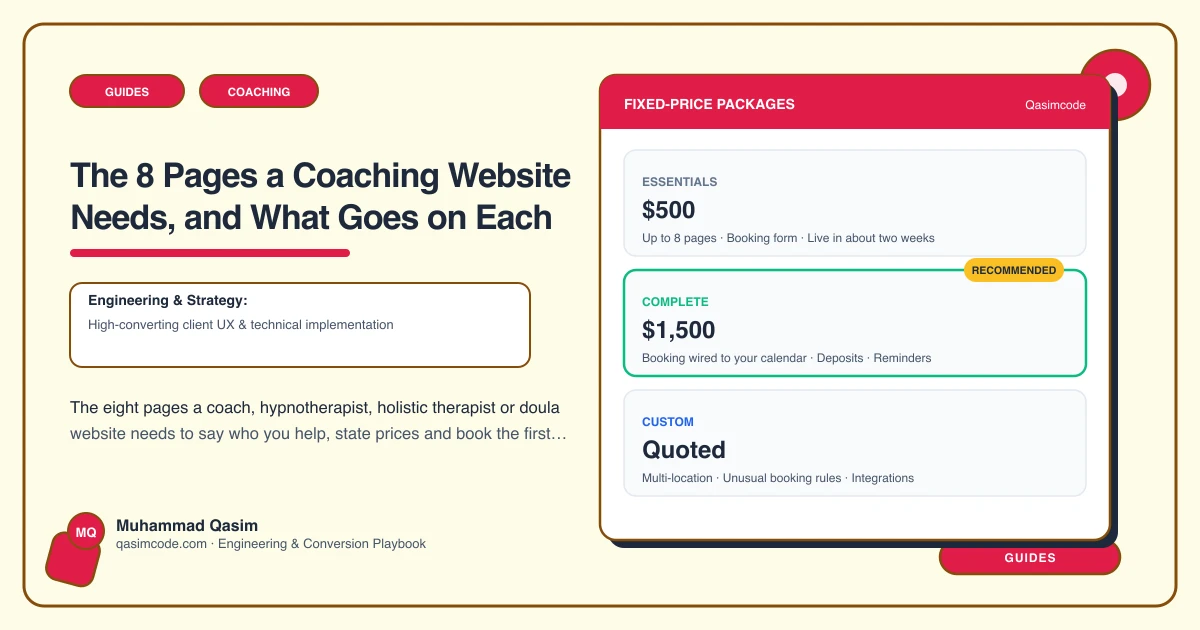
These eight kinds are the page list for every coaching practice website we build, at the Essentials tier for a solo practice and Complete for a group, with the records, the booking wiring and the claims review included; pricing is published in the same way we ask you to publish yours. Coaches and therapists arrive expecting a brochure and leave with a site that says exactly who they help and books the first session.