The problem
"Book a free discovery call to find out how we can work together." The price is not on the site because the practitioner has been told it should not be: that price is a conversation, that stating it anchors low, that a call converts better than a page.
Watch what actually happens. The client who could afford you reads "book a call" as "expensive, and they want to sell me on the phone", and leaves for the practitioner who told them. The client who cannot afford you books the call, spends half an hour with you, hears the number and goes quiet. The call was free for them and cost you the hour.
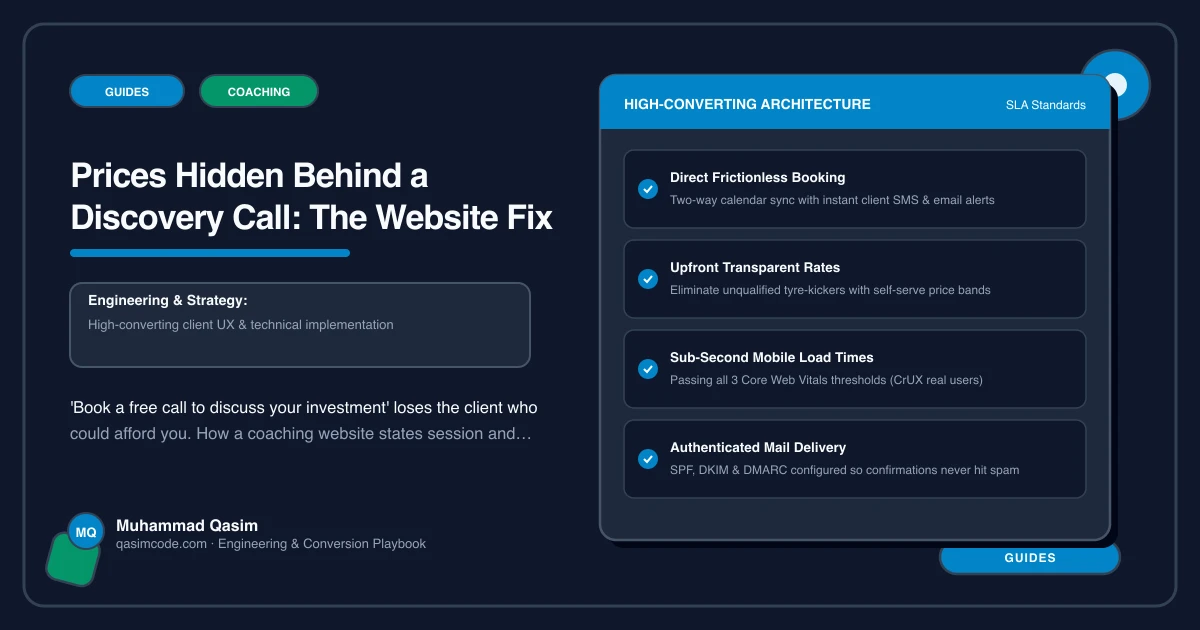
Publishing prices reverses both. It is the second of the three pains on our coaching practice website page because it is the one practitioners most often argue against, and the one whose fix is quickest.
What to publish
Session fee. Per session, with the length. Online and in-person if they differ.
Packages. The number of sessions, the period, what is included between sessions, the price, and the saving against single sessions if there is one. Paperbell and CoachAccountable both sell packages directly; Acuity handles them as packages or gift certificates.
Programmes, for coaches who run them: duration, group or one-to-one, what is included, the price or a stated range.
The first session. Whether the discovery call is free and how long it is, or whether the first session is paid and at what rate.
Policies. Cancellation and rescheduling terms, payment terms, whether a deposit is taken. Stated beside the price, because it is the second question.
Sliding scale or concessions, if you offer them, with the criteria. It is a kindness to say so and it removes an awkward call.
Where it goes
- A Prices page, in the main navigation, one screen, no scrolling through philosophy first.
- Beside every Book button on every situation page: "First session £X / $Y, 60 minutes. Book."
- In the booking flow, so the tool shows the same figure at checkout as the page did.
- In the discovery call confirmation, so the client arrives knowing the number and the call is about fit.
Practice types
A business coach lists programmes with prices or ranges, because owners budget and compare. A career counsellor lists single sessions and packages, with a separate line for students where parents are paying. A doula lists birth packages, postnatal rates and antenatal courses, each with what is included, because parents are budgeting for a baby. A holistic therapist lists price and duration per treatment, with the deposit taken at booking. A sleep consultant lists consultation, plan and follow-up packages as a menu an exhausted parent can read at 3am.
The objections, answered
"My price depends on the client." Then publish the range and what moves it, or publish the standard rate and say concessions are available. A range is still an answer; "book a call" is not.
"Competitors will undercut me." They already know your prices; your clients tell them. The client comparing two sites will book the one that gave them a number.
"A call converts better." A call with a client who already knows the price and has come to check fit converts best of all. A call that is secretly a price reveal converts worst.
"It anchors low." Only if the page is a number and nothing else. A situation page that describes the client's problem, shows credentials and explains what changes, then states the price, anchors on the value it has just described.
What the discovery call becomes
Once the price is on the site, the call stops being a sales conversation and becomes what it should be: a fit conversation between two people who both already know the number. Shorter, more honest, more often converted. The intake form in Calendly or Acuity can ask what the client wants to work on, so you arrive prepared and the call is about them.
Keeping it current
Prices change. The site should hold them as editable records, so a fee rise is one change reflected on the Prices page, every situation page and the booking tool, rather than a hunt through paragraphs. Set a date each year to review them.
Where this sits
Stated prices for sessions and packages are on the must-have list for every coaching practice website we build, and adding them to an existing site is the fastest fix a diagnosis ever recommends. The client who cannot afford you stops wasting your hour; the client who can stops wondering whether to ask.