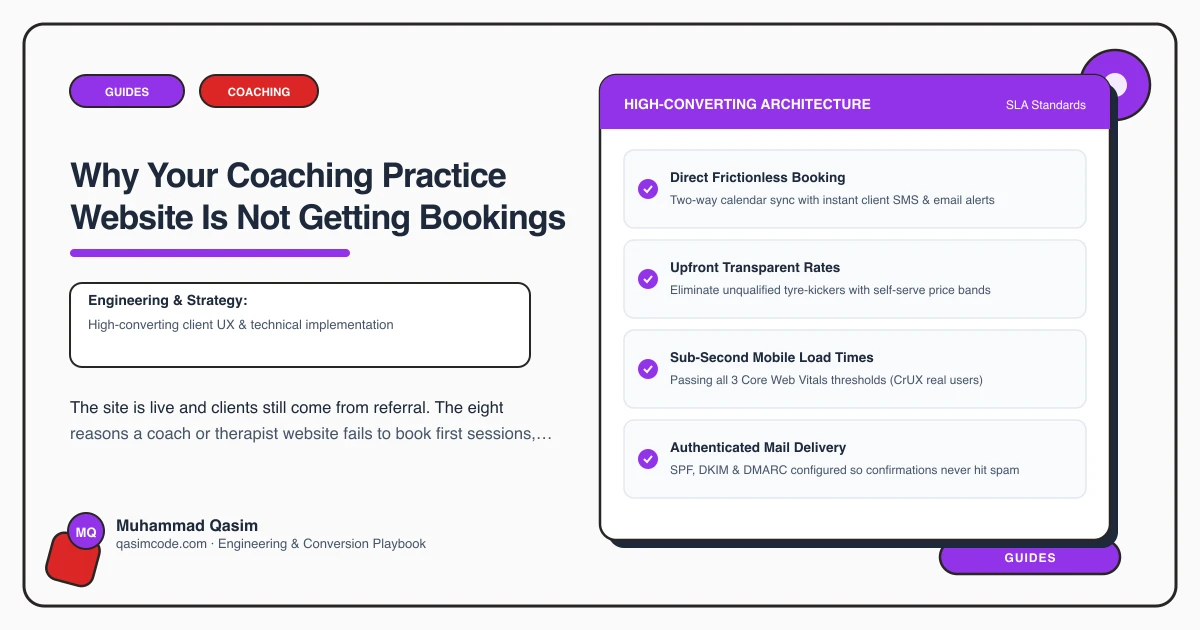
The symptom
The website exists, it has a calm photo of you and a paragraph about your approach, and every client still comes from someone who recommended you. Analytics says people visit. Nobody books. On coaching and therapy sites we review, the cause is on this list, usually several at once. Check them in order; the first three are the path from a reader to a booked first session.
1. The copy describes nobody
"Helping you live your best life." "Unlock your potential." "A safe space to explore." The client arrived with a specific situation: a career that has stalled at forty, a fear of flying before a wedding, a baby due in March. They read the home page, saw nothing about themselves, and left.
Fix: a page per situation or issue you work with, headed in the client's words, saying who it is for, what the situation feels like, what changes, and how you work with it. Link them from the home page in a list a client can scan for their own.
2. The price is behind a discovery call
"Book a free call to discuss your needs and investment." The client reads that as "expensive, and they want to sell me". The one who could afford you leaves; the one who could not books the call.
Fix: session and package prices on a Prices page and beside every Book button. Say what is included, how long, and the cancellation policy. The life coaches and business coaches sub-pages both treat this as a must-have because it is.
3. Booking is a link to a calendar with nothing around it
The Book button opens a bare scheduler. No price, no intake, no sense of what happens next. Or worse, a contact form asking the client to describe why they want therapy in a text box before anyone has spoken to them.
Fix: the discovery call or first session booked through Acuity, Calendly, Paperbell or Practice Better, embedded on the site, with a short intake form in the tool's flow, the price beside it, and a confirmation saying what happens next and how the video link arrives.
4. The credentials are a logo in the footer
Coaching is unregulated in most countries; hypnotherapy and holistic therapy are voluntarily regulated in many. Clients know this and look for evidence. A tiny accreditation badge with no explanation does not supply it.
Fix: a credentials section on the About page and a line on every service page: body, level, training and hours, memberships, insurance, supervision where relevant, each linked to the register where one exists, with a plain sentence on what the qualification covers.
5. Nobody has said what happens in a session
The hypnotherapy client is afraid of losing control. The therapy client does not know whether they have to talk about their childhood. The doula's client is not sure a doula is not a midwife. Each fear is a booking that did not happen.
Fix: a How it works page: what a first session involves, how long, what it feels like, that the client stays in control, what happens after. For hypnotherapists it is the most read page on the site.
6. Online and in-person are not explained
"Sessions available online and in person" and nothing more. Which platform, do I need a camera, where is the room, is there parking, what if my connection drops.
Fix: a short section on each: the video platform, what the client needs, how the link arrives; the room, the address, parking, what the building is like on arrival.
7. The copy makes claims a regulator would question
"Cure anxiety in three sessions." "Guaranteed results." "Stop smoking for good." Beyond the legal risk, a sceptical client reads these as marketing and trusts the site less.
Fix: describe what you help clients work on and what typically changes, in careful language, without guarantees or medical claims. Testimonials only where your professional body and country permit them, and never for health outcomes where they do not.
8. You cannot tell what the site does
Without tracking, you cannot know which of the seven above is the problem.
Fix: booking-click and booking-complete events by page; a monthly look at which situation pages produced calls; the intake form asking "how did you find me".
The order
Items 1 to 3 are the path; fix them and bookings start within weeks. Items 4 to 6 are why the client trusts you enough to book. Item 7 keeps you out of trouble and, oddly, converts better. Item 8 is how you know.
Where this sits
This is the checklist every coaching practice website we build is tested against before launch, and the first half of a diagnosis on an existing one. Most coaching sites fail at least four; most failures are fixable without a rebuild, and the situation pages are the one that changes the practice.