The page couples open second
A couple finds a photographer or a planner on Instagram, opens the site, looks at the work, and then goes looking for the price. If the Packages and prices page is missing, or says "get in touch for a quote", most of them close the tab and open the next shortlist entry. If it shows three packages, each with a from-price and what is included, they either enquire or rule themselves out, and both outcomes save you time.
Here is how to build that page so it does the filtering for you and stays accurate without a developer.
Packages as records
Each package is a record with fields, not a paragraph typed into a page:
| Field | Purpose | |---|---| | Name | "Full day", "Half day", "Elopement" | | Service | Wedding photography, engagement session, commercial | | From-price | The lowest realistic figure, with currency | | Price basis | Per event, per hour, per head, per item, percentage of budget | | Inclusions | Repeating lines: hours, second shooter, edited images, album, travel | | Not included | Extras and how they are priced | | Turnaround | When the gallery or film is delivered | | Enquiry route | Date check, brief form or instant booking | | Order | Where it sits on the page |
The Packages page renders every record in the same layout. Editing a price is changing a number in one place, and it updates the package card, the service page it appears on and the FAQ that references it.
What the from-price means
A from-price is the cheapest way to hire you for that service, stated honestly. If the full-day package starts at a figure but every real booking adds a second shooter, either fold the second shooter in or list it plainly as an extra with its price. A from-price that nobody actually pays is what makes couples distrust the whole page.
State the basis beside the number. Photographers and videographers price per event or per hour; caterers per head by menu style; florists per item, bouquet and buttonhole and table centre; wedding planners as a from-price per service level or a percentage of the wedding budget; venues per day and season. Say which one you use, and whether tax is included. UK and EU visitors expect VAT-inclusive figures; US visitors expect tax added later.
Inclusions do the selling
Couples compare across three or four suppliers with different package names, so the inclusions are what they actually compare. Be specific: "8 hours coverage, two photographers, 600 edited images, online gallery within six weeks" reads very differently from "full coverage and edited images". For a DJ or band, that is hours, equipment, lighting and MC duties. For a videographer, film length, highlights, raw footage and turnaround. For a children's entertainer, duration, age range and what the show includes.
Put the "not included" list under it. Travel beyond a radius, extra hours, albums, rush delivery. Stated extras are a price list; discovered extras are a complaint.
Three packages, one recommended
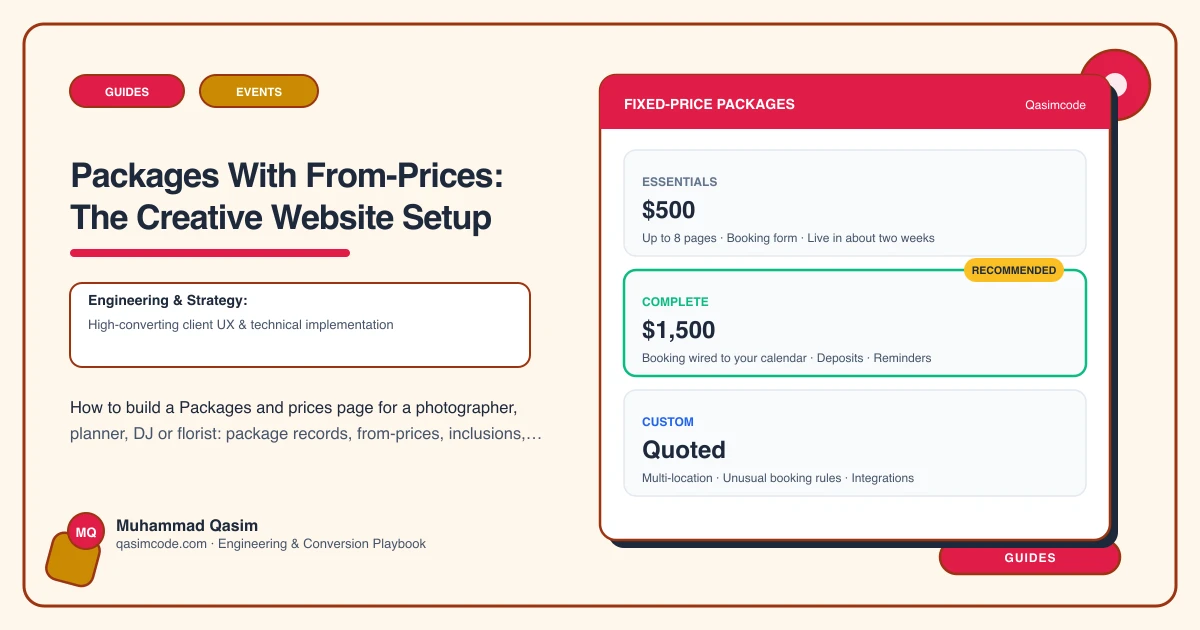
Three is the number couples can hold in their head. Fewer looks thin; more becomes a spreadsheet. Mark one as the package most couples choose, and make it the middle one. Anything bespoke goes under a single line at the bottom: "Something different? Tell us on the date check and we will price it."
Tie every package to the date check
Each package card ends in a button. For weddings and events, that button opens the Check my date form with the package pre-selected, so the enquiry arrives already saying "Full day, 14 June, 120 guests, budget in range". For portrait, engagement and mini sessions, the button opens instant booking in Acuity, Studio Ninja or HoneyBook with a deposit taken. The package record's enquiry route field decides which.
Where the page lives and what links to it
Packages and prices is a top-level menu item, one tap from the home page. It is linked from the portfolio ("See packages" under each gallery), from every sub-service page, and from the FAQ answer to "How much do you charge". The home page shows the three from-prices in a strip so the couple does not have to hunt.
Keeping it current
Prices change once or twice a year. The person who runs the business logs in, opens the package, changes the number, saves. Nothing else on the site needs touching, and the change date is recorded so an enquiry quoting an old price can be checked. A site where the prices are baked into a page design, and a developer has to be asked, is a site where the prices are out of date.
What not to do
- "Prices on request" with nothing else. It reads as expensive and evasive at once.
- A PDF price list. Not searchable, not mobile-friendly, out of date the day after you export it.
- From-prices with no inclusions, so the comparison is on the number alone.
- Different prices on the site, on Instagram and in your proposals.
- A package card with no button.
Where this sits
Packages with from-prices and inclusions, editable by you and wired into the date check, is one of the six things every photography and events website we build has to have, alongside the fast portfolio and the contract and deposit flow. It is included in the fixed package prices we publish for our own work, because we would not ask you to state yours if we did not state ours.