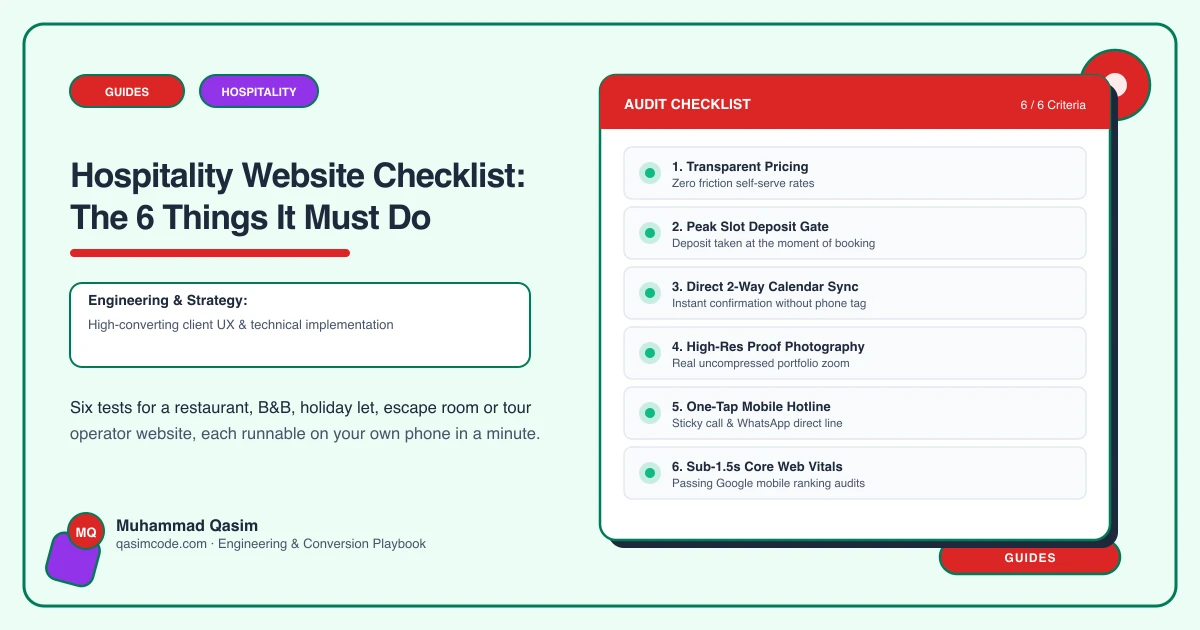
Six tests, ten minutes
A hospitality business website has six jobs. Each has a one-minute test on your own phone. The first three are the path from a guest's search to a booking you did not pay commission on.
1. Take the booking, on your site
Test: as a stranger, tap Book on the home page. Where does it go?
Pass: a booking engine on your domain showing live availability: OpenTable, ResDiary or Tock for a table; SiteMinder, Little Hotelier, Lodgify or Beds24 for a room or cottage; FareHarbor or Bookeo for a tour or escape room slot.
Fail: a contact form; an email address; a button that opens Booking.com, the OpenTable app or Viator in a new tab.
Fix: embed the engine you already pay for, synced with your channel manager so the availability matches the marketplaces, with the Book button in the header on every page.
2. Show the real price before checkout
Test: pick a room, tour or table with a deposit. Compare the price on the page with the total at the last step.
Pass: the same number. Tax, cleaning fees, booking fees and service charges shown on the page.
Fail: a headline rate that grows at checkout; "from" prices with no explanation; prices missing entirely.
Fix: inclusive prices as records on room, tour and menu pages, matching the engine's total, as consumer law in most countries requires.
3. Appear in under two seconds
Test: private window, mobile data. Load the home page and a room or menu page. Count.
Pass: under two seconds; Core Web Vitals Good on mobile.
Fail: blank, then a slider of the dining room.
Fix: photos sized and compressed, the hero prioritised, gallery lazy-loaded, slider removed, decent hosting. Hospitality sites are photo-heavy by nature; compression is not optional.
4. Show the place as it is
Test: find a photo of the actual room a guest would sleep in, the actual table, the actual boat or escape room set. Then find the menu as text, or the room's size and inclusions.
Pass: real photography on every page that sells; a page per room, tour or escape room; the menu as structured text with prices and allergens.
Fail: the theme's stock photos; one Rooms page with three unlabelled thumbnails; a PDF menu.
Fix: a half day of photography; a page per room, unit, tour or game; the menu as editable text marked up for Google.
5. Answer the arrival questions
Test: find how to get there, where to park, check-in or arrival time, and the cancellation policy, within a minute.
Pass: a location and getting-here page, policies stated plainly, and the same information in the confirmation message the engine sends.
Fail: a map pin and nothing else; the policy only in the engine's small print.
Fix: a getting-here page with transport, parking and arrival times; a plain policies page; confirmation templates written from the phone calls you actually get. Campsites add rules and what to bring; boat charters add the weather policy; escape rooms add a first-timer FAQ.
6. Know what it produced
Test: ask whoever runs the desk how many bookings came direct from the website last month, and how many came through marketplaces.
Pass: known, by page, and compared with last year's commission.
Fail: "most of them come through Booking.com, I think."
Fix: events for Book taps, completed bookings, voucher sales and call taps by page; the engine's source report; a monthly look against the marketplace statements.
Scoring
Six of six: the site is working; add a direct-booking perk and vouchers if you have not. Four or five: fix the failures, no rebuild. Three or fewer with 1, 2 or 3 failing: every booking the site loses to the marketplace costs commission, and it is losing them every day.
Where this sits
This is the launch checklist for every hospitality business website we build and the first ten minutes of a diagnosis on an existing one. Most hospitality sites fail at least three, and embedding the engine is the fix that turns the commission line on last year's accounts into this year's margin.