The commission is the budget
A hospitality business already pays for bookings. Accommodation pays 15 to 30 percent to the marketplaces; restaurants pay per cover; tours pay a cut to the activity platforms. The website question is not "how much does a site cost" but "how many of those bookings could the site have taken direct, and what would that have saved". Here is how a template and a custom build compare on that number.
The template
A hospitality theme on Squarespace, Wix or WordPress with your logo, a gallery, a PDF menu or a rooms list, and a "Book now" button that opens the marketplace or the booking tool in a new tab.
Cost: hundreds to low thousands.
Good at: existing; looking like a hotel or restaurant website.
Weak at: taking the booking. The button leaves your site, so the guest is back on the marketplace and you pay the commission anyway. Prices are absent or exclusive of tax and fees. The menu is a PDF Google cannot read. Photos are the theme's stock or your own, uncompressed, so the page takes four seconds on a phone. Hosting is with the vendor.
The custom build
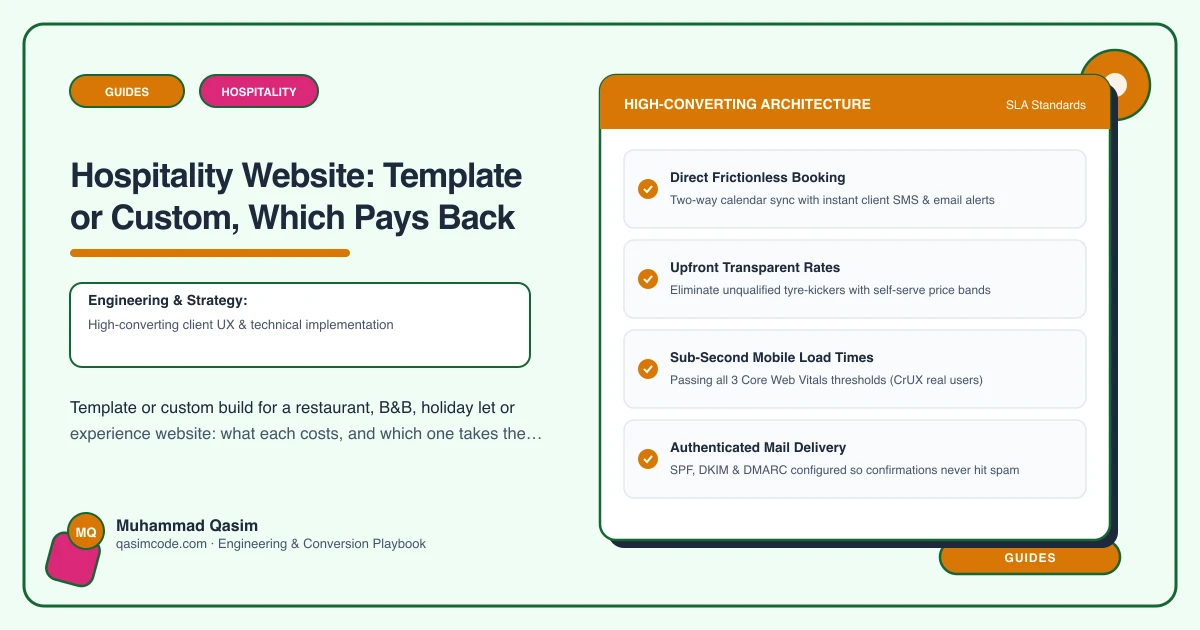
Built around how a guest chooses and books: the reservation or booking engine from OpenTable, ResDiary, SiteMinder, Lodgify, FareHarbor or Bookeo embedded on your site with live availability; inclusive prices; a page per room, menu section, tour or escape room, as text Google reads; real photography compressed to load fast; a location and getting-here page; Google reviews pulled in; gift vouchers sold online; tracking on every button; everything in your name.
Cost: mid four figures, fixed.
Good at: ranking for your name and area, showing the guest exactly what they are booking, and taking the booking without the commission.
Weak at: the invoice, and two to three weeks of your time on photos and copy.
Where the direct bookings come from
The guest who checks your site. Most accommodation guests find you on a marketplace and then search your name to see your own site. A B&B or holiday let whose site shows the same availability at an equal or better price, with warmer photos and a direct-booking perk, wins that booking. A template with a link back to Booking.com loses it.
The diner who wants a table now. A restaurant with the ResDiary or OpenTable widget embedded takes the reservation on the spot. A template that sends them to a marketplace app charges you per cover for a diner who was already on your site.
Search for the experience. "Escape room [town]", "boat trip [harbour]", "walking tour [city]" are separate searches. An escape room with a page per room and a Bookeo slot picker on each ranks for them and books from them. A template with one Games page and a link out ranks for none.
Vouchers. Escape rooms, restaurants and experiences sell a large share of vouchers before holidays. A voucher shop on your own site sells them at full margin; a template usually has none.
Speed. Guests are on a phone in the street, on a train, or in a Google Maps in-app browser. Photo-heavy templates lose them before the page draws.
The arithmetic
Take last year's marketplace commission and per-cover fees. Then estimate what share of those guests had already found you by name and would have booked direct if your site could take the booking at the same availability and price. For most accommodation and restaurant businesses that share is not small, and even a modest one recovers the price difference between the builds inside the first year. For experiences, add the vouchers sold online that were previously sold at the desk or not at all.
When the template is right
- A single holiday let in its first season, using Lodgify's or Airbnb's page.
- A café that is full every weekend from walk-ins and does not take bookings.
- A business about to change hands.
When the template is a leak
- Guests find you on a marketplace, check your site, and book on the marketplace because your site cannot take the booking.
- The Book button opens another company's website.
- Prices on the site exclude tax, cleaning or booking fees that appear at checkout.
- The menu is a PDF.
- The home page takes over three seconds on mobile data.
- The site is on a vendor's hosting.
Deciding
Three numbers: last year's commission, the share of guests who searched your name, and your home page load time on a phone. If the commission is four figures and the Book button leaves your site, the custom build pays back in months. If the site already embeds the engine and loads fast, keep it and fix the pricing and photos.
Our hospitality business website builds are custom at a fixed price, with the booking engine embedded, inclusive prices, real photography and speed included, because that is the version that takes the booking back.