The leak
A guest sees your restaurant on a friend's Instagram, searches your name, lands on your website, likes the look of it, and taps Book. The button opens OpenTable's app. They reserve there. You pay a per-cover fee on a diner who came looking for you by name.
The same thing happens to a B&B whose site links to Booking.com, a holiday let whose site links to Airbnb, and a tour operator whose site links to Viator. The marketplace did not find the guest. You did. It charged you anyway, because your site could not finish the job.
The marketplaces earn their commission on discovery: the guest who had never heard of you. The leak is the commission on the guest who had. Here is what a website does about it.
1. Embed the engine, do not link to it
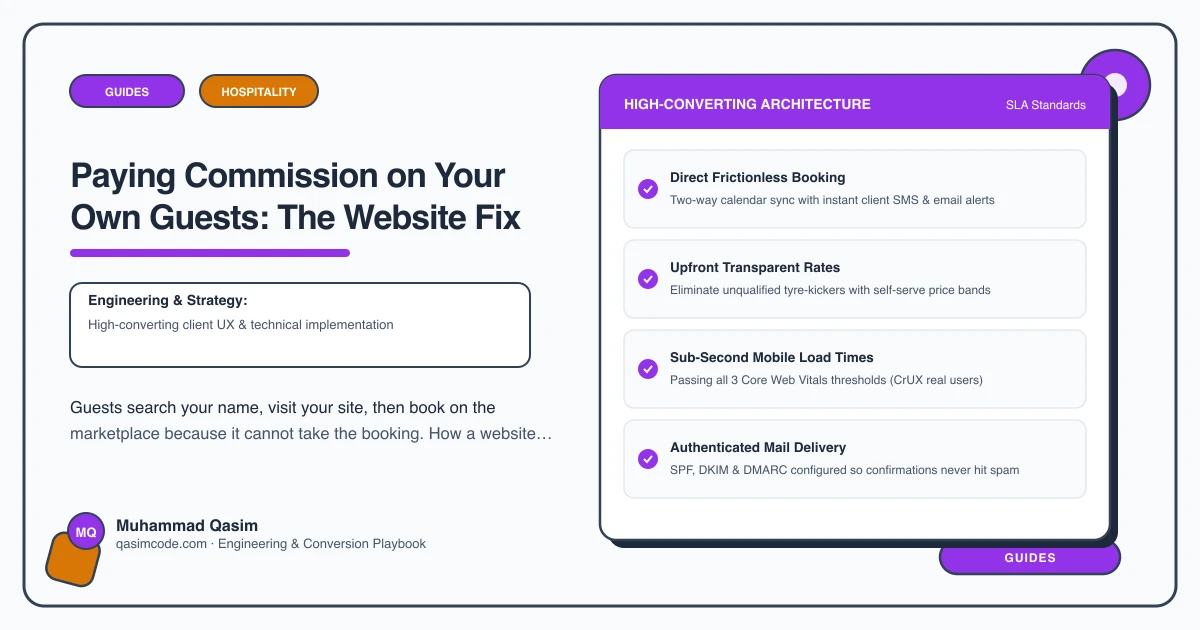
The single change that matters. Your reservation or booking system almost certainly has an embeddable widget or booking engine that runs on your own domain.
Restaurants: OpenTable, ResDiary, SevenRooms, Tock and Quandoo all embed. Bookings through the widget on your site cost less than bookings through the marketplace network, or nothing at all on a flat subscription such as ResDiary. The restaurant website design with reservations that pays for itself is the one where the widget lives on the site.
Accommodation: SiteMinder, Little Hotelier, Lodgify, Beds24, Hostaway and Smoobu take direct bookings on your site with the same availability they push to the marketplaces, so there is no double-booking risk and no reason to send the guest away.
Experiences: FareHarbor, Bookeo, Rezdy and Xola embed a slot picker per tour or room and sync with the activity marketplaces.
The Book button in the header on every page goes to the embedded engine with the choice pre-selected. Nothing leaves your site.
2. Show the same availability
Guests go back to the marketplace when they cannot see whether you are free. A contact form asking for dates is a request to wait; the marketplace answers in a second. The engine embedded with live availability answers in the same second, on your site.
For accommodation this means the channel manager synced properly, so the calendar on your site is the calendar. For restaurants it means the widget showing real tables, not a "request a booking" form.
3. Give a reason to book direct
Even with the engine embedded, a guest with the marketplace open in another tab needs a reason to close it. State it beside the Book button in one sentence: a best-rate guarantee, a small direct discount, a late checkout, a welcome drink, a free upgrade on a voucher. B&Bs and holiday lets that state a perk win the comparison; those that rely on loyalty lose it.
Check your marketplace contract on rate parity before discounting; a non-price perk is always safe.
4. Match the marketplace on the things it does well
The marketplace has good photos, an inclusive price, free-cancellation terms in plain sight and a checkout that works on a phone. Your site has to match each.
- Photography of the actual rooms, tables and activities, compressed to load fast.
- Inclusive prices, tax and fees shown, so the total at checkout is the number on the page.
- Policies stated plainly next to the button, not buried in the engine.
- Speed under two seconds on mobile data.
5. Keep the guest
A marketplace booking gives you a guest for one night and the marketplace a customer for life. A direct booking gives you their email address. The confirmation the engine sends should carry directions, arrival time and a line inviting them to book direct next time. A card in the room or a note on the bill does the same. Repeat guests are the direct-booking base, and every one of them was once a marketplace guest whose details you never received.
6. Measure the shift
Track Book taps and completed bookings on your site by page. Once a month, put the direct count beside the marketplace statement. The number to watch is the direct share, and it moves within weeks of embedding the engine.
What does not change
The marketplaces stay. They bring the guests who had never heard of you, and that is worth the commission. The website's job is narrower and more valuable: make sure the guest who searched your name never has to leave your site to book.
Where this sits
Embedding the engine with live availability, inclusive prices, a stated direct perk and tracking on every Book button is the core of every hospitality business website we build, and the scope is at a fixed price. Last year's commission line is the budget; the guests who already knew your name are the return.