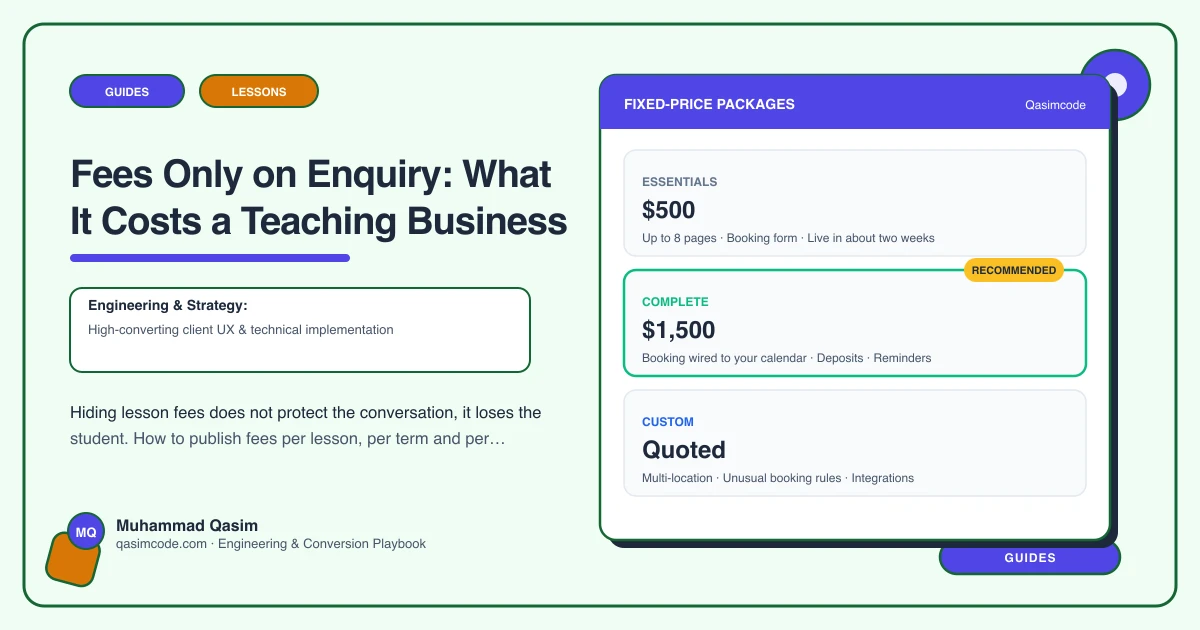
The argument for hiding fees, and why it fails
The reasoning is familiar. If we publish the fee, people will compare us on price alone. If they enquire, we get to explain the value first. And besides, our fees vary by teacher and level, so a single number would be misleading.
In practice, three things happen instead. The visitor who cannot find a fee assumes it is high, or assumes it is being hidden, and leaves. The visitor who does enquire is often only asking the price, so you spend the week answering fee emails that were never going to become students. And the provider down the road who published a number gets the family, because a weekly commitment cannot be agreed without knowing what it costs.
A lesson is not a bespoke project. It is a recurring commitment with a knowable price. Publishing it is not a discount, it is a qualification filter that works while you are teaching.
What to publish
Per lesson. The fee for each lesson length you offer. Thirty, forty-five and sixty minutes are usually different numbers, and stating all three prevents the follow-up email.
Per term. The number families actually plan around, with the number of lessons it covers. A term fee makes the commitment visible and makes your cancellation policy comprehensible.
Per course. For language schools, adult education and test prep, the fee for the whole course, with the number of hours, the start date and the group size.
What is included. Materials, books, exam entry fees, practice resources, recordings, access to a portal. And what is not, so nobody is surprised at the second invoice.
How it is collected. Termly in advance, monthly by direct debit or card on file, or per lesson. Say when it is taken and what happens over holidays.
Handling genuine variation
Fees do vary, and the answer is a structure rather than silence.
- By teacher. Publish a range and say what moves it: "£X to £Y per hour depending on the teacher's experience and level taught. Each teacher's fee is on their profile." Then put the number on the profile.
- By level. A table by level or exam stage. A music school charging more for advanced grades should show the ladder, because it also shows progression.
- By group size. One to one, pairs, small group, and class rates in one small table.
- By location. In person at your premises, in the student's home with travel, and online. Three rows.
- Concessions and discounts. Sibling rates, block bookings, concessionary rates for adult classes. Publish the rule, not a vague "discounts available", so the person entitled to it knows before they enquire.
A table with five or six rows answers all of this and is quicker to write than the emails it replaces.
Where the fees go
Not only on a Fees page. The fee belongs on every page where someone is deciding.
- The fees page itself, with the full structure.
- A line on each subject or instrument page: the lesson length and its fee, beside the Book a trial button.
- Each teacher profile, where the fee varies by teacher.
- Each course or class page, with the total fee, the dates and the places left.
- The trial booking step, if the trial itself is charged or discounted. Say so before the button, not after it.
What to write around the number
A fee alone can read as a demand. A fee with two sentences of context reads as a plan.
Say what the family gets for a term: the lessons, the teacher's preparation, the lesson notes, the exam guidance, the recital or showcase. Say what a typical student's first term looks like. Say what your notice period is and how a missed lesson is treated, because those policies are part of the price and finding them later feels like a trap.
Avoid comparing yourself to cheaper providers by name, and avoid claiming outcomes you cannot evidence. Describe the service and let the fee sit next to it.
The trial fee decision
Charging for a trial reduces no-shows and attracts people who are serious. Offering it free increases volume and fills a diary faster. Either works, and both should be stated plainly on the page and repeated at the booking step. What does not work is being unclear, because a family that expected free and is asked to pay at checkout abandons.
What changes when you publish
Expect the number of enquiries to fall and the number of enrolments to rise. That is the correct direction. The enquiries you lose are the ones that ended with "thanks, that is more than we hoped"; the ones you keep have already accepted the fee and are asking about times.
You also get your evenings back, because the fee email was the most common one you were answering.
Where this sits
Fees stated per lesson, per term and per course, repeated on each subject page beside the booking button, is one of the three things every education and lessons website we build has to do. It is also the fastest change to make on a site you already have, and usually the one that moves the diary first.