The problem
A woman whose father has died is trying to work out what to do with his house. She searches "what to do when someone dies house". Your firm has done hundreds of these. Your website calls it "Private Client: Estate Administration and Contentious Probate".
She does not find the page. If she did, she would not be sure it was about her.
The same gap sits under most professional services websites. "Assurance and advisory" for a business owner asking whether they need an audit. "Protection review" for someone asking whether they need life insurance. "Corporate restructuring" for a director trying to close a company. "Residential conveyancing" for a first-time buyer who has just had an offer accepted. Every one of those is a real search that a properly written page could answer, and a client who could not translate it walked away.
Why it happens
The words on the site come from the practice management system, the professional body's category list, or the way partners describe work to each other. Those are accurate, standard and useful internally. They are not the words a stranger types at nine in the evening.
There is also a quieter reason. Precise legal and financial language protects you. Plain language feels like it might promise too much, and in regulated work an overclaim is a real risk. So the copy retreats into terms that cannot be misread, and becomes invisible.
Both concerns are solvable. You can be precise and plain in the same sentence; you just have to write it twice.
The fix: a page per service, titled as a question
One page per distinct thing you do, not one Services page listing them. Each page:
Titled the way a client would ask. "Sorting out a deceased person's estate", with "probate" in the first paragraph and in the heading structure. The formal term stays; it is no longer the door.
Opening with their situation, not your capability. Two sentences describing where the client is when they need this: an offer accepted, a letter from a tax authority, a business partner leaving, a visa expiring.
Then what actually happens. The stages, in order, in plain sentences. What you do, what they do, roughly how long each part takes.
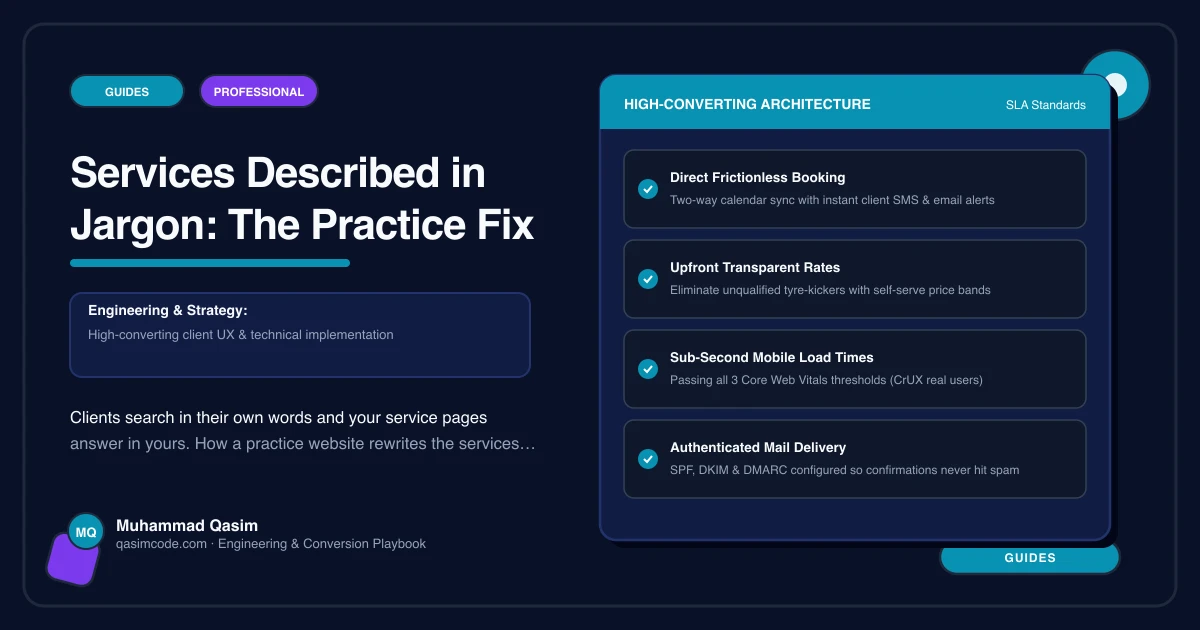
Then the money. A fixed fee, an hourly range, a package, or a paragraph on how you quote and what moves the number. This is the paragraph the client came for.
Then how to start. A booking button for the right meeting type, and the phone number.
The correct terms of art still appear, because clients who know them search for them too, and because your compliance lead will want them. They just no longer stand alone.
Write from the phone log, not the brochure
The best source material is the enquiries you already get. For a week, whoever answers the phone writes down the first sentence each caller says. Those sentences are your page titles and your opening lines. They are also, almost exactly, what people type into a search engine.
Then add the questions asked in the first meeting that you find yourself answering every time. Those are the subheadings.
Keep it inside the rules
Plain language and regulatory care are not in tension, but the second has to be checked. General points that apply in most regimes: describe outcomes as possible rather than promised, avoid comparative superlatives you cannot evidence, be careful with anything that reads as a guarantee of result, keep required status and risk statements attached to the content they belong to, and remember that in financial and investment work the marketing rules cover the whole page, not just the disclaimer.
The specifics differ by profession and country, and the rules move. Treat this as orientation, put every rewritten page in front of your compliance lead before it goes live, and keep a record of the review.
What it looks like across the professions
For law firms, a page per matter type rather than per department. For accountants, pages by business type and situation, so a contractor and a restaurant owner each recognise themselves. For financial advisers, pages by client situation such as approaching retirement, selling a business or an inheritance. For mortgage brokers, first-time buyer, mover, remortgage and buy-to-let. For business consultants, a page per problem by client type, because a buyer wants to see their own situation named. For insurance brokers, a page per product with the quote form that fits it.
What changes
The pages start ranking, because a page about one thing in the words people use is what a search engine can match. Enquiries arrive better informed, because the client read what happens and what it costs before they called. And the first meeting is shorter and more useful, because the explaining was done in writing, once, rather than out loud, every time.
Where this sits
Service pages in the client's language, each with process, cost and a booking button, are the backbone of every professional services website we build. The packages that include them are on pricing. The formal terms stay on the page. They just stop being the only thing on it.