The symptom
The site gets visitors. The diary does not fill from it. Enquiries arrive as "how much do you charge for a will" and "do you do limited company accounts", answered by whoever picks up, and half of them never come back. The clients who do instruct came from referral, not from the website.
On practice sites we review, the cause is on the list below, usually several at once. Work through them in order.
1. There is no way to book, only a way to ask
The site's call to action is a contact form or an email address. The client sends a message and waits. A firm that answers in four hours has already lost to the one whose site put a Tuesday morning slot in front of them.
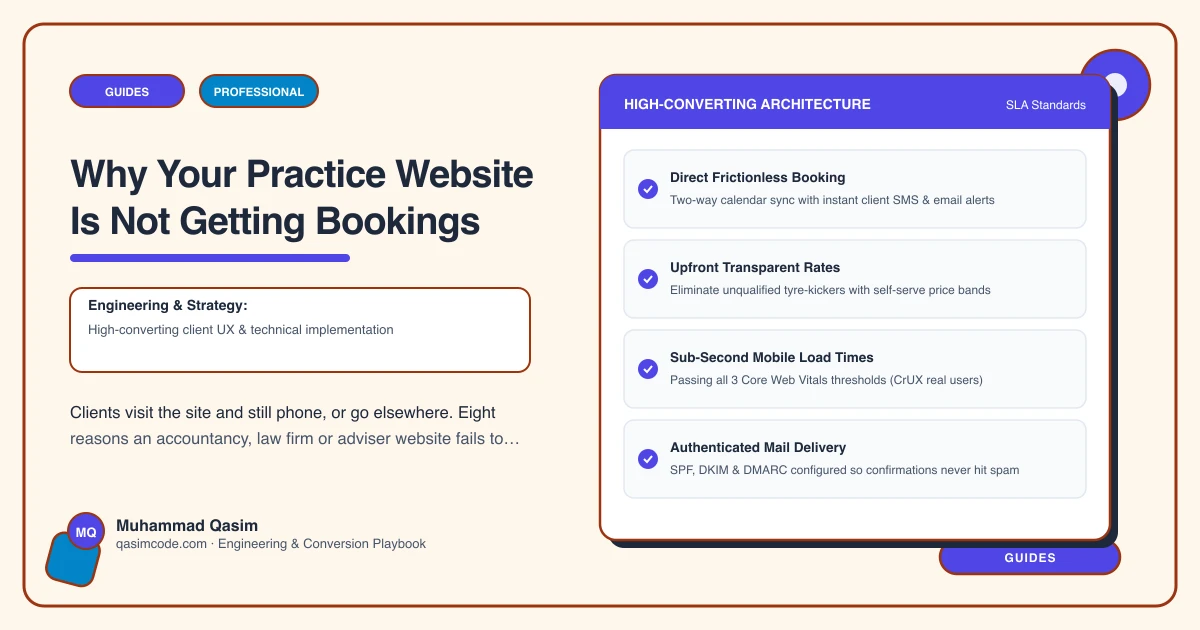
Fix: consultation booking with a short intake form, through Calendly, Acuity, Microsoft Bookings or a practice tool such as Clio Grow, Karbon or Intelliflo. A Book button in the header on every page, and a booking button on every service page pre-selecting that meeting type. Keep the phone number beside it, because a lot of professional services clients still prefer to ring.
2. The services are described in your language, not theirs
"Corporate restructuring", "IHT mitigation", "assurance services", "protection review". Clients search for "help winding up a company", "reduce inheritance tax", "do I need an audit", "life insurance advice". If the page does not use their words, they neither find it nor recognise themselves in it.
Fix: a page per service, titled the way a client would ask, opening with the situation they are in, then what happens, roughly what it costs and how to start.
3. There are no fees and no explanation of how you quote
The most common reason a professional services enquiry never becomes a meeting. "Contact us for a quote" is read as expensive.
Fix: state what you can. Fixed fees for defined work, hourly ranges by seniority, monthly packages by business type, or a plain paragraph on how a quote is built and what drives it up or down. Fee transparency is also something several regulators now expect in certain areas of work, so check your own body's current requirements.
4. The client cannot verify that you are regulated
For law firms, financial advisers, mortgage brokers and immigration consultants this is the check a cautious client runs before enquiring. If your registration number, professional body membership or authorisation status is missing, buried or out of date, some of them stop there.
Fix: a regulatory information page and correctly placed details in the footer and on the pages your body expects, built as editable records rather than baked into a template. Which details, and where, is set by your own regulator; treat any general guidance, including this, as orientation and confirm it with your compliance lead.
5. The team is invisible
Clients hire a person. A page with a group photo and no names loses to a firm where each solicitor, adviser or partner has a profile, qualifications, the areas they cover and a booking button.
Fix: individual profiles with a real photograph, credentials, professional body, specialisms, and a way to book that person directly.
6. The site is slow, or awkward on a phone
Clients read about a legal problem or a mortgage on a phone in the evening. A heavy theme, an uncompressed hero image and a cookie banner covering the button lose them.
Fix: images sized and compressed, sliders removed, decent hosting, tap targets that work, and the booking embed loading without shifting the page. Under two seconds on mobile data.
7. There is nothing to send the hesitant client away with
Many professional services decisions take weeks. A client who is not ready to book today leaves with nothing and forgets you.
Fix: something useful and specific: a what-happens-next page for the common matters, a checklist of what to bring, a deadlines calendar for tax preparers, a process page by stage. Then a light follow-up route they can opt into, within your regulator's rules on marketing.
8. Nobody knows what the site produces
Without tracking, you cannot tell which of the seven above is the problem.
Fix: events for booking taps, completed bookings, form submissions and call taps, all recorded with the page they happened on. Then a monthly look at which service pages produce meetings and which are read and abandoned.
The order
Items 1, 2 and 3 are the path from a client's question to a meeting in the diary, and they are where almost all the loss happens. Items 4 and 5 are whether the client trusts you enough to take that path. Items 6 and 7 are friction and patience. Item 8 is how you know.
Where this sits
This is the conversion checklist every professional services website we build is tested against, and the first half of a diagnosis on an existing one. Most practice sites fail at least four, and the two fixes that move the diary fastest are a page per service in the client's words and a booking button where the contact form used to be.