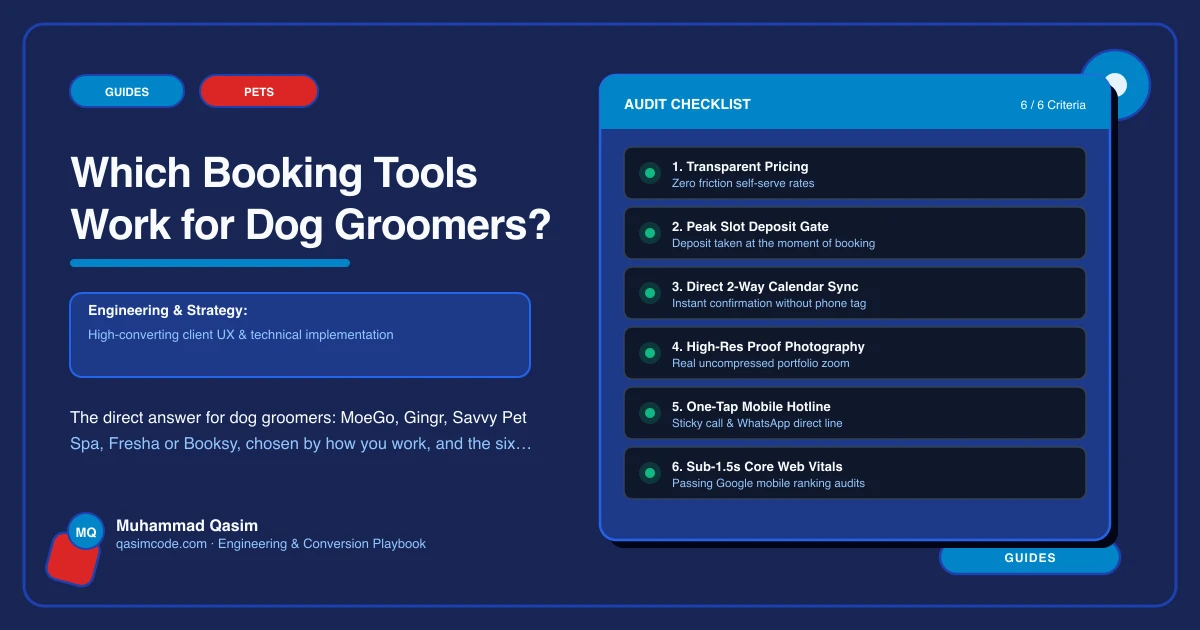
The short answer
MoeGo, Gingr, Savvy Pet Spa, Fresha and Booksy. They handle pet profiles, durations and prices that vary by breed and size, vaccination records, consent forms, deposits and rebooking reminders, which is the list a grooming diary needs and a general appointment tool does not have.
Which of the five depends less on features than on how your salon is shaped.
Pick by your situation
A salon on its own, in the UK or Ireland. Savvy Pet Spa or MoeGo. Both are built for grooming rather than adapted to it.
A salon on its own, in the US, Canada or Australia. MoeGo is the common answer, and the messaging side is genuinely strong.
Grooming inside a daycare, boarding or kennel business. Gingr, because the animal record has to be shared across services and the vaccination tracking has to work for stays as well as grooms.
A solo groomer wanting the simplest possible start. Fresha or Booksy, accepting that they are general appointment platforms and the pet-specific parts are thinner. Confirm with the vendor what they capture for vaccination expiry and signed consent before relying on either for those.
Mobile rounds. MoeGo, for the routing and travel time.
If you already run something that works, stay on it. Migrating a client list, a diary and a year of pet records is a real cost and rarely repays itself unless something is genuinely broken.
The six things any of them has to do
Whatever you choose, judge it against this list rather than a feature page.
1. Vary the slot length. A large wool coat is not a bath and tidy. If the calendar treats every groom as ninety minutes you will run late permanently.
2. Vary the price. By size and coat, matching the table on your website, so nothing is a surprise at collection.
3. Hold a real pet profile. Breed, weight, coat, health notes, behaviour and handling notes, the owner's vet, carried forward to every future booking.
4. Capture vaccinations and consent in the flow. With an expiry date and a reminder where the platform supports it, so no health document travels by email.
5. Take a deposit or hold a card. With the cancellation and no-show policy stated on the booking page.
6. Prompt the rebooking. At the interval you set, per service, with a link that opens the diary rather than asking for a phone call.
What generic tools get wrong
A general calendar tool, a form plugin or a plain contact form can take a request. None of them can hold the dog.
What you lose is specific: no coat and behaviour history, so the next groomer starts blind. No vaccination expiry, so somebody checks a photo on a phone. No variable duration, so Saturdays overrun. No rebooking prompt, so dogs drift. The booking appears to work and the operational cost lands quietly on you.
What the website has to do about it
The platform is the diary. The website's job is to get the owner into it in one tap and to make the price known first.
That means a Book button in the header on every page, deep linked so the service is already chosen. It means the price table on the site matching the platform's pricing exactly. It means the whole route tested inside the Instagram in-app browser, because a large share of grooming traffic arrives from a link in bio and that browser is where widgets fail silently. And it means booking clicks and call taps recorded by page, so you can tell which page fills the diary.
Hosted page or embedded widget
Either works. Hosted booking pages tend to be more reliable on small phones, and embeds keep the owner on your domain.
If you embed, check the widget on a real handset for height, for an internal scroll that traps the calendar, and for whether the payment step opens correctly. Test it after any platform update as well as at launch.
On marketplaces
Fresha and Booksy both bring some discovery through their own apps, which is a genuine benefit for a new solo groomer.
The trade-off is that their listing for your salon competes with your own site for your own name, and the client relationship sits partly with the platform. Use the traffic, keep your own site as the place people find your prices and your first-groom page, and make sure your own booking link is the one on your social profiles.
When switching is worth it
Move platforms when the diary is costing you money rather than when a competitor recommends something. The honest triggers are: you cannot vary durations, vaccination expiry is tracked in your head, there is no rebooking prompt, or the booking flow is failing on phones.
Otherwise, spend the effort on the site and the intake configuration around the platform you already have.
Where this sits
Embedding whichever platform a salon runs, matching the price table to it and putting the pet profile in front of the first visit is the core of a dog grooming salon website, and the same approach runs through the other pet business websites we build. The packages are on pricing. Choose the platform for the diary, then let the site do nothing but open it.