A course is eight bookings, not one
A new client at a grooming salon is a haircut. A new client at a training business is usually a block: six weeks of puppy class, then often the next course up, then a one to one when adolescence hits, and a recommendation to the rest of the puppy group's WhatsApp thread. A behaviour client is an assessment plus two or three follow ups, and the referral value of a case that goes well is high.
So the question is not what a website costs. It is how many filled course places and booked consults it produces per month against what the build cost once. Here is how the two options compare on that.
The template
A theme or builder layout with your logo, a page about classes, a gallery, a contact form and a link out to booking.
Cost: hundreds to low thousands.
Good at: existing, looking friendly, going live in a week.
Weak at: showing which courses are actually starting and how many places are left; treating behaviour work as its own route rather than one line on a services page; carrying an intake questionnaire; explaining methods in a way a sceptical owner will read; prices for classes, consults and packages; speed once the gallery loads; hosting that stays with the vendor.
The custom build
Built around the two people who arrive on the site. The puppy owner and the owner with a problem.
Cost: low to mid thousands.
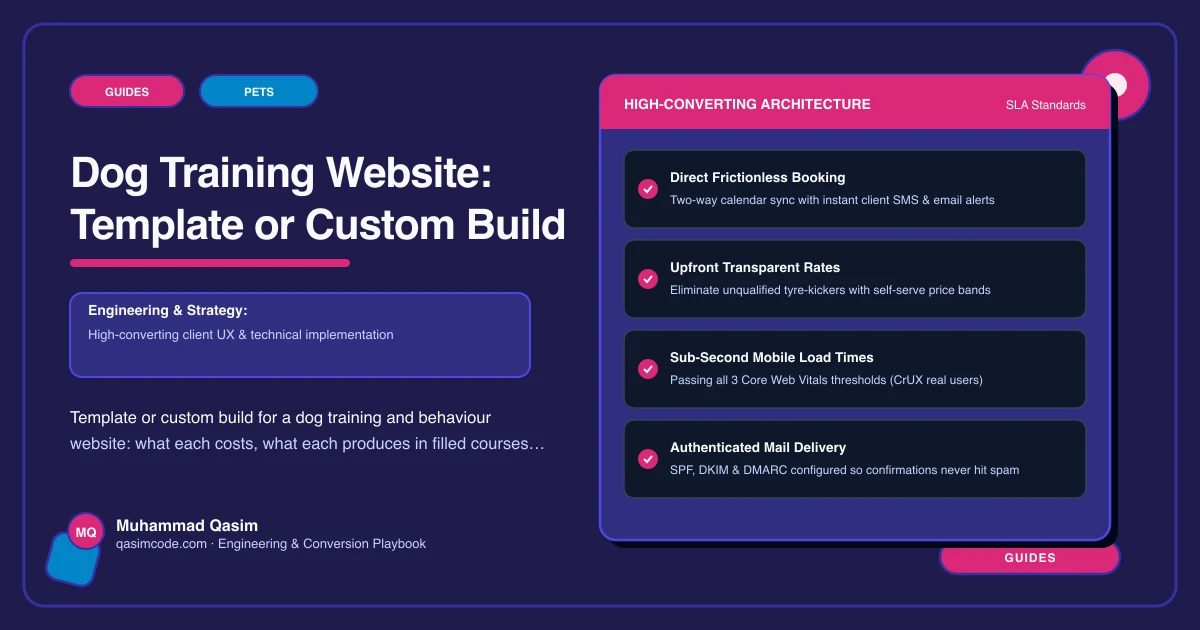
Good at: the class timetable as live data from TeamUp, Bookeo or Acuity, showing the next start dates, the venue and places left. Behaviour consults booked as appointments with the intake questionnaire attached. A methods and qualifications page that names your assessments and memberships plainly. Prices for classes, consults and packages, editable by you. Trainer profiles. Online consults and courses where you offer them. Google reviews near the buttons. Speed on a phone, local search foundation, tracking, everything in your name.
Weak at: being cheap, and being finished in five days.
The four places the template actually loses money
The timetable. A PDF or a hand typed list goes stale within one course cycle. Owners read "starting September" in November and assume you are not running. A live timetable with a start date and places left creates urgency the template cannot.
The two routes. Templates put everything on one services page. The owner of a reactive rescue scrolls past puppy class photographs looking for someone who will take them seriously, and often leaves. Two clear entries on the first screen fixes it, and it is a structural choice, not a styling one.
The intake. Without a questionnaire attached to the consult booking, every behaviour case starts with three emails asking how old the dog is, what the vet has said and what has already been tried. Some of those threads never come back.
Methods. Owners increasingly arrive having read about training approaches and having decided what they will not accept. A template has a paragraph about loving dogs. A page that states your approach, your qualifications, your memberships and what a session actually looks like wins the clients you want and quietly filters out the ones who will argue with you in week three.
When the template is genuinely the right call
Take the cheap route when you are testing whether the business works at all, when you are running two classes a month and both fill from the vet's noticeboard, when you have no budget and would rather spend it on a venue, or when your entire client flow is a Facebook group and you need somewhere for the link to land. A template site that exists beats a custom site you cannot afford to finish.
Move up when any of these is true. You are turning away puppy owners because a course filled and nobody knew there was a waiting list. You are spending evenings answering the same methods question. Behaviour enquiries arrive with no history and half of them go cold. You have added a second venue or a second instructor. You want to rank for puppy classes plus your town rather than living on referrals.
The middle path
You do not have to jump. Keep the template for now and fix the two things that cost most: put a real timetable on the site with next start dates and a booking link per course, and add a behaviour page with its own booking and an intake questionnaire attached. That is a day or two of work on most builders and it will tell you honestly whether the demand is there before you commit to a build.
How to decide in one sitting
Count last month. New course registrations, behaviour consults booked, and enquiries that arrived by email or Instagram and needed a reply before they became anything. If the third number is bigger than the first two together, your site is not doing its job and the build pays for itself in the evenings you get back. If the first two are healthy and you are already at capacity, spend the money on a second venue instead.
Where this sits
Our dog training and behaviour websites are the custom side of this comparison at a fixed price, with the live timetable, the two routes, the intake questionnaire and the methods page as standard, and the same structure runs through our other pet business websites. The template is not a mistake. It is a stage, and the signal to leave it is when the work the site is not doing lands in your inbox every evening.