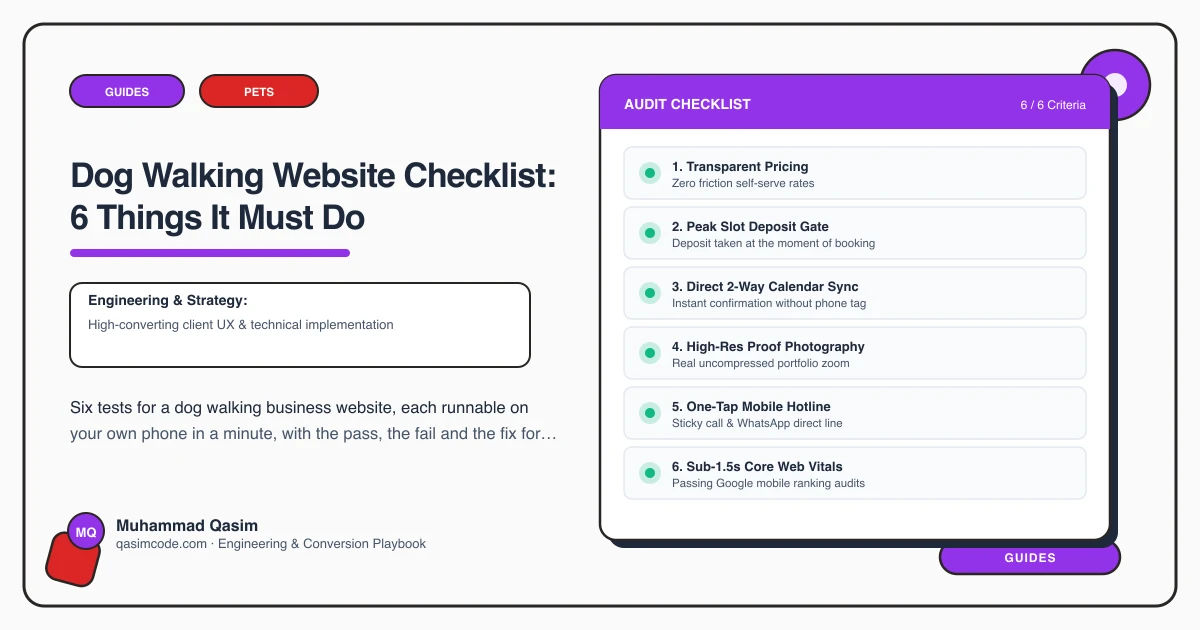
Six tests, ten minutes
A dog walking website has six jobs. Each has a test you can run on your own phone in the van between walks. Do them on mobile data, in a private window, as a stranger would. The first three are the route from a nervous owner's question to a meet-and-greet in your diary.
1. Prove you are safe with a key
Test: starting from the home page, find your insurance, your background check and your first aid training. Time yourself.
Pass: a trust page, linked from the header, found in under thirty seconds. Public liability insurance with the insurer named. DBS or the equivalent check for where you work. Canine first aid with the provider and the year. References. A redacted sample visit report.
Fail: one line in an About paragraph saying "fully insured and DBS checked", or nothing at all.
Fix: build the page and link it everywhere. This is the highest-converting page on a walking site, because the decision an owner is making is about their house and their dog, not about walking.
2. Price the owner's week
Test: find what four sixty minute group walks a week would cost, and the maximum number of dogs in a group.
Pass: a plain list with thirty and sixty minute group walks, solo walks, puppy visits, senior pop-ins, bank holiday rates and weekly packages, with the group size limit printed beside the group price.
Fail: "competitive rates", "from £14", or a price list you last updated two years ago.
Fix: prices as editable records so you change them yourself. Group size beside the group price. One honest line on what varies, such as travel outside your core area or two dogs from the same household.
3. Book the meet-and-greet in one tap
Test: without scrolling, tap the main button. Where does it go?
Pass: one tap into a real booking or the client request flow in Time To Pet, Pet Sitter Plus, Scout or Precise Petcare, with a tappable phone number beside it.
Fail: a contact form, a mailto link, a button inside a menu, or a platform page where the owner has to search for your business again.
Fix: a Book the meet-and-greet button in the header of every page and in a bar fixed to the bottom on phones. Test it inside the Instagram in-app browser as well as Safari and Chrome.
4. Tell them whether you cover their street
Test: pick a village at the edge of your patch. Can a stranger tell from the site whether you go there, and when you walk?
Pass: an area page per place you cover, naming the estates, streets or parks, with your walking windows on each. "Walks run between ten and two, Monday to Friday."
Fail: "covering the local area and surrounding villages", or a map graphic with no place names on it.
Fix: write one page per area, in your own words, mentioning the green spaces you actually use. It stops the out-of-area enquiries and it is the same content that gets you found locally.
5. Explain group and solo walks
Test: read the site as an owner with a nervous rescue. Do you learn how many dogs go out together, how they are matched, and what happens with a reactive dog?
Pass: a section covering maximum group size, how dogs are paired, off-lead policy, what happens with nervous or elderly dogs, solo walk pricing, and how dogs travel, with photographs of the actual van.
Fail: a gallery of happy dogs and nothing written down.
Fix: four short paragraphs. These are the questions owners are too polite to ask and too worried to ignore.
6. Load in under two seconds, with your own photos
Test: load the home page and one area page on mobile data. Count.
Pass: under two seconds, Core Web Vitals Good on mobile, with real photographs of you, your van and your fields.
Fail: a slider, a hero video, uncompressed images, or stock retrievers on a beach that is nowhere near you.
Fix: drop the slider, size and compress every image, prioritise the hero, lazy-load the gallery. Spend two hours getting real photos on a real walk, with owner permission for every dog.
Scoring
Six passes and the site is doing its job. Four or five and it is leaking clients you will never hear about. Three or fewer and the site is a business card that happens to be online, which is fine if you are full and expensive if you are not.
Rerun the six after any change, on a phone, on mobile data. A site that passes on your laptop over office broadband tells you nothing about the owner standing in a wet field deciding whether to message you.
Where this sits
All six are how we build a dog walking business website, and the same checklist discipline runs through our pet business websites. What is in each package is on pricing. Run the tests before you spend anything. Two of the six are usually a morning's work on the site you already have.