A yard is not one booking
Before the comparison, the number that decides it. A single horse owner is a vaccination, a dental and maybe a lameness workup in a year. A livery yard with fourteen horses on your books is a standing entry in your route for as long as the manager stays put, plus the private work of every owner on that yard, plus the recommendation to the yard down the road.
That is the unit an equine website wins or loses. Not a booking. A yard, and the years of route days attached to it. Judge template against custom on how many yards each brings in, because the cost difference is small next to one manager deciding you are the practice that answers the phone properly.
The template
A theme bought or picked from a builder, filled with your text and photographs. A few hundred to a couple of thousand, and a week or two of your evenings.
What you reliably get: a domain of your own, a services page, a contact form and something to put on the side of the vehicle.
What you reliably do not get, because it is not what a general purpose theme is for: an area and route structure, a fee table you can edit, a booking form that captures a yard and several horses, an emergency route pinned to every page, or a yard account page.
The custom build
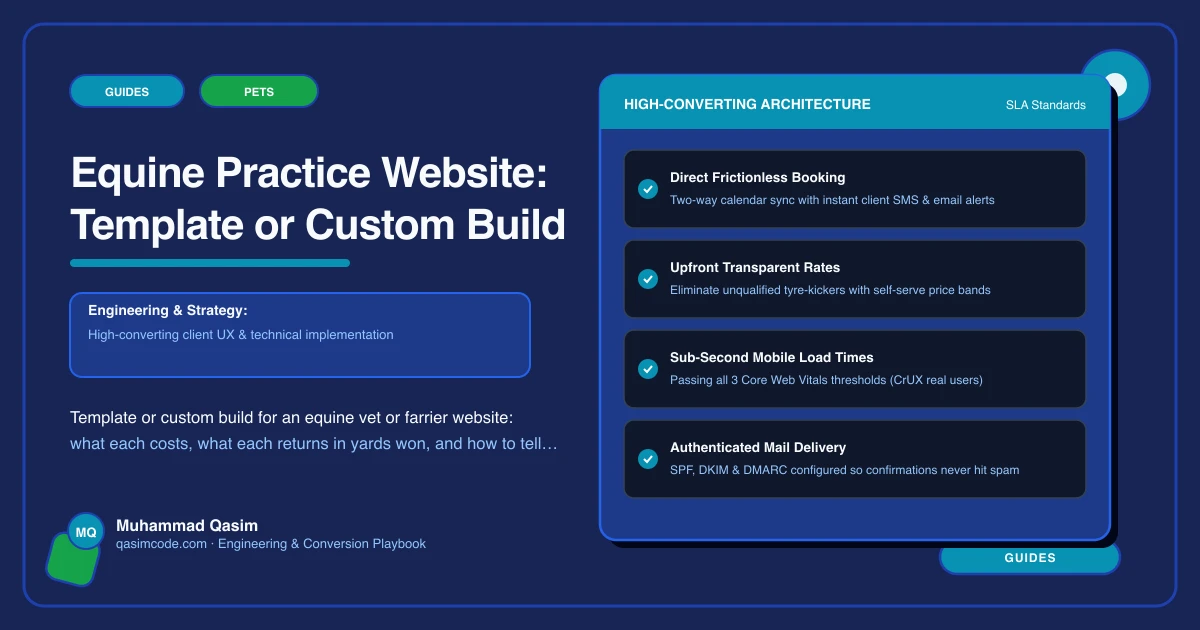
Designed around the two moments that matter in equine work. Route-day booking by area with yard and horse details. Emergency route on every page with tap to call and short holding guidance. Fees stated for visits, routine procedures and callouts. A page per service covering vaccinations, dentistry, lameness, shoeing and trimming. A yard account page with shared visit fees and terms. Practitioner profiles carrying registration. Reviews near the buttons. Two to six thousand dollars, roughly sixteen hundred to five thousand pounds, and a few weeks with someone else doing the work.
Where the extra yards come from
Areas as pages. A yard manager searches for a horse vet or a farrier plus their village, not plus your town. A template has one Contact page. A custom build has a page for each area you cover, saying which day you are usually there. That is most of the search advantage, and templates rarely have the structure for it.
The fee table. Yard managers budget. A practice that publishes visit fees, routine procedure costs and how emergency callouts are charged gets shortlisted by the manager who needs a figure for the yard owner. A practice that says "please enquire" gets rung once, or not at all.
The emergency route. A first emergency is often how a practice acquires a yard permanently. If your number is one tap from any page and the site says something useful about colic while they wait, you are the practice they call again. If it is buried on Contact behind a menu, someone else is.
Booking that captures the yard. A form that takes yard, access notes, horse names and work per horse produces a job you can schedule. A template contact box produces a message saying "hi can you come out", which produces a phone call, which produces a callback, which is where bookings go to die.
The arithmetic
Pick your own numbers, but run it. Take the annual value to you of one average livery yard on your books. Take the difference between a template and a custom build, which is usually two to four thousand pounds. Divide. For most equine practices and busy farriers the custom build pays for itself somewhere between one and two yards, and it runs for four or five years.
That is not an argument that everyone should spend the money. It is an argument that the decision is about yards, not about design taste.
When the template is right
You are a newly registered farrier building a round and every hour of cash matters. You are a single handed vet whose diary is already full and closed. You are testing a second brand or a new area before committing. You have no photographs, no fee structure settled and no time, in which case a template now and a proper build in eighteen months is a sensible order of operations.
When the template is a leak
You cover several distinct areas and only one of them appears anywhere on your site. Your fees are not published and your reception spends a third of the morning quoting them. Your emergency number is on Contact. A yard manager cannot see terms for an account. Bookings arrive as messages that need a phone call to become jobs. Any two of those and the template is costing you more each year than the build would cost once.
Deciding
Ask what your website is for. If it is a business card for people who already have your number, a template is honest and sufficient. If it is meant to bring in yards from areas you drive through anyway, it needs area pages, published fees, a booking form that captures horses and an emergency route that works one handed in the dark. Themes do not come with those, and bolting them on afterwards usually costs more than starting right.
Where this sits
We build equine vet and farrier websites with route-day booking, area pages, the fee table and the emergency route as standard, and the same approach runs through our other pet business websites. Packages and what each includes are on pricing. Whatever you choose, count it in yards rather than in pages.