What you are actually buying
An equine site has two jobs that pull in opposite directions. On a calm Tuesday it has to let a yard manager book six horses into the day you are already in their postcode. At two in the morning it has to put a phone number under the thumb of an owner standing in a stable with a colicking horse. A site that does one well and the other badly is only half a site.
The free option, and what it costs you
ServiceM8, Jobber and most practice management systems will give you a public request or booking page with your name on it. Squarespace and Wix will give you a template with a photograph of a chestnut in a field.
You get: a way to receive a request and a phone number somewhere on the page.
You do not get: a domain of your own ranking for horse vet or farrier plus your area, visit fees stated, a route map of the areas you cover, an emergency route that survives being read one handed in the dark, or anyone to ring when the page breaks.
Right for: a newly registered farrier or a solo ambulatory vet still building a round.
A template site
Roughly. A veterinary or trades theme with your branding, a services list and a contact form.
You get: something presentable with your practice name on it.
Usually missing: speed on a phone at the edge of a signal; fees stated rather than "please enquire"; booking embedded rather than linked out; areas and route days published; the emergency number pinned to every page rather than buried on Contact; anything for yard managers with eight horses; hosting held in your name.
Right for: a practice that is full from word of mouth and wants a business card.
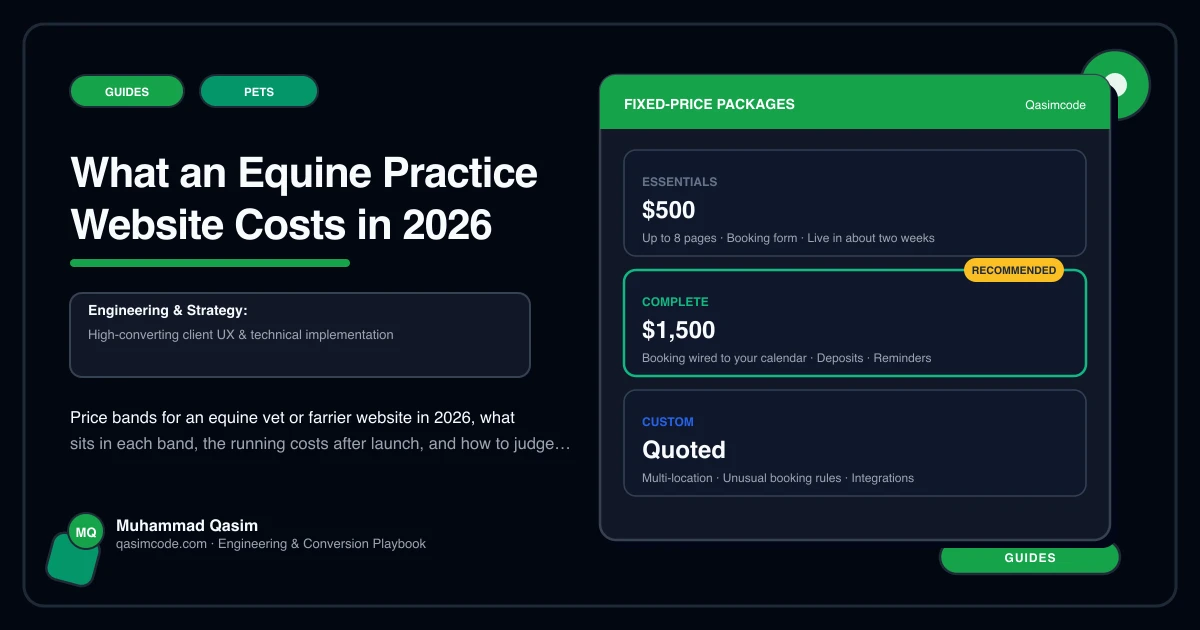
What we build: Essentials at $500, Complete at $1,500
Roughly and this is the band where the two jobs get built properly.
Route-day booking by area, capturing the yard, the horses and the work, feeding whatever runs your diary. An emergency route on every page with tap to call, current out of hours arrangements, and short holding guidance for colic, wounds and lameness. Visit fees, routine procedures and the basis on which callouts are charged, held as editable records. A page each for vaccinations, dentistry, lameness work, shoeing and remedial trimming. A yard account page covering shared visit fees and terms. Practitioner profiles carrying registration details. Google reviews near the buttons. Fast on a phone, structured data, call and booking tracking, everything in your name.
Not usually included: photography and copy unless the quote says so.
Right for: an established practice or a farrier with a full round that wants new yards from search rather than referral alone.
When it goes past that: Custom, quoted after a call — multi-vet, multi-site and hospital
Roughly £6,400 and up. Several branches with their own rotas and out of hours arrangements, referral pages aimed at other vets rather than owners, hospital admissions, or a practice running both first opinion and referral work from one brand.
After launch
- Hosting: managed WordPress at $20 to $50 a month, or often nothing on a framework host, in your name.
- Domain: small, annual, and yours.
- Practice software: whatever you already pay ServiceM8, Jobber, Provet Cloud or ezyVet.
- Maintenance: a care plan from $99/mo, which is where fees, rota and out of hours details get kept current.
- Photography: half a day on a yard with owner permission. Your own vehicle, your own forge or kit, your own people. Stock photographs of American quarter horses do nothing for a practice in Shropshire.
Where the money goes
- The fee table as structured records, so a visit fee, a set of vaccinations and a standard set of shoes are all stated and all editable by you in April.
- Route-day capture, so a booking arrives with the yard, the horse names and the work, and drops into the correct area day rather than into an inbox.
- The emergency route, tested one handed, in the dark, on a bad signal, from every page on the site.
- Yard terms, so a manager with a dozen horses can see shared visit fees and account arrangements without a phone call.
- Registration and credentials shown plainly, which for equine work is orientation for the owner as much as compliance for you.
- Speed, local search foundation and tracking of call taps and booking submissions by page.
Judging a quote
Ask six things. Are visit fees and the callout basis stated, and can I edit them myself. Does booking capture yard, horses and work, and does it land in a route day. Is the emergency number on every page or only on Contact. Are the areas I cover published as pages. Are the photographs mine. Whose name is the domain and hosting in. A quote that cannot answer those is a template quote whatever the figure at the bottom says.
Where this sits
Our equine vet and farrier websites are built to that standard at a fixed price, with route-day booking, the emergency route and the fee table included, and the wider approach is on the pet business page. Veterinary advertising and practice standards, and farrier registration, vary by country and are worth checking against your own regulator before you publish fees or credentials. If your current site is a template or a booking-platform page and your phone still rings all morning asking when you are next near Ludlow, that is the number to weigh against a rebuild.