The message you answer twelve times a day
You are in the van with a wet cocker on the table and one hand on the dryer. The phone buzzes. Do you come to Sandbach. You dry your hand, type yes, and go back to the dog. Forty minutes later, do you cover CW11. Then someone from a town an hour away, and you type a polite no.
Every mobile groomer runs this loop, and most treat it as part of the job. It is not. It is a question the website should have answered, and each unanswered instance costs you three things: the interruption in the middle of a groom, the enquiries you lose because you answered an hour late, and the ones you never saw because an owner found a site that told them straight away.
What the question actually costs
The interruption. A dog on a table cannot be left. A van with the water running cannot be left. Answering costs the rhythm of the groom, and on a tight round it costs the schedule.
The lag. Grooming enquiries go to several groomers at once. An answer three hours later, after the dog is booked elsewhere, is worth nothing. A page that answered at eleven at night is worth a client.
The wrong people. Half the messages are out of area. You are doing unpaid triage for a question a form field could have asked. And because the site never filtered, some of them get through to the diary, which is worse: a booking you have to cancel costs you the slot and the reputation.
Why the footer list does not work
Nearly every mobile grooming site answers coverage the same way: a run of place names in the footer or a sentence saying "Nantwich, Crewe, Sandbach, Middlewich and surrounding areas".
It fails three times over. On a phone it is a grey blur nobody reads. It ranks for none of those towns, because one paragraph cannot compete with a page written about a place. And "surrounding areas" is exactly the ambiguity that generates the message, because the owner in the village between two of your towns still cannot tell.
What to publish instead
A page per patch. One page per town, suburb or postcode group you genuinely drive to, each written for that place, each with prices, a Book button and a line about which days you are usually over there. That is what a stranger searching for a mobile groomer in their town actually finds, and it answers before they type anything at you.
A plain coverage statement high on the home page. Not a list. A sentence: the towns at the four corners of the round, the rough radius from a place everyone knows, and one line about the edge. Something like: we cover roughly fifteen miles around a named town, and beyond that on set days with a stated surcharge.
An area check in the booking. The postcode asked first, before the calendar, so the answer is given by the form rather than by you. MoeGo, Savvy Pet Spa, Fresha and Booksy all take an address; the ordering and the service-area rules are configuration, not features you have to build.
A map you can read. Optional, and only useful if it is drawn with real text underneath it, because an image on its own tells search engines nothing and tells a screen reader less.
Answer the edge cases too, in writing
Coverage is never a clean circle. The site should say so, because the ambiguity is what produces the messages.
Name the day you are on a particular side of the patch. Say what happens for an address ten minutes past the edge: a surcharge, a minimum of two dogs, or a place on a waiting list for when that direction fills up. Say whether a village with a difficult lane is in or out. Say whether you cross a river, a motorway or a county line, because owners near a boundary always assume they are on the wrong side.
None of that is complicated to write. It is just never written, and every sentence of it removes a message.
Make the rest of your presence agree
Your Google Business Profile has service areas. Set them to match the site rather than leaving a single pin, because that is what feeds "mobile groomer near me". Your Instagram bio should link to the coverage page or the area pages, not just the home page, since a large share of mobile grooming traffic starts there. Your booking platform's rules should reject the same addresses the site says are out of range. When those three disagree, the messages come back.
What is left of the messages
You will still get some. They will be different ones: an owner in a village you do reach, checking; someone asking whether you can do two dogs on one visit; a person with a nervous rescue asking what happens if he will not settle. Those are short and they convert. The twelve-a-day coverage triage stops, and the enquiries that do arrive already know where you drive and roughly what it costs.
Where this sits
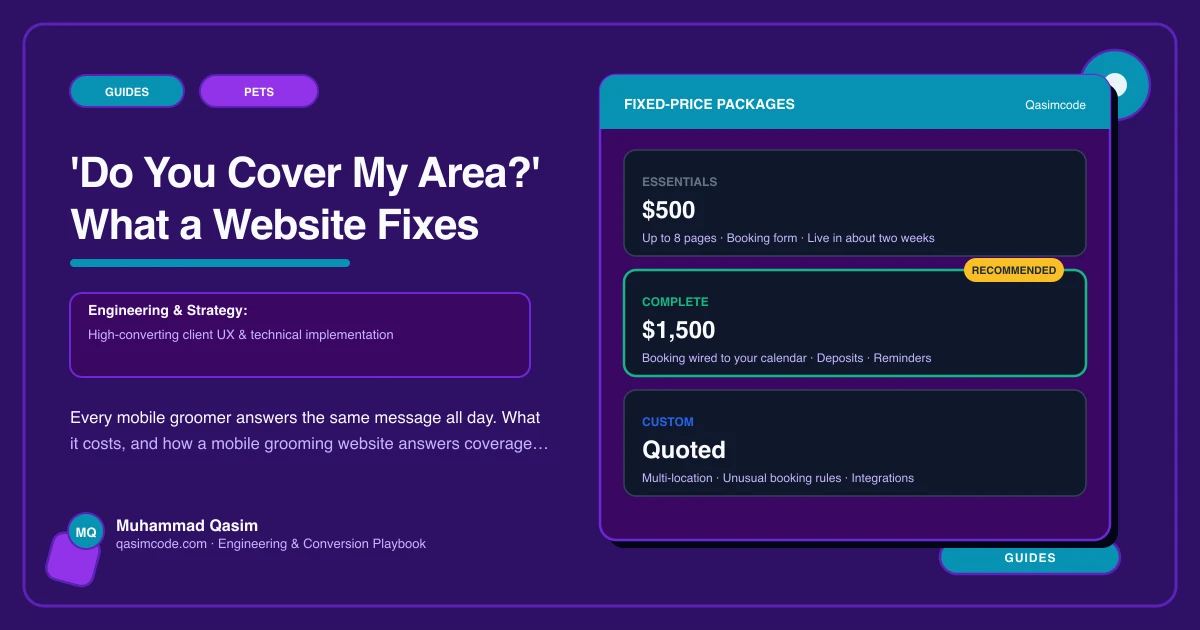
Area pages, a readable coverage statement, an area check before the calendar and a Google Business Profile set to match are all part of a mobile grooming website as we build it, and the same pattern of answering the question before it is asked runs through our other pet business websites. What each package includes is on pricing. Your round has an edge. The site should be the thing that describes it.