The unit you are buying is a filled drive, not a click
A van has a hard ceiling. One dog at a time, six or seven a day at best, and every gap between two appointments is unpaid diesel. A new client is only worth what a new client on the right street is worth. Two dogs on the same road on the same morning are worth far more than two dogs forty minutes apart.
That changes the template question. It is not whether the site looks nice. It is whether the site brings you clients clustered where you already drive, with addresses you can reach and driveways you can park on. Here is how the two options compare on that.
The template
A grooming theme or a builder layout with your logo, a gallery of finished dogs, a list of towns on the home page, a contact form, and a link out to booking.
Cost: hundreds to low thousands.
Good at: existing, looking friendly, going live in a week.
Weak at: coverage, which is the whole business. A comma-separated list of thirty place names in a footer is one page competing with itself for thirty searches, and it wins none of them. It is also weak at a price table that states whether travel is included, at booking that takes the address before it offers a slot, at saying what the owner has to provide on the day, and at showing the van.
The custom build
Built around the sequence a mobile client actually follows: find someone who comes here, work out what it costs for their dog with travel, decide whether the van and the person look safe, book at their address.
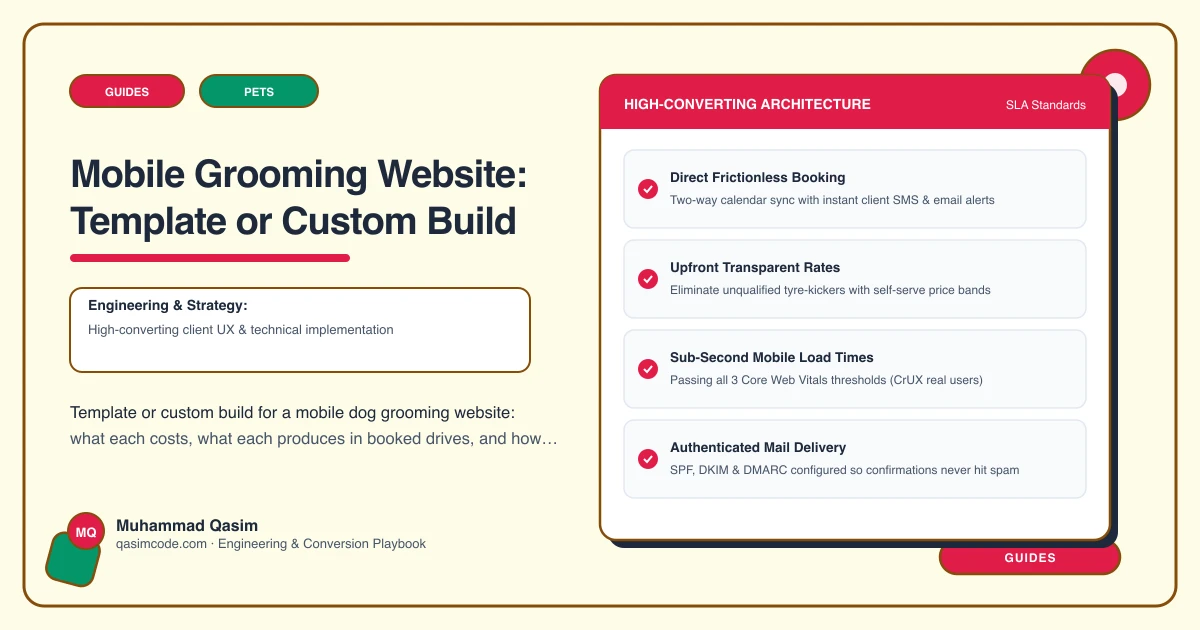
An area page per town or postcode group, each one a real page with local detail. An area check in the booking flow. Prices as a size and coat table with travel inside the figure, a stated minimum and any out-of-area surcharge, held as editable records. Booking from MoeGo, Savvy Pet Spa, Fresha or Booksy embedded and deep-linked, capturing the address, access, the dog's size, coat and vaccination status, and consent. A requirements page for parking, water and power. Real van photography, inside and out. Rebooking reminders. Insurance, qualifications and any licence displayed. Fast on a phone, structured data, tracking, everything in your name.
Cost: mid four figures, fixed.
Good at: ranking in the places you drive, filtering out the addresses you cannot serve, and booking a first dog with the driveway already agreed.
Weak at: the invoice, and two to three weeks of your attention while you are also grooming.
Where the extra bookings come from
Area pages. Somebody types mobile dog groomer plus their town. A page written for that town, naming the streets and estates you know, with your prices and a book button, competes. A home page with thirty towns in a sentence does not. This is the single largest difference between the two options for a van, and it does not exist for a salon.
The travel-inclusive price table. Owners compare a mobile groom against a salon groom and assume mobile costs more. Publishing the size and coat table with travel included, and stating the minimum, answers the comparison honestly and stops the message that begins "is that plus mileage".
Address before slot. Booking that offers times first and asks where you live afterwards generates bookings you have to cancel, which is worse than no booking. Taking the postcode first turns an out-of-area enquiry into a polite no in three seconds and never touches your diary.
Requirements stated up front. Parking space, access to water and mains power where your van needs them. Published on the site, asked in the booking, repeated in the confirmation. Every wasted journey it prevents is an hour and a tank of goodwill.
The van. A stranger is handing a dog to one person and watching it disappear into a vehicle outside their house. Photographs of the inside, the bath, the table, the dryer and the restraint, plus real client dogs, do more persuading than any copy.
When the template is the right answer
- You are in your first months, the round is filling from a local group, and the money is better spent on the van itself.
- You are already full and turning work away, and the site only has to exist and look tidy.
- You cover one small town, so area pages have nothing to divide.
In those cases put the effort into the booking platform, a well-filled Google Business Profile and asking every client for a review.
When the custom build pays back
- You cover several towns and want the ones with the best drive density.
- Your gaps are geographic, not numeric. The diary is half full and the half that is full is scattered.
- Messages asking whether you come to their area outnumber bookings.
- You are running two vans, or planning to.
The honest test
Count last month. How many enquiries arrived, how many were inside your patch, how many became a first groom, and how many of those live within ten minutes of a client you already have. If the answer is that most enquiries were out of area or on the wrong side of town, the site is sending you the wrong people, and a nicer template will send you more of them.
Where this sits
We build mobile grooming websites as the custom option, with area pages, the travel-inclusive price table, address-first booking and the requirements page included at a fixed price, and the same approach shapes our other pet business websites. Either choice is defensible. Make it on drive density, not on the look of the theme.