What you are actually buying
A vet practice website has three jobs that most quotes never mention. It has to register a new client and their pet without a clipboard at the desk. It has to state consultation fees and health plan pricing so the till is not a surprise. And it has to give a frightened owner at two in the morning a phone number they can tap without hunting.
Everything else on the site supports those three.
The free option, and what it costs you
Vetstoria, ezyVet, Provet Cloud and Covetrus all give you some form of client-facing booking page carrying your practice name. Squarespace and Wix give you a template with a photo of a labrador on it.
You get: a way to take an appointment and a phone number somewhere on the page.
You do not get: a domain of your own ranking for your town plus "vets", fees and plan pricing laid out properly, service pages for vaccinations, neutering, dental and surgery, team profiles with professional registration shown, or an emergency route on every page.
Right for: a brand new practice in its first months, still building a client list.
A template site
A veterinary or medical theme with your branding, a stock exam room, a contact form and a link out to booking.
You get: something presentable with your name on it, live in a week or two.
Usually missing: speed on a phone, fees stated rather than "please call", registration handled online rather than on paper, booking embedded rather than linked, an emergency route that survives on every page, and hosting held in your own name.
Right for: a practice that is full from word of mouth and wants a business card.
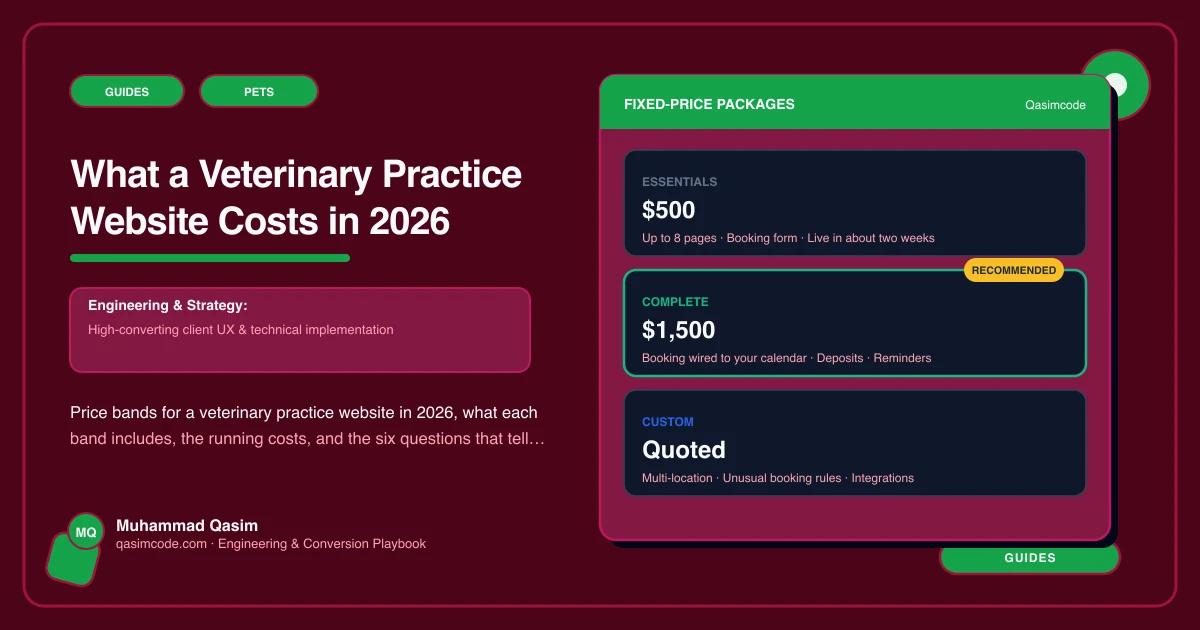
What we build: Essentials at $500, Complete at $1,500
Built around the sequence an owner actually follows: find a practice, work out what registering costs, decide whether these are people they trust with a family member, register and book.
That means online booking and registration driven from your practice management software, so the client and the pet exist as records before the first consult. Consultation fees and health plan tiers stated plainly. Service pages for vaccinations, neutering, dental and surgery. Vet and nurse profiles carrying professional registration. Real photography of your own consult rooms, prep area and team. Google reviews near the buttons. And an emergency route on every page: tap-to-call, hours, and whether you cover out of hours yourself or who does.
You get: a site that ranks locally, registers clients while the practice is closed, and answers the fee question before anyone reaches the desk.
Not usually included: photography and copy unless the quote says so in writing.
Right for: an established single-site or two-site practice that wants new registrations from search rather than from the sign outside.
When it goes past that: Custom, quoted after a call — groups, referral and mixed practice
Several branches with separate diaries and separate teams, a referral practice that has to serve both owners and referring vets, or a practice attached to boarding or daycare where the site sells two unrelated services to the same person.
After launch
- Hosting: managed WordPress at $20 to $50 a month, or often free on a framework host, in your name.
- Domain: small, annual, and yours.
- Booking and practice software: whatever you already pay Vetstoria, ezyVet, Provet Cloud or Covetrus.
- Maintenance: a care plan from $99/mo, which is where fees, plan pricing and rotas get kept current.
- Photography: half a day in the practice, with consent from the owners of any animals in shot. Real rooms beat stock every time on a site where the whole question is trust.
Where the money goes
- Registration and booking as one flow, tested on a phone, so a new client arrives already on the system.
- Fees and plans as editable records, so a January price change is your job for five minutes, not a developer ticket.
- Service pages for the work you actually do, written carefully because veterinary advertising is regulated.
- The emergency route, present on every page, with your own cover arrangement stated.
- Team profiles with registration details, which is both a trust signal and, in most regimes, an expectation.
- Speed, local search foundation and tracking of booking clicks and call taps by page.
Judging a quote
Ask six things. Does registration happen online or on paper. Is booking embedded and connected to the practice diary, or a link to a page. Are consultation fees and plan pricing on the site. Is there an emergency route on every page. Are the photos of my practice. Whose name are the domain and hosting in. A quote that cannot answer those is a band 2 quote whatever the number on it says.
Where this sits
Our veterinary practice websites are built to that standard at a fixed price, with online registration, fees and plans, service pages and the emergency route included, and the wider approach is on the pet business page. Rules on veterinary advertising and on what a practice may claim differ by country, with the RCVS Code in the UK and state veterinary boards and AVMA guidance in the US bearing on it, so treat this as orientation rather than legal advice and have your own adviser check anything you are unsure of.