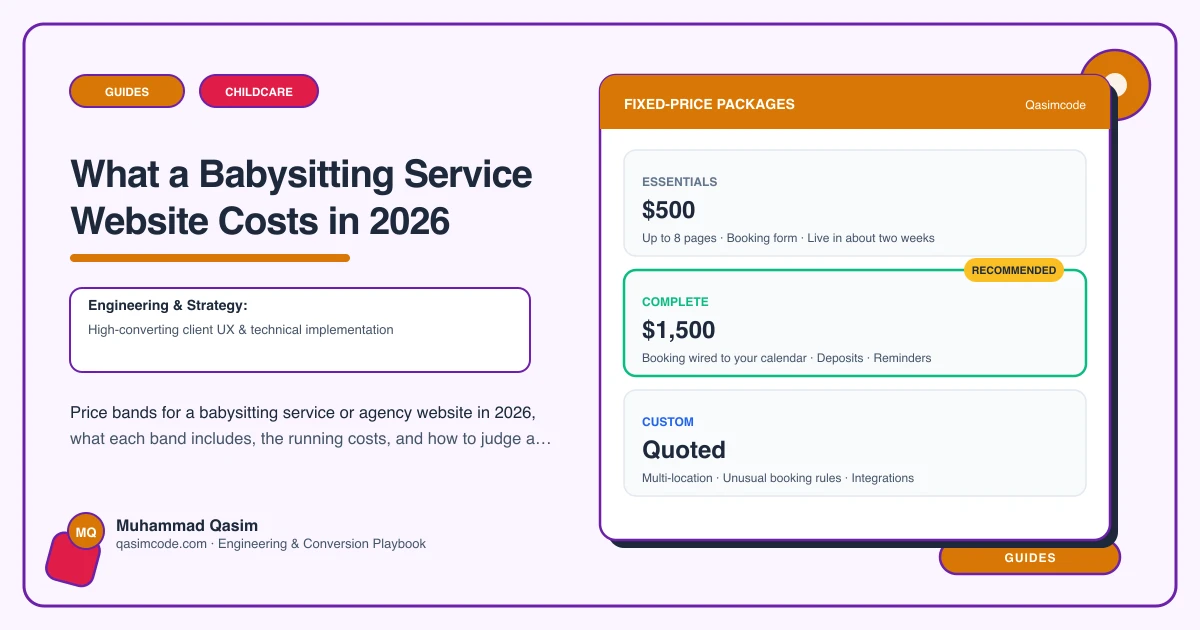
What you are actually buying
A babysitting site has a narrower job than a nursery site. It answers three questions for a parent who is going out on Saturday and has never met you: who is the sitter and how do you know they are safe, what does it cost an hour, and can I book it now without ringing anyone. Everything else is in service of those three.
The free option, and what it costs you
Acuity and Bookeo both give you a public booking page with your name on it. Sitter marketplaces give you a profile. Both take bookings today and cost almost nothing to start.
You get: a calendar and a phone number.
You do not get: a domain of your own ranking for babysitting plus your town, a vetting page that explains what you check and how, rates and surcharges stated in plain language, sitter profiles, or any way to be found other than by someone you already told.
Right for: a sole sitter in the first months, filling the diary from friends and the school gate.
A template site
A family or services theme with your branding, some photographs, and a link out to booking.
You get: something presentable with your name on it.
Usually missing: an hourly rate table that handles minimum hours, late nights and short notice rather than one "from" figure; booking embedded rather than linked; a vetting page a nervous parent will actually read; a last-minute route; hosting in your name.
Right for: a service that is already full from word of mouth and wants a business card.
What we build: Essentials at $500, Complete at $1,500
Built around how a parent picks a sitter. Vetting and first aid stated for every sitter, in the same words every time, with what each check covers and when it was last renewed. Rates held as editable records: hourly rate, minimum booking, late-night rate after a stated hour, short-notice surcharge, travel where it applies, and how bank holidays are treated. Booking by date, time, number of children, ages, location and any needs, through Acuity, Bookeo or a custom form, embedded rather than linked away. Sitter profiles where you let parents choose. A last-minute route with the surcharge on the same page. Areas covered as real place names. Cancellation and safeguarding policies. Reviews from parents near the buttons. Fast on a phone, local search foundation, tracking, everything in your name.
You get: a site that is found locally, answers the rate question before it is asked, and takes a booking at eleven at night without a call back.
Not usually included: photography and copy unless the quote says so.
Right for: an established service or a small agency with a bench of sitters and a diary worth defending.
When it goes past that: Custom, quoted after a call — agency platforms
A sitter bench with logins, availability that sitters maintain themselves, matching by area and age group, invoicing across a month of bookings, several towns or a wider region. This is software with a website attached rather than a website, and it is priced that way. Most services that think they need it are better served by that standard plus a booking tool for a year first.
After launch
- Hosting: managed WordPress at $20 to $50 a month, or often free on a framework host, in your name.
- Domain: small, annual.
- Booking tool: whatever Acuity or Bookeo costs on your plan, or nothing if the form is custom.
- Maintenance: a care plan from $99/mo, which is where rates, sitter profiles and check renewal dates are kept current.
- Photography: a short shoot of your sitters, with their written consent and with no children identifiable unless every parent has agreed in writing. Stock photographs of strangers with toddlers are worth nothing on a trust page.
Where the money goes
- The rate card as structured records, so the minimum, the late-night rate and the short-notice surcharge are all stated and all editable by you in January.
- The vetting page, written once and applied to every sitter, with references, identity, first aid and any background check described in orientation terms rather than legal ones.
- Booking that collects what you need to match a sitter: date, time, ages, address, allergies, pets, bedtime routine.
- The last-minute route, because same-day and next-day requests are a large share of demand and they arrive on a phone.
- Areas, policies and parent reviews, which is the part that turns a browse into a booking.
- Speed, structured data and tracking of booking starts and call taps by page.
Judging a quote
Ask six things. Is the rate card editable by me, including surcharges. Is booking embedded and does it collect ages and address. Is there a vetting page, and who writes it. Can I add and retire sitter profiles myself. What is the mobile speed target. Whose name are the domain and hosting in. A quote that cannot answer those is a template quote whatever the number on it says.
Where this sits
Our babysitting service websites are built to that standard at a fixed price, with the rate card, the vetting page, online booking and the last-minute route included, and the wider approach is on the childcare websites page. If your site is a template or a booking-platform page and your phone still rings on a Friday afternoon asking what you charge, count how many of those callers booked.