The decision is not about looks
Templates look fine. That is what they are for. A Squarespace or Wix family services theme will give you a calm palette, a photograph of a hallway and a contact form, and a parent will not think less of you for it.
The decision is about four things a babysitting service has to do that a template was not designed around: state hourly rates with a minimum and surcharges, prove vetting for a bench of sitters, take a booking that captures ages and an address, and handle a request for tonight. Judge the two routes on those, not on the hero image.
What a template does well
Speed. You can be live in a weekend. For a sitter going out on their own, that matters more than anything on this page.
Cost. A subscription and your own time, or a few hundred to have someone set the theme up for you.
Editing. Changing a paragraph is genuinely easy, and you will change paragraphs.
Good enough pages. Home, about, contact, a gallery. If your bookings come from the school gate and a village Facebook group, and the site exists so people can check you are real, a template is the correct answer and spending more is a waste.
Where templates run out
Rates. A template gives you a text box. Type your hourly rate, the four-hour minimum, the rate after midnight and the short-notice surcharge into a paragraph, and in six months two of those four numbers will be wrong, because a paragraph is not a record. Rates held as structured records are edited in one place and appear correctly everywhere.
Sitters. A bench of sitters is a repeating pattern: name, photograph, area, age groups, first aid, checks and their renewal dates, a line about them. Templates handle three of those as hand-built pages and then you add a fourth sitter and it takes an hour. A custom build treats a sitter as a record you add in two minutes, and the vetting badges come from fields rather than from you remembering to paste them.
Booking. Templates link out. The parent lands on a hosted calendar with none of your reassurance around it, which is exactly the moment they are deciding whether to trust you. Embedded booking, with the vetting statement and the rate card on the same page, converts differently.
Short notice. A same-day route needs its own page, a stated surcharge, a stated response time and a phone number that behaves like a button on a phone. Templates can be pushed into this. They rarely are, because nobody thinks of it on setup day.
Speed and search. A theme with a slider, three web fonts and a stock photograph is slow on a phone on mobile data, which is where a parent standing in a kitchen at six is reading it. Local search for babysitting plus your town is winnable, and the pages that win it are fast and specific.
What a custom build actually buys
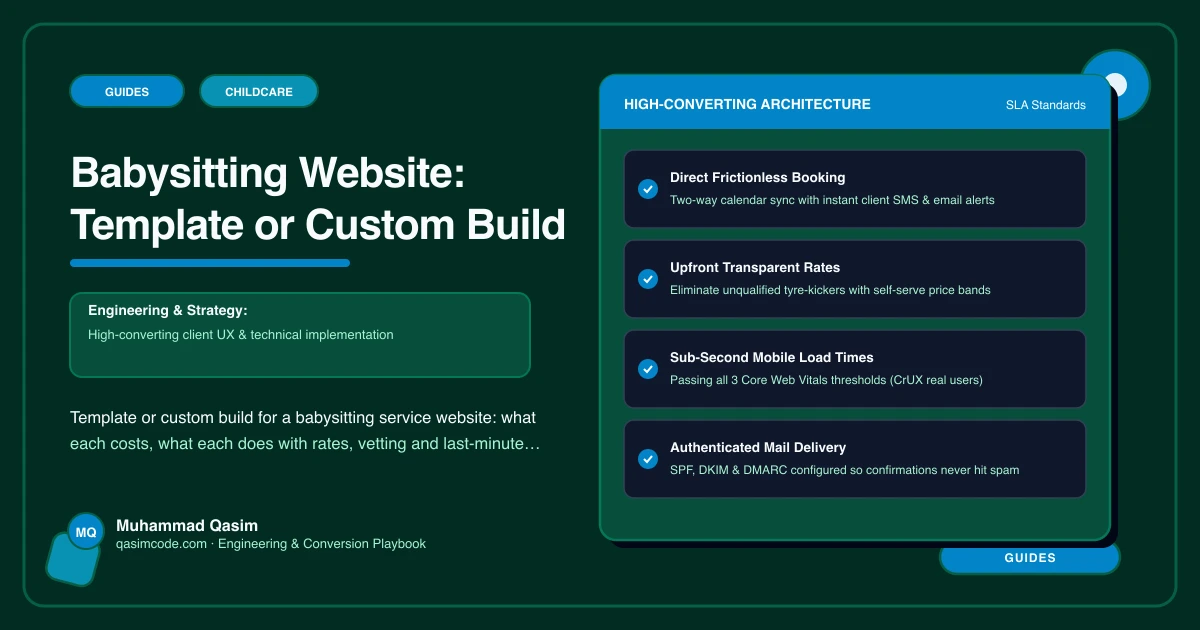
Not bespoke design for its own sake. The rate card as editable records including minimums and surcharges. Sitter profiles as records with vetting and first aid fields. Booking embedded and collecting date, time, number of children, ages, location and needs. A last-minute route with the surcharge on it. Areas covered as real place names, which is most of the local search work. Policies and parent reviews. Speed, structured data, tracking of booking starts and call taps, and hosting and domain in your name.
The payback arithmetic
Do it in bookings rather than in feelings. Take your average booking value, four hours at your hourly rate, and think about how many of those a repeat family produces in a year. A family that books you monthly is worth many multiples of one evening.
Now count what a template loses. The parent who could not find a rate and rang three services instead of one. The Friday request at four that went unanswered because there was no urgent route. The parent who reached a hosted calendar, saw no mention of checks or first aid, and closed the tab. If a custom build recovers a handful of families a year, the difference between the two routes pays for itself, and keeps paying, because those families rebook.
If it does not recover a handful of families a year, because your diary is already full from word of mouth, then it does not pay back, and you should stay on the template. That is a real answer, not a polite one.
The honest middle
There is a third route. Start on a template while you build a diary, but buy your own domain on day one, keep hosting in your name, and write the rates, vetting and areas pages properly even if the design is generic. Then a rebuild later is a rebuild of the design, not a rescue of your search presence and your email.
The expensive version of the template route is the one where the domain is registered to whoever built it, the content is trapped in a proprietary editor, and three years of local ranking has to start again.
Which to pick
Template if you are one sitter, under a year in, and word of mouth is filling the week.
Custom if you have a bench of sitters to prove, rates with more than one number in them, short-notice demand you are currently losing, and search traffic you want to win rather than hope for.
Where this sits
Our babysitting service websites are the custom route at a fixed price, with rates, sitter profiles, embedded booking and a last-minute route built in, and the wider approach across nurseries, clubs and agencies is on the childcare websites page. If you are unsure which side of the line you are on, count the rate calls you took last month.