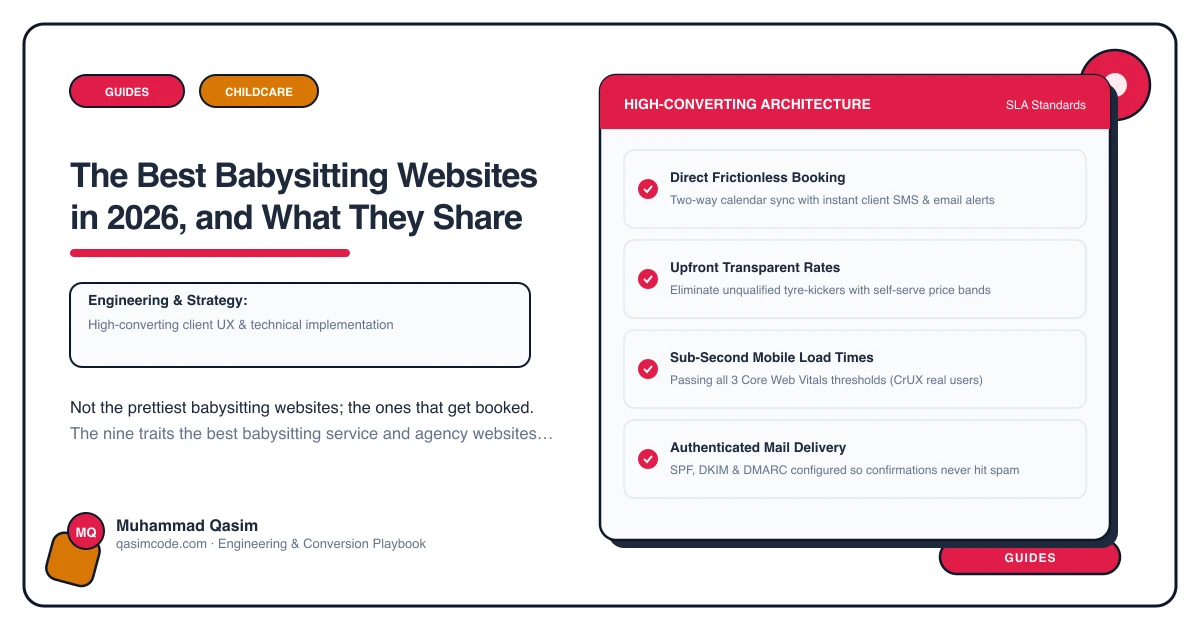
How to read a list like this
There is no league table of babysitting websites worth publishing, and any list of named sites would be out of date by spring. What is useful is the pattern. Look at the babysitting services and agencies whose diaries are full from search rather than from the school gate, and the same nine things keep appearing.
Use these as a scoring sheet against your own site. Nine out of nine is rare. Six is a good site. Three is why the phone rings instead of the booking form.
1. The rate is visible without asking
The best sites put the hourly rate, the minimum booking and the surcharges where a stranger finds them in one scroll. Not a bracket that spans triple. Not a promise of a quote. The number, the minimum, the late-night rate after a stated hour, the short-notice uplift, and how bank holidays work.
It feels exposing. It is the single biggest difference between a site that books and a site that gets asked.
2. Vetting is described, not claimed
Weak sites say sitters are fully vetted. Strong sites say what that means in order: identity confirmed, references taken up and spoken to, background checking appropriate to where they operate, paediatric first aid with a renewal date. They say what they can show a parent on request, and they do not publish certificate images or numbers.
The tone matters as much as the content. Calm, specific and unemotional reads as a service that does this every week.
3. Sitters are people, with faces and limits
Where the service lets parents see who is coming, the good sites give each sitter a short profile: first name, a photograph used with their consent, the areas they cover, the age groups they are comfortable with, first aid, and two or three lines that sound like a person rather than a CV.
Where sitters are matched by hand rather than chosen, the good sites say so plainly and explain how the matching works, which is its own kind of reassurance.
4. Booking asks the right questions
The best booking flows ask date, start and end time, number of children and their ages, address, and anything the sitter should know: allergies, bedtime routine, pets, whether a parent is contactable nearby. That is not friction. It is the parent seeing that you know what the job involves.
Whether it runs on Acuity, Bookeo or a form of your own matters far less than what it collects and how it looks on a phone.
5. There is an obvious route for tonight
Short notice is a large share of demand, and most sites hide from it. The good ones have a visible short-notice route with the surcharge stated, a cut-off time, a stated reply window and a phone number that behaves like a button.
6. Areas are named
Not "the local area". Towns, villages, suburbs and postcode areas, listed. Travel charges stated where they apply. This is honest, it saves you calls you would decline anyway, and it is most of the local search work in one page.
7. Policies are written down and easy
Cancellation, the minimum, what happens if a child is ill, what happens if the parent is late back, how payment works and when. Safeguarding described in plain terms. These pages do not sell, but their absence stops a careful parent, and careful parents are the ones who book repeatedly.
8. Parents speak for you
Reviews sit near the booking button, not on a testimonials page nobody opens. First names only. No child named or pictured. A handful of specific reviews outperforms a wall of generic ones, and a Google reviews link outperforms both for anyone checking whether you are real.
9. It is fast, and it works in the app browsers
The best sites are quick on a phone on mobile data because that is where the decision happens, usually in a kitchen, in the evening, in a hurry. They also work in the Instagram and Facebook in-app browsers, because a good share of visits come from a link in bio and those browsers break embedded booking flows quietly.
The three that matter most
If you only fix three, fix the rate, the vetting page and the booking route. A parent who can see what it costs, can see how you check people, and can ask for Saturday in under a minute will book. Everything else on this list makes that more likely, not less necessary.
What is not on the list
Animation. A video header. Clever copy. A chatbot. None of these appear in the pattern, and a couple of them actively hurt, because they slow the page and delay the three answers a parent came for.
Score your own site
Open your site on your phone, from a cold start, and time yourself finding the hourly rate. Then the vetting description. Then the booking route. If any of the three takes more than thirty seconds, that is your next piece of work, and it is worth more than a redesign.
Where this sits
Rates and surcharges stated, vetting and first aid per sitter, sitter profiles, online booking and a last-minute route are what we build into a babysitting service website, and the same standard runs through the other childcare and family websites. What each package includes is on pricing. Score yourself against the nine, then fix the lowest one.