What you are actually buying
A tutoring site for children has an unusual job. The person reading it is not the person being taught. A parent lands on the page worried that their nine year old has gone quiet about maths, and they want four things before they will act: what you teach and to what age, how sessions actually run, who you are and how you are vetted, and what it costs per session and per term. Then they want to book a trial without ringing anyone.
Everything you pay for on a tutoring website is in service of that sequence.
The free option, and what it costs you
TutorBird includes a website builder with its tutoring software, and Squarespace or Wix will give you a template with a photograph of a child holding a pencil.
You get: a public page and a way to be contacted.
You do not get: a domain of your own ranking for "maths tutor" plus your town, a page per subject and age group, fees stated per session and per term, vetting and safeguarding set out where a cautious parent will find it, or anyone to call when the booking form stops sending.
Right for: a tutor in their first term, filling a diary from the school gate.
A template site
An education theme with your branding, an about page, a list of subjects and a contact form.
You get: something presentable with your name on it.
Usually missing: speed on a phone, a separate page for each subject and age band, fees rather than "contact for prices", a trial booked online instead of an email, anything on how progress is reported, and hosting in your own name.
Right for: a tutor whose diary is already full from referrals and who wants a business card.
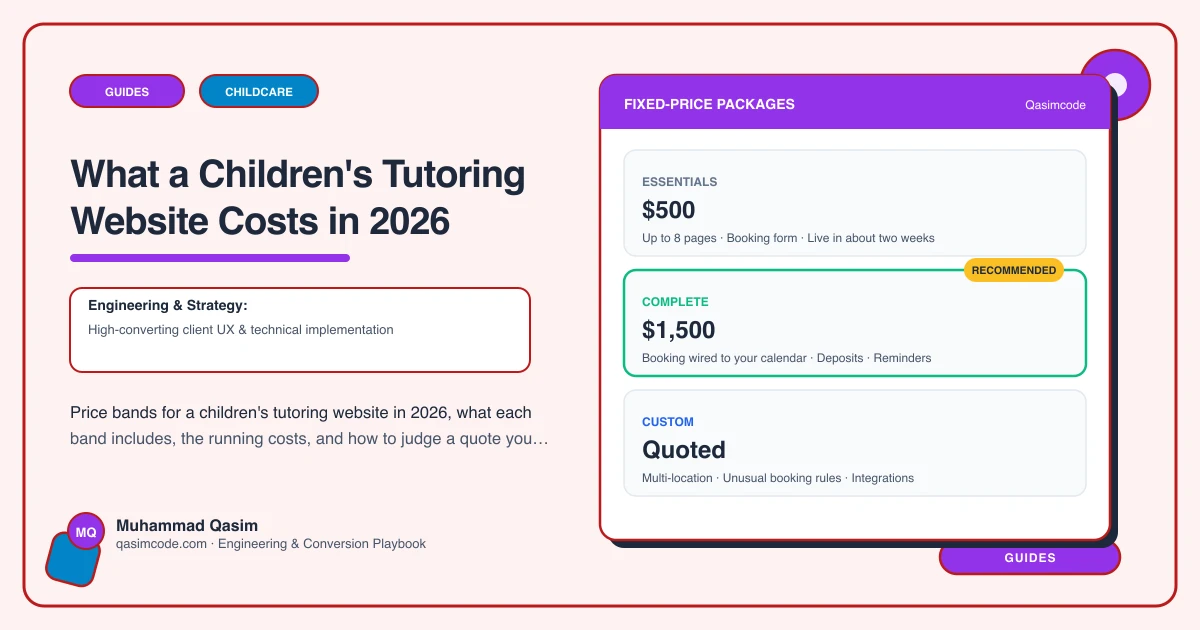
What we build: Essentials at $500, Complete at $1,500
Built around how a parent chooses. A page for each subject and each age band, because primary maths and GCSE physics are different searches by different parents. A page on how sessions work: length, frequency, where, what happens if a child is ill, and how homework is handled. A vetting and safeguarding page that names your background checks and your policy plainly. Fees per session and per term, held as editable records. Trial booking through TutorBird, Teachworks, ClassForKids or Acuity, embedded and deep-linked. Tutor profiles with qualifications and experience with children. A plain explanation of how parents hear about progress. Online session safety spelled out. Reviews from parents near the buttons. Fast on a phone, structured data, tracking, everything in your name.
You get: a site that ranks locally by subject, answers the fee question before the email, and books a trial from a parent who has already been reassured.
Not usually included: photography and copy unless the quote says so.
Right for: an established tutor or a small centre that wants enquiries from search rather than from word of mouth alone.
When it goes past that: Custom, quoted after a call — centres, multiple tutors and group classes
Several tutors with their own profiles and calendars, group classes sold by term alongside one to one sessions, more than one location, or a parent portal doing real work. The complexity is in the timetable and the term billing, not the design.
After launch
- Hosting: managed WordPress at $20 to $50 a month, or often free on a framework host, in your name.
- Domain: small, annual.
- Tutoring software: whatever you already pay TutorBird, Teachworks, ClassForKids or Acuity.
- Maintenance: a care plan from $99/mo, which is where fees, term dates and tutor profiles get kept current.
- Photography: a short session for tutor portraits and the room, with written consent from any family whose child appears. Most tutoring sites are better off with no children in the photographs at all.
Where the money goes
- A page per subject and age band, each one a search result rather than a bullet on a list.
- Fees as editable records, per session and per term, so September's increase takes ten minutes and not a developer.
- Trial booking deep-linked so the subject and age are already chosen, tested on a phone.
- Vetting and safeguarding written in plain words, prominent rather than buried in a footer policy nobody opens.
- The progress answer: reports, check-ins or a portal, described concretely.
- Online session safety, if you teach remotely: platform, recording, whether a parent is present.
- Speed, local search foundations and tracking of trial bookings and enquiries by page.
Judging a quote
Ask six things. Is there a page for each subject and age group. Are fees on the site, per session and per term, and can I edit them. Is trial booking embedded or just an email link. Is vetting on its own page or a line in the footer. Does the site say how parents hear about progress. Whose name is the domain and hosting in. A quote that cannot answer those is a template quote whatever the number says.
Where this sits
Our children's tutoring websites are built to that standard at a fixed price, with subject and age pages, fees, vetting and trial booking included, and the wider approach is on the childcare and family page. If your site is a template or a booking-platform page and parents still email to ask what you charge, the number worth weighing against a rebuild is how many of those emails turned into a term of lessons.