The question underneath the question
Nobody actually wants a custom website. What a party venue owner wants is Saturdays that fill without the phone, and parents who arrive knowing what is included. The build question is only worth asking in those terms: which route gets the room booked, and how soon does the difference pay for itself.
A party venue is unusual in one respect. Its inventory is small, fixed and highly perishable. You have a handful of party slots a week, most of them on two days, and an empty eleven o'clock on Saturday is gone forever. That changes the maths of this decision considerably.
What a template genuinely gives you
A leisure or events theme gives you a home page, a gallery, a contact form and a look. Set up carefully, with a link out to your booking platform, it is a real business presence and it costs very little. For a venue in its first year, still learning which packages sell, that is often the right call. Spend the money on the rooms and the photography instead.
Templates are also fine when your bookings genuinely all come from a school gate, a soft play regulars group and repeat parents. If nobody is finding you through search, a faster site does not help you very much.
Where templates start to cost you
The trouble begins when the site has to carry the actual shape of your offer.
Packages by age. A party venue sells three or four packages that differ by age range, duration, inclusions and price per child, with a minimum number underneath. In a template that becomes a page of text and a picture of a price list. It goes stale the moment you change what a package includes, and nobody can edit it without going back to whoever built it.
Availability. A parent has one date. If the site cannot tell them whether the room is free on it, they ring, and if you do not answer within the hour they ring somewhere else. A template links out to booking at best, usually to a home page rather than to the package, which loses a share of parents at every hop.
Food and add-ons. Party bags, an extra half hour, a character visit, dietary options. These are decided in the booking or they are decided in a chain of emails on a Wednesday evening. A template site pushes them into the email chain.
The deposit. Without a deposit taken online, a provisional booking is a pencil mark, and pencil marks are what leave you with a Saturday hole in April.
The parent FAQ and allergens. Adult supervision, allergies, invitations, what to bring and arrival time are the questions you answer over and over. They need a real page, structured so search engines can read it and parents can scan it.
What a custom build changes
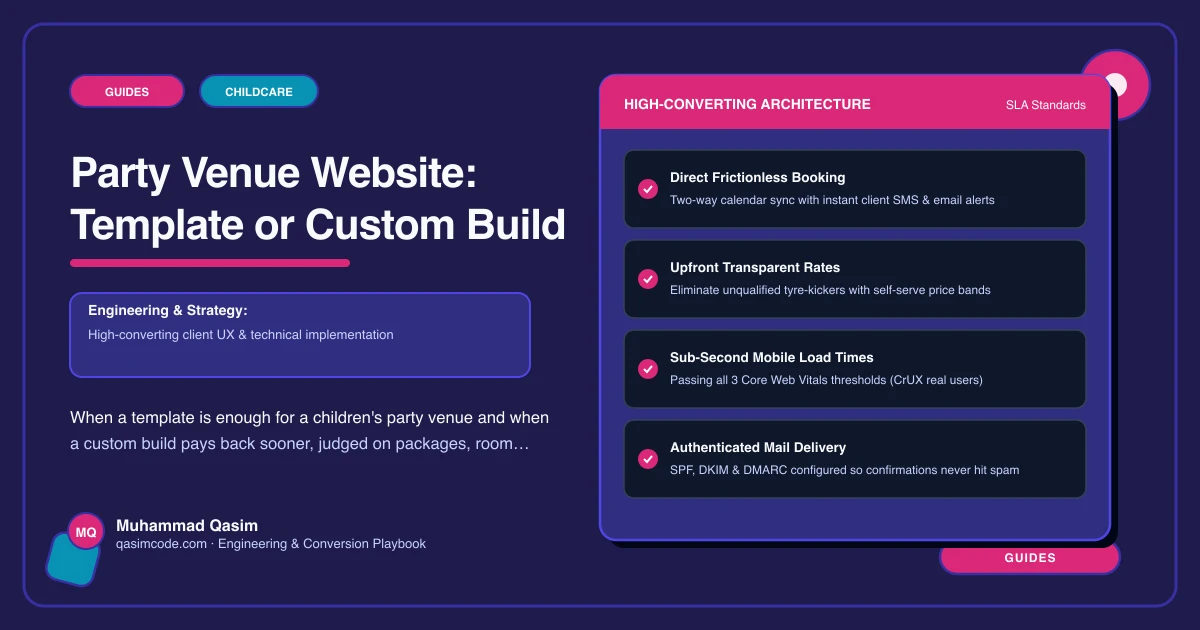
A purpose built site models the offer rather than describing it. Packages become records with fields for age range, duration, inclusions, price per child, minimum numbers and add-ons, rendered as comparable cards and editable by you. Room availability from ROLLER, Bookeo, Xola or Party Center Software is embedded and deep linked per package, with the deposit taken in the same flow. Food and add-ons sit inside that flow. The FAQ and allergen pages are proper pages. The photography is your rooms, mid party, with consent.
That is the difference: a template tells a parent about your venue, and a custom build lets them book it.
The payback maths
Do this on your own numbers rather than anyone else's. Take your average party value including food and add-ons. Ask how many parties a month you currently lose because the enquiry went cold over a weekend, or because the parent could not see whether Saturday was free. In most venues that number is not zero, and in a venue with a decent local search position it is meaningful.
Divide the gap between a template and a custom build by your average party value. That is how many extra parties the build has to win to pay for itself. For most venues the answer lands in the low single digits, once, not per month. Weigh that against the risk that your weekends are already full, in which case the honest answer is that you do not need this yet.
A sensible middle
You do not have to choose all or nothing. A common path is a good template now, with two things done properly: booking deep linked per package rather than to a home page, and packages written as clear comparable blocks with price per child stated. Then rebuild when the venue has settled its offer, usually after a full year of seasons.
What is not worth doing is a mid priced template build that pretends to be custom. That is where money goes and nothing changes.
How to tell which you are being sold
Ask whether packages are editable records or page content. Ask whether availability is embedded or linked. Ask whether the deposit is taken on your site or on a separate platform page with different branding. Ask whose name the domain and hosting sit in. The answers separate the two routes faster than any price.
Where this sits
We build children's party venue websites as the custom route, with packages as records, room availability embedded, add-ons in the flow and a parent FAQ, and the same approach runs through our childcare and family websites. The packages are on pricing. If your weekends are already full, keep the template. If your Saturdays have holes and your phone rings on Tuesdays, the build pays for itself in parties, not in months.