The question behind the question
Nobody actually wants a custom build. What a clinic wants is enough consultations at the treatment values it is set up to deliver. Template or custom is only a question about which route gets there for less money over three years.
For a check-up practice the honest answer is often the template. For a cosmetic and implant clinic it usually is not, and the reason is specific rather than snobbery about design.
What a template is, here
A dental or medical theme bought or licensed, your logo and colours applied, your text poured into the existing page layouts, a gallery plugin, a contact form, and a link out to booking. Fast to stand up, a few weeks, a low four-figure sum or less.
Templates are good at the things every practice site shares: an address, opening hours, a team page, a treatment list, a contact route.
What a custom build is, here
The same pages, but the content types are modelled on how a cosmetic clinic actually sells. Treatments as records with a from-price, a finance line, a visit count and their own FAQ. Cases as records with treatment, clinician, number of appointments, and a consent reference. Consultation types as records mapped to appointment types in your practice system. The design is then built over that structure rather than the structure being squeezed into the design.
Where templates break for this specific business
The gallery. A template gallery is a lightbox. What a cosmetic clinic needs is a set of cases, each carrying the treatment name, the honest scope of the work, and a link between the image and its written consent record. When a patient withdraws consent, and they do, you need the image gone from every page in one action, not hunted across six pages and a slider.
Prices and finance. From-prices need to be editable by the practice, in one place, appearing on the treatment page and anywhere the treatment is listed. Finance wording usually has to carry a representative example from your lender, and it has to be identical everywhere it appears. In a template that is copied text in nine places, and nine places is how one of them ends up out of date.
A page per treatment. Veneers, composite bonding, whitening, single implants, full-arch and smile makeovers are six different searches, six different budgets and six different objections. Templates push towards one Treatments page with accordions, which ranks for nothing and answers no one.
Speed with heavy images. Cosmetic sites are image-heavy by nature. A template gallery plugin plus a slider plus an embedded booking widget is the standard route to a four-second load, and a slow gallery on a phone is the fastest way to lose a patient who was comparing you against two other clinics.
Country rules. Photography and finance promotion are regulated differently by market. A build that can restrict or switch off the gallery per country is a structural decision. Bolting that onto a template later is expensive.
Where the extra consultations come from
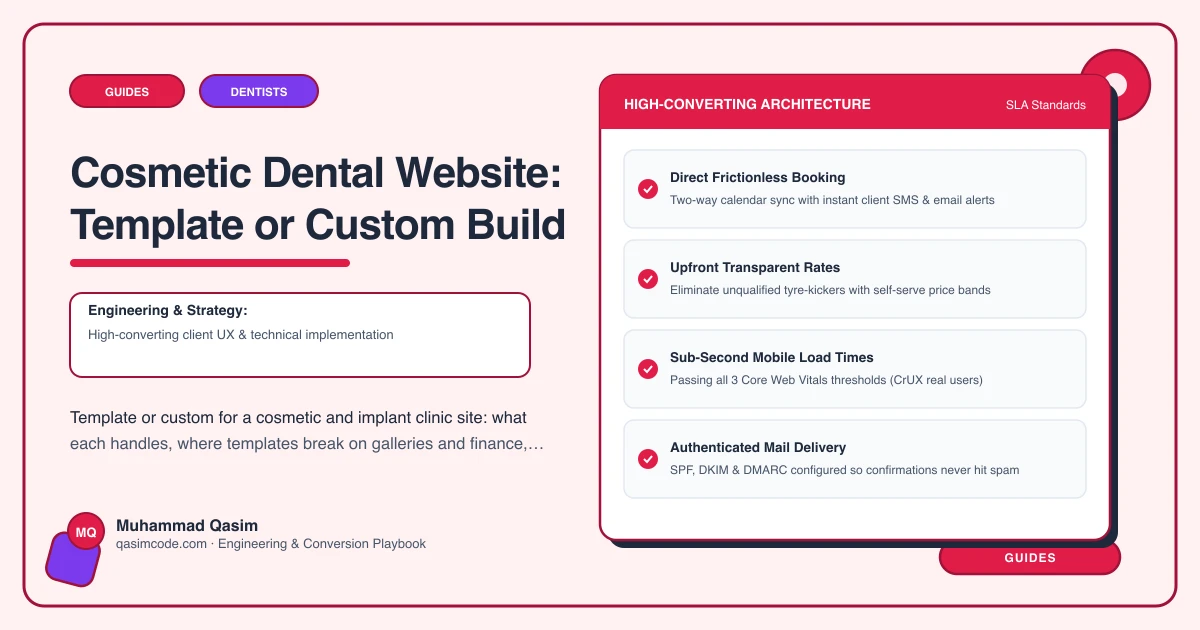
Not from the design. From four structural things: each treatment ranking for its own search, prices visible so the enquiry is already qualified, cases that read as evidence rather than decoration, and booking that reaches the diary in one tap from any page.
The arithmetic
Work it in your own numbers. Take the average value of the treatment you most want more of, and your consultation-to-treatment conversion rate. Then ask how many extra consultations a year would repay the difference between a template quote and a custom quote.
For most clinics the difference is a few thousand, and the answer comes out at a small number of cases. That arithmetic is why the calculation lands differently here than it does for a general practice competing on check-ups.
When the template is right anyway
- The cosmetic work is occasional and you are not trying to grow it.
- You are testing one treatment before committing.
- Your list is full for months from referrals and word of mouth.
- Cash is genuinely tight. A tidy template now beats a custom build you cannot afford to finish or maintain.
If you go template, go in with your eyes open: put real from-prices on it, make the gallery small and captioned, keep a consent file outside the website, and hold the domain and hosting in your own name so you can leave.
When the template is a false economy
If implants or veneers are a meaningful share of income, if you compete against two or three clinics in your city with strong sites, or if you take patients who travel to you, the template will cost you more in missed cases in a year than the custom build costs once.
Deciding in one meeting
Answer four questions. How many treatments deserve their own page. Will you publish from-prices and finance. How many cases will you photograph in the next twelve months, and who tracks the consent. Does booking have to reach the practice diary. Two or more "the bigger answer" and the template is the more expensive route.
Where this sits
We build cosmetic dentistry and implant clinic websites as custom structure at a fixed price, with treatment records, consented case records and consultation booking included, and the same approach across our other dental practice websites. This is orientation, not legal advice. What you may publish about results and finance is set by your regulator and your lender, and they should see the wording before it goes live.