What you are actually buying
A specialist practice website is not a general dental site with a longer treatment list. It has two audiences arriving for opposite reasons. A referring dentist wants to send a case with the radiographs attached in under two minutes and know it landed. A patient who was told this morning that a lower wisdom tooth has to come out wants to know what happens, what it will feel like afterwards, and what it costs. They are market ranges rather than our numbers, which are on pricing.
The free option, and what it costs you
Some practice systems give you a public booking page or a thin profile site. It has your name on it and a phone number.
You get: an appointment route for patients who already know who you are.
You do not get: a referral form, procedure pages, anything that ranks for your specialty plus your city, or hosting in your own name.
Right for: a first-year associate list still built entirely on personal relationships.
A template site
A dental theme with your logo, a team page and a contact form.
You get: a presentable brochure.
Usually missing: a referral route that accepts files, a page per procedure, consultation booking into the diary, specialist registration presented properly, and any thought about who is reading which page.
Right for: a practice whose referral base is complete and closed.
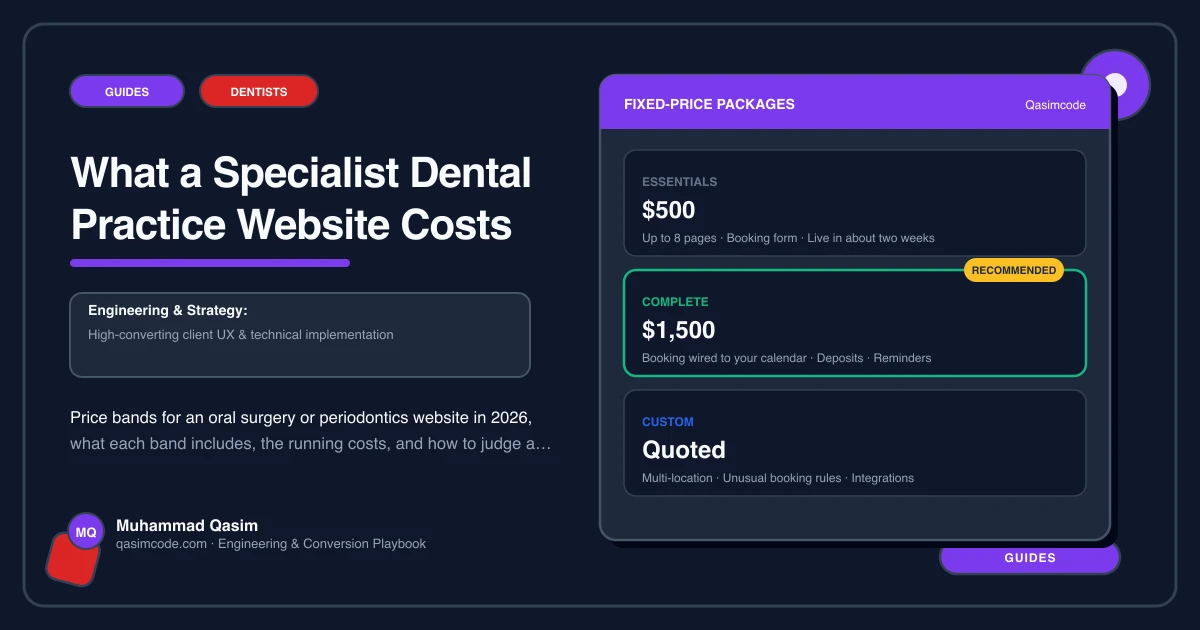
What we build: Essentials at $500, Complete at $1,500
Built around the two front doors. A referrer section with a secure upload form that takes the referral letter, radiographs and patient details in one submission and confirms back to the sender. A page per procedure covering extractions, wisdom teeth, implants, grafting and gum surgery, each describing what happens on the day, what anaesthesia or sedation is offered, what recovery looks like day by day and what to eat. Consultation booking into the practice diary with the referral reference collected. Specialist registration, training and hospital posts stated factually. Clinical imagery handled to the rules that apply where you practise. Fees and insurer information. Fast on a phone, tracked, everything in your name.
You get: a site that referrers prefer to a fax machine and that patients read before they cancel.
Not usually included: photography and copy unless the quote says so.
Right for: an established specialist or a small specialist group that wants a wider referral base.
When it goes past that: Custom, quoted after a call — multi-site and hospital-linked
Two or more locations with separate diaries, several specialists with their own referral routes, or a practice that also runs general dentistry alongside the specialist list and needs both audiences kept apart. A group like that is closer to the dental practice websites pattern with a specialist layer on top.
After launch
- Hosting: managed hosting at $20 to $50 a month, in your name.
- Domain: small, annual, renewed by you.
- Form and file handling: a form platform that will sign the right agreement for your country, typically a business associate agreement in the United States or a processing agreement under UK and EU data protection law. Expect a paid tier for that, not the free one.
- Practice software: whatever you already pay for Dentally, Software of Excellence, Dentrix, Open Dental, Curve Dental or Jane.
- Maintenance: a care plan, which is where fees, insurer lists and clinician profiles get kept current.
Where the money goes
- The referral form. File uploads sized for panoramic images and photographs, a route for large cone beam files that no web form should carry, routing to the right inbox or person, and an automatic confirmation to the referrer with a reference.
- Procedure pages written for a frightened reader. Not a paragraph each. A page each, with the day of surgery and the days after described honestly.
- Consultation booking into the diary, with the referring practice captured at the point of booking.
- Credentials. Specialist registration, the register or list you appear on, training, hospital appointments, years in practice.
- Imagery governance. Consent recorded, factual captions, and clinical images kept to information pages where advertising rules restrict their use.
- Fees and insurance. Consultation fee, how estimates are produced after assessment, and which insurers or schemes you work with.
Judging a quote
Ask six things. Does the referral form accept files, and where do they go. What agreement will the form vendor sign. Is consultation booking wired to the diary or is it an email form. Is there a page per procedure or one treatments page. Who writes the recovery content, and who reviews it clinically. Whose name are the domain and hosting in. A quote that cannot answer those is a template quote whatever the figure says.
Where this sits
Our oral surgery and periodontics websites are built to that standard at a fixed price, with the referrer section, a page per procedure and consultation booking included. Nothing here is legal or clinical advice; the imagery and data rules that apply to you depend on where you practise and are worth confirming with your regulator and your indemnity provider. If your current site is a template or a booking-platform page and referrals still arrive as paper, the number to weigh is how many referrers would send you more cases if sending one took two minutes.