What you are actually buying
A children's dental practice website has a narrower job than a general practice site. The patient is five. The person reading the page is a parent at nine in the evening who wants to know three things: that you are kind to children, that you are properly qualified, and that there is a slot after school on a day they can manage. Everything on the site exists to answer those and then offer a booking button. They are general market figures, not our own numbers, which live on pricing.
The free option, and what it costs you
Dentally, Software of Excellence, Dentrix, Open Dental and Curve Dental all offer some form of patient-facing booking or portal. A practice with no site of its own can point parents at it.
You get: a way to take an appointment.
You do not get: a domain of your own that ranks for children's dentistry in your town, a first-visit page, staff profiles that show paediatric training, fees explained by scheme, or family booking presented in a way a parent understands.
Right for: a squat practice in its first months, still filling the book from local referrals.
A template site
A dental theme with your logo, a stock photograph of a child holding a toothbrush, a treatment list and a link out to booking.
You get: something presentable with your name on it.
Usually missing: speed on a phone, a first-visit page written for a worried parent, nervous-patient options explained plainly, fees set out by scheme, family booking, real photographs of your own rooms, and hosting held in your name.
Right for: a practice that is full and wants a business card.
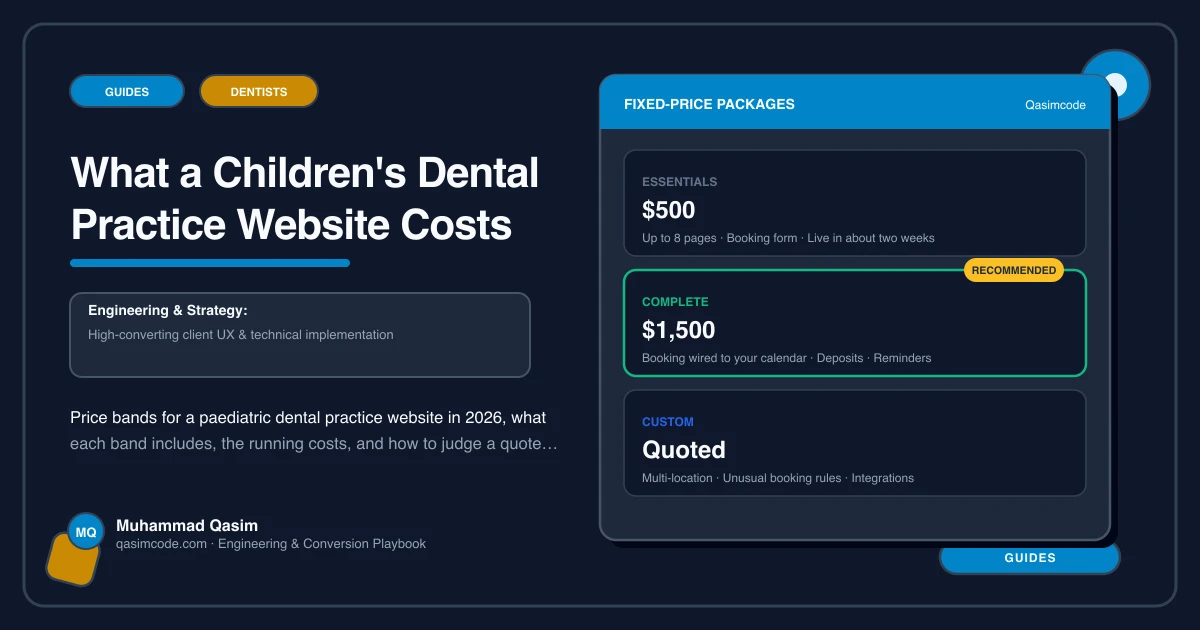
What we build: Essentials at $500, Complete at $1,500
Built around how a parent chooses a children's dentist. A first-visit page describing exactly what happens, how long it takes and what happens if the child will not open their mouth. Family booking so a parent picks two or three children and back-to-back slots in one flow, wired into the practice diary with reminders sent to the parent. Nervous-patient options set out one by one, each with how to request it at booking. Fees by scheme on a single page. Team profiles that state paediatric training and the registration details your regulator expects. Photography of your actual team and surgery rooms. An emergency route for a knocked-out tooth. Fast on a phone, structured data, tracking, everything in your name.
You get: a site that ranks locally, answers the first-visit call before it happens, and lets a parent book both children after school without ringing.
Not usually included: photography and copy unless the quote says so.
Right for: an established children's practice that wants new families from search rather than referral alone.
When it goes past that: Custom, quoted after a call — multi-site and mixed practices
Two or more locations with separate diaries, or a general practice with a children's arm where the site has to speak to adults and to parents without confusing either. That is a different information architecture, and it costs more because it is more.
After launch
- Hosting: managed hosting at roughly $20 to $50 a month, in your name.
- Domain: small, annual, and renewals diarised so nobody misses one.
- Practice software: whatever you already pay Dentally, Software of Excellence, Dentrix, Open Dental or Curve Dental.
- Maintenance: a care plan from $99/mo, which is where fees, staff changes and opening hours get kept current.
- Photography: half a day in the practice. Rooms, equipment and staff, not patients, unless you hold written parental consent for a specific image and have decided you want to use it. Many practices deliberately never publish images of child patients at all, and a site built without them looks no worse.
Where the money goes
- Family booking with multiple children and back-to-back slots, tested on a phone as a parent would use it.
- The first-visit page, which is the single page that replaces the most phone calls.
- Nervous-patient options written out plainly, with a way to flag the request when booking rather than a note to ring.
- Fees by scheme, held as editable records so a fee change is ten minutes and not a developer ticket.
- Team and room photography, which is the most persuasive thing a children's practice can publish.
- The emergency route, one tap from the home page, for the parent standing in a playground with a tooth in a tissue.
- Speed, local search foundation and tracking of booking clicks and call taps by page.
Judging a quote
Ask six questions. Can a parent book two children in one flow, or is it one at a time. Is there a first-visit page, and who writes it. Are the photographs of my rooms or bought in, and what is the policy on images of children. Are fees shown by scheme and can my team edit them. What is the mobile speed target. Whose name are the domain and hosting in. A quote that cannot answer those is a template quote whatever the number on it says.
Where this sits
Our paediatric dental practice websites are built to that standard at a fixed price, with family booking, the first-visit page, nervous-patient options and fees by scheme included, and the wider approach is on the dental practice websites page. If your site is a template or a booking-platform page and reception spends its mornings describing the first appointment down the phone, the number to weigh against a rebuild is how many of those callers booked, and how many rang the practice down the road next.