The honest comparison
A template site for a windscreen business costs a few hundred and a weekend. A purpose-built one costs a few thousand and a fortnight. The question is not which is better in the abstract. It is which one gets a driver with a spreading crack to send you a photograph instead of ringing the national chain.
What a template does well
Templates have got good. A Squarespace or WordPress theme gives you a fast, responsive, presentable site with your logo, your coverage area, your reviews and a contact form. It will rank for your business name. It will look more professional than the Facebook page it replaces.
If you are a single van two months into trading, working mostly off garage referrals, that is a reasonable place to start. Spend the difference on the van livery and the tools.
Where the template breaks
Four places, and all of them are where the money is.
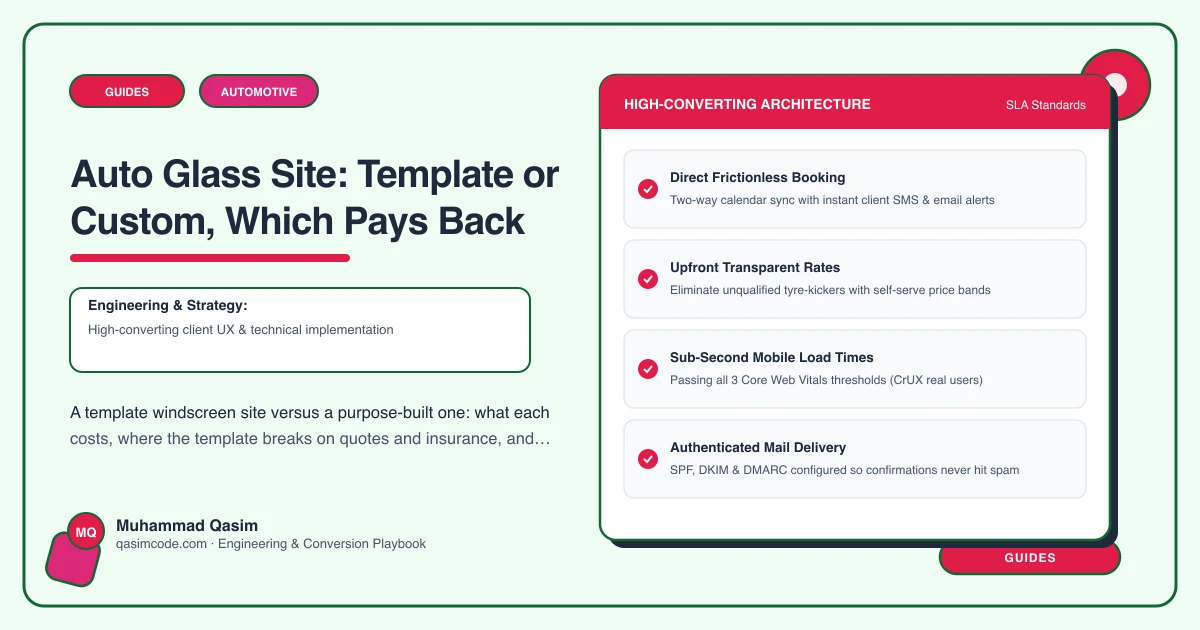
The quote form. A template form asks for name, email and message. A windscreen quote needs a registration, two photographs, and a repair-or-replace indication. Template form builders can be pushed into photo upload, but you will fight file sizes from modern phone cameras, and the photos usually land in an email inbox rather than a job record.
The insurance page. This is the most-read page on an auto glass site and the hardest to template, because it is entirely your specifics: which insurers you deal with, whether you bill direct, how the excess works, what happens to a policy's no-claims. Themes have no shape for it, so it ends up as a wall of text nobody reads.
ADAS recalibration. A page that explains it plainly, says whether you do it in-house or subcontract, and states whether it is in the price. On a template it becomes a paragraph on the services page, which is where trust goes to die.
Mobile versus in-shop. The same visitor needs a different next step depending on where they are. That is routing logic, and templates do not route.
What custom actually means here
Not artwork. Structure.
- A quote form that resizes photographs in the browser, captures the registration, and posts into Jobber, ServiceM8 or Housecall Pro as a request.
- Prices held as editable records, so a chip repair price change is one edit, not four.
- An insurance page built as a question-and-answer structure a worried driver can skim.
- An ADAS page that can be found on its own from a search, because people do search for it.
- Coverage areas as real pages, so a search for a windscreen fitter in a town you serve has something to land on.
The payback arithmetic
A template site at $800 that turns two direct jobs a month into enquiries is doing fine work. A purpose-built site at $4,000 has to produce roughly one extra windscreen replacement a month to pay for itself inside a year, on typical retail margins. Most shops that switch see more than that within a quarter, because the photo form converts visitors who would never have made a phone call.
The other half of the payback is not revenue. It is the hour a day you get back when the insurance page answers the question instead of you.
When the template is the right call
- Turnover under roughly $80,000 and mostly referral.
- No intention to chase retail work.
- You are testing whether a location or a service line works before committing.
- Cash is tight enough that $4,000 is a real risk. A template now beats a custom build you cannot afford to maintain.
When to build properly
- You are paying for advertising. Sending paid clicks to a template contact form wastes most of them.
- Insurance work is a large share of your book and the phone is the bottleneck.
- You cover several towns and want to be found in each.
- You do ADAS recalibration in-house. It is a genuine differentiator and a template will not say so convincingly.
Where this sits
Our auto glass websites are the purpose-built version at a fixed price, with the photo-and-registration quote form, the insurance page and the ADAS page included. The wider comparison across the trade is on the automotive page. If a template is genuinely right for where you are now, start there and move when the phone becomes the constraint.