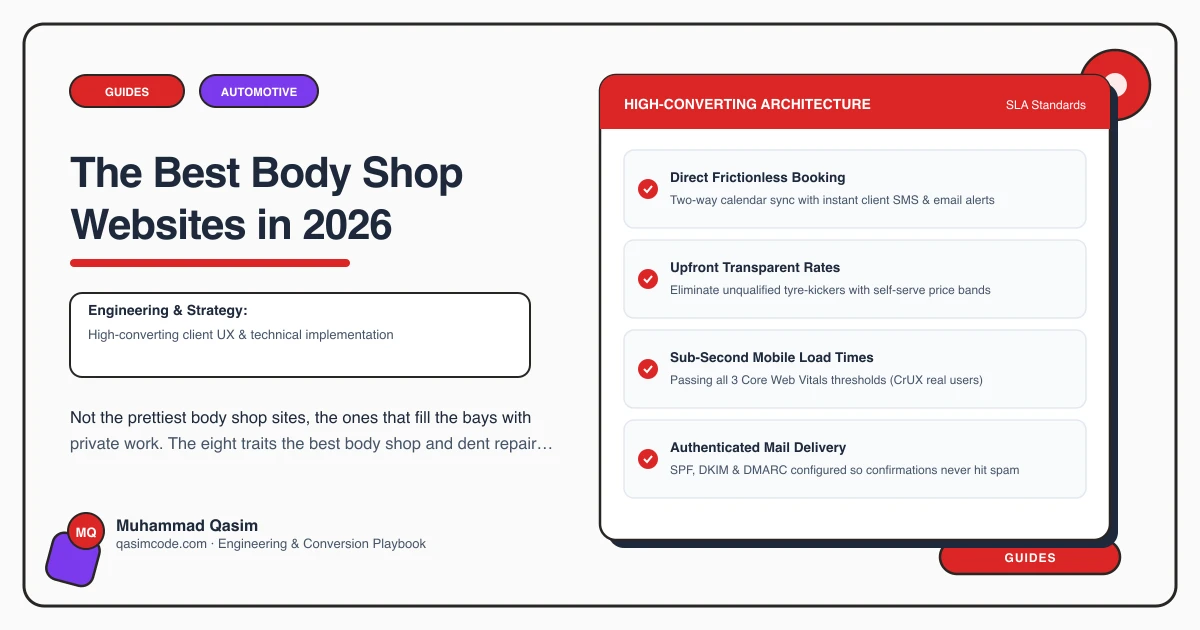
Best means booked with private work
The best body shop websites are not the most designed. They are the ones that turn a driver with a creased door into four photographs and an estimate request, without a phone call. Here is what they share.
1. An estimate form that starts with the camera
Photographs first, with example images showing the angles wanted: straight on, at forty-five degrees, close enough to see the crease, wide enough to see the panel. Something for scale. Then the registration for the paint code, and a phone number. The good ones resize the images in the browser so a phone photograph does not stall on mobile data.
2. Before-and-after pairs, grouped by damage
Not a grid of whole cars in a car park. Pairs, filterable by damage type — bumper, panel, dent, alloy, full respray — each with at least one close-up under light showing the paint match and the panel edge.
Ten jobs shown this way outperform a hundred thumbnails. And on the best sites the gallery is added to weekly from a phone, because it was built as records rather than as a page.
3. The claim-or-pay question answered honestly
An insurance-or-private page with real arithmetic: what an excess means, when paying directly costs less, and a plain statement that they may not want to claim at all. The shops that say this out loud are the ones people trust with the estimate.
4. Smart repair and PDR as their own pages, with prices
A car park dent and a rear-end respray are different customers. The best sites give each small service its own page with a stated price or a tight range, because those searches carry the clearest intent and almost nobody competes properly for them.
5. Paint matching and the guarantee, explained
The customer's real fear is that the repair will be visible forever. So the best sites have a page on how paint is matched to the code and then blended, what materials are used, how long the guarantee runs and what it covers. Plain language, no chemistry lecture.
6. Courtesy cars stated, not implied
Whether there is one, what the conditions are, what the age and licence requirements are. Or, honestly, that there is not one but there is a collection service. Either answer beats silence, because for a working driver this is often the deciding factor.
7. Under two seconds on a phone, despite the photographs
This is the hard one on a gallery-heavy site, and the best ones manage it: correctly sized images in modern formats, everything below the fold lazy-loaded, no chat widget, no slider, and no booking script on pages that do not need it.
8. Reviews and approvals next to the buttons
Live Google reviews rather than typed quotes. Any manufacturer or insurer approval you genuinely hold, stated accurately. Trade bodies and technician qualifications. Placed beside the estimate form, where the hesitation happens.
What the best ones do not share
They do not share a look. Some are dark and technical, some are bright and simple. What none of them have is stock photography: the bays, the booth and the technicians are the real ones, and a visitor can tell in three seconds.
They also do not have long home pages. The visitor has a specific piece of damage and a specific worry, and the good sites get out of the way.
Test your own, on your phone
Photograph a mark on your own car and try to submit an estimate request. Then try to find out whether to claim, whether a bumper scuff has a price, and whether you can borrow a car. Time all four. If any of it takes more than a minute, you have your list.
Where this sits
Our body shop websites are built to those eight traits at a fixed price. The comparison across the wider trade is on the automotive page. None of it is expensive. It is just rarely done, which is why the shops that do it get the private work.