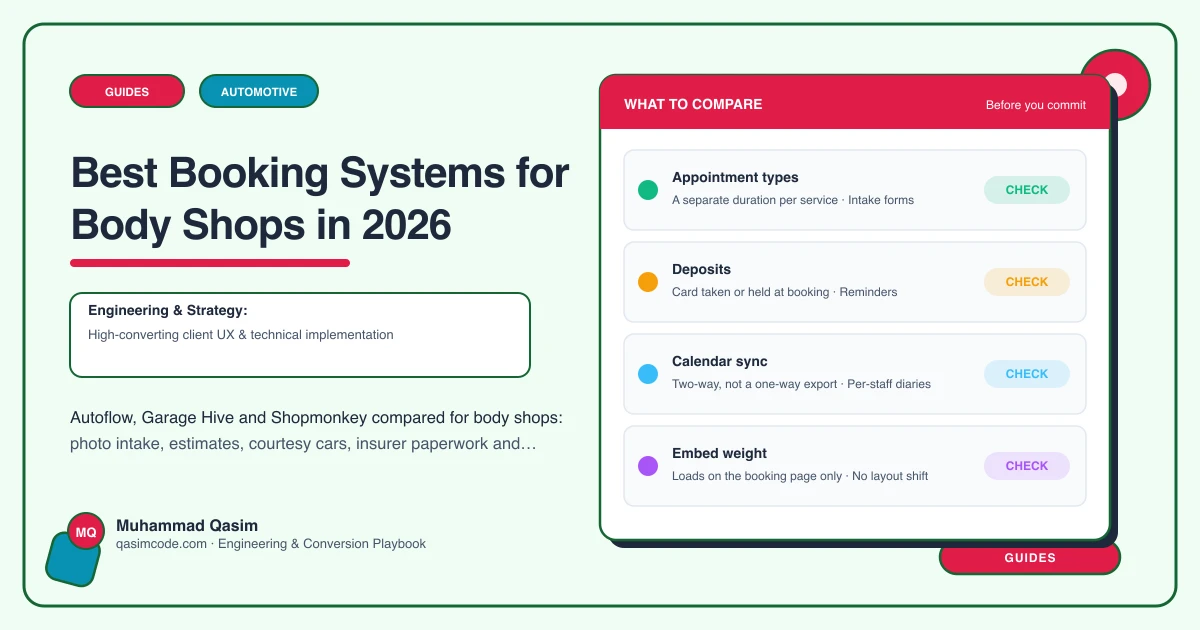
What body work needs from a system
A body shop booking is not an appointment. It is a job with a car in it for three days, an estimate that had to be approved by somebody who is not the driver, parts on order, a courtesy car allocated, and a paint booth to schedule around.
So the useful test is not "does it take bookings". It is: can it hold an estimate with photographs, manage a multi-day job through stages, and produce the paperwork an insurer will accept.
Autoflow
Built for workshops, and strongest at the customer communication side. Digital vehicle inspections with photographs and video sent to the customer by text, approval captured on their phone.
Strong at: the estimate approval loop, which is the bottleneck in body work. The customer sees the damage as you see it, approves the additional panel on their phone, and the record shows they did. Text-first communication. Works well alongside an existing estimating package.
Weak at: it is not a full shop management system for parts and paint stock. Online self-booking is limited, which is realistic here but means the website has to do the intake.
Choose it if: your problem is estimate approvals and customer updates rather than scheduling.
Garage Hive
A full workshop management system built on Microsoft Dynamics, popular with UK and Irish shops.
Strong at: the whole job. Estimates, parts, technician time, invoicing, courtesy car fleet management, and reporting that tells you which work is actually profitable. Handles a job that runs across a week without pretending it is an appointment.
Weak at: it is a serious system with a serious setup. Expect implementation effort, and it is more than a two-bay shop needs.
Choose it if: you are a proper bodyshop with a paint booth, a courtesy fleet, and enough throughput that job-level profitability matters.
Shopmonkey
Cloud shop management with a modern interface, strong in North America.
Strong at: estimates that look good on a phone, digital approval, integrated payments, and a clean workflow board for jobs in progress. Good customer messaging. Easier to adopt than Garage Hive.
Weak at: more general-repair oriented than body-specific, so paint and panel specifics need configuring rather than coming out of the box.
Choose it if: you want a modern all-in-one and you are mixing body work with general repair.
Others worth knowing
Tekmetric is a strong North American alternative to Shopmonkey with similar shape. Workshop Software suits Australian and New Zealand shops. And for pure body shops, the estimating platforms your insurers already require will dictate part of the stack whether you like it or not — pick the management system that lives alongside them rather than fighting them.
A plain scheduler such as Calendly is the wrong tool here. It cannot hold an estimate, a photograph or a three-day job.
What your website needs from any of them
- A photo estimate form on your own site, feeding the tool as a lead rather than relying on the tool's booking widget.
- A clear split between what is bookable — an inspection slot, a smart repair — and what is quoted first.
- Text-based communication, because body shop customers wait days and want updates.
- Nothing loading from the tool until the customer taps the button.
- Courtesy car availability stated on the site, not discovered on the phone.
Choosing
If your bottleneck is approvals and updates, Autoflow. If you are running a full shop with a courtesy fleet and want job profitability, Garage Hive. If you want a modern all-in-one and you are in North America, Shopmonkey or Tekmetric. If body work is one line in a general garage, whatever the garage already runs.
Where this sits
Our body shop websites work with whichever of these you run, with the photo estimate form feeding it, at a fixed price. The wider trade version is on the automotive page. Choose for the three-day job, not for the appointment.