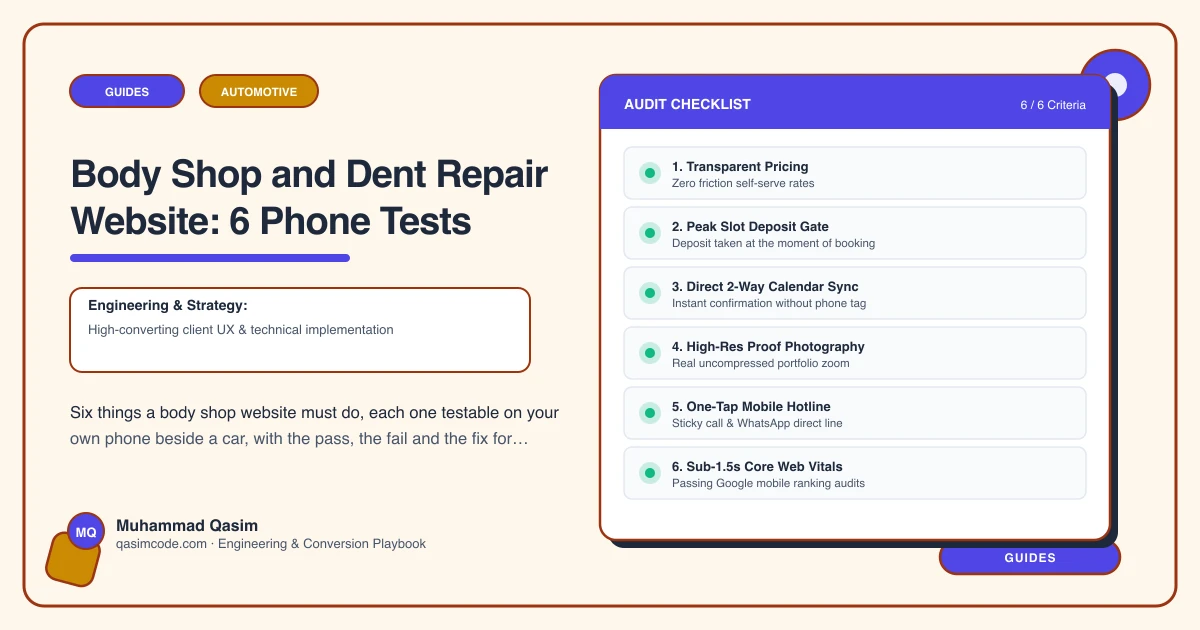
Do these standing next to a car
Six things a body shop site has to do, each written as something you can carry out yourself in a couple of minutes. Stand in the yard beside a damaged car with your own phone, on mobile data rather than the workshop wifi. Note which ones fail: which ones matters far more than how many.
1. Send damage photographs from the yard
The test: find the estimate route from your home page, photograph a mark on the nearest car from two angles, put a coin in one frame for scale, type the registration and send it.
Pass: it goes first time, in about two minutes, and what arrives at your end is legible with the registration attached.
Fail: one attachment slot, a general message box, no registration field, or an upload that stalls and resets silently.
The fix: a labelled slot per angle with an example frame beside each, a prompt for something to give scale, the registration captured so the paint code can be looked up, and the images shrunk in the browser before sending.
2. Work out whether to claim, knowing nothing
The test: read the site as a driver who could not tell you their excess and has never claimed. Try to decide without ringing anybody.
Pass: a page named for the question that explains what an excess is, walks through comparing it against a repair figure, and says plainly whether you are an approved repairer for any insurer.
Fail: a strip of insurer logos, or "we work with all major insurers" and nothing beneath it.
The fix: write the page and link it twice — beside the estimate button, and next to the claiming question inside the form. Plenty of drivers are about to make a claim that costs them more than paying you would.
3. Prove the colour matched on the difficult one
The test: pick the hardest colour you have sprayed recently — a pearl, a solid red, a pale metallic — and find that job in your own gallery.
Pass: a before and an after from the same angle, plus one close frame with light running across the panel, where a mismatch or a blend edge would show.
Fail: whole cars photographed in bright sun, afters with no befores, or nothing added since last year.
The fix: a fixed shooting standard for every finished job, and a gallery you can add to from the phone in your pocket. Ten jobs shot that way settle the question; two hundred snapshots do not.
4. Ask whether it will still match in two years
The test: look for the answer to what owners actually worry about — not the price, but whether the repair stays invisible.
Pass: a page explaining the paint code and why the code alone is not the finish, how you check a mix against the panel, and why paint is blended into the next panel. Then the guarantee: how long, what it covers, what it excludes, whether it passes to the next owner.
Fail: "fully guaranteed" in the footer, or a number of years with nothing after it.
The fix: one page in plain words, and one line quoting the guarantee in every estimate you send.
5. Price the smallest job you do
The test: use your site's own search, or Google with site: and your domain, for the words a driver uses: car park dent, bumper scuff, kerbed wheel.
Pass: smart repair and paintless dent repair each have a page, titled the way drivers describe the damage, with a price or a tight range on it.
Fail: both buried as bullets on one services page, or a form where the price should be.
The fix: a page each, a number on each. These are the clearest-intent searches in the trade, and the driver making them assumes a body shop will treat the job as a nuisance.
6. Check you can keep working, and that others trusted you
The test: the two things a driver checks last before phoning. Can I keep driving while you have it, and what do other people say.
Pass: the courtesy car position with its conditions, or an honest no with what you do instead — collection, a lift, a hire arrangement. Beside it, reviews pulled live from Google rather than typed out.
Fail: "courtesy cars subject to availability" as the whole answer, or three testimonials with first names and no source.
The fix: a short courtesy car section on the process page, one line about it in the estimate reply, and Google reviews wired in so the count keeps moving.
Reading your score
Tests 1 and 2 decide whether an enquiry starts at all, so repair those first even if the rest passed. Tests 3 and 4 decide whether the estimate you send gets accepted; shops losing work at that stage usually fail one of them. Test 5 wins searches you are not competing for yet. Test 6 is the work you never hear about, because the driver assumed the answer was no.
Where this sits
Our body shop websites are built to pass all six at a fixed price. For the same ground ordered by what each failure costs, read why a body shop site gets no enquiries. To build test 1 properly, follow the photo estimate form setup, and for the build itself see what a body shop website costs.