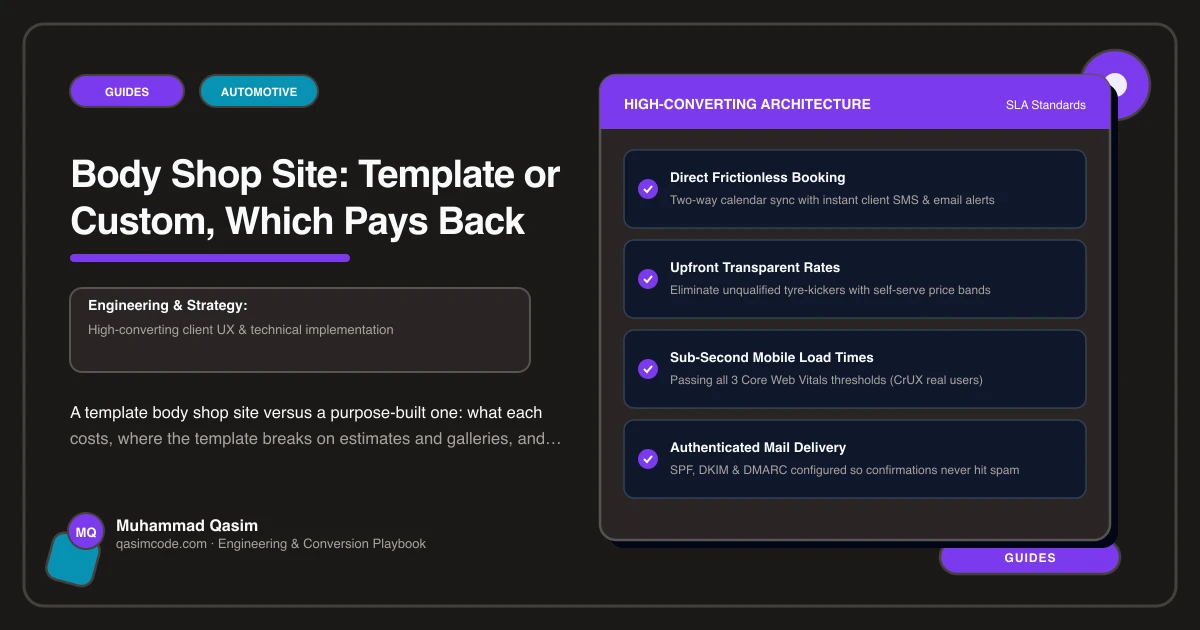
The honest comparison
A template site for a body shop costs a few hundred and a weekend. A purpose-built one costs a few thousand and a fortnight. The question is which one gets a driver with a creased door to send you four photographs instead of driving to the shop on the main road with the big sign.
What a template does well
A Squarespace or WordPress theme gives you a fast, responsive site with your logo, your address, your reviews and a contact form. It will rank for your business name and it will beat the Facebook page it replaces.
If you are two months into trading and living on dealer referrals, that is a reasonable place to start. Put the difference into the paint booth.
Where the template breaks
Four places, and all four are where the retail money is.
The estimate form. A template form takes a name, an email and a message. A body estimate needs four photographs from specified angles, something for scale, and the registration for the paint code. Template builders can be pushed into file upload, but you will fight phone-camera file sizes, and the photographs land in an inbox rather than on a job record.
The gallery. This is the one that really hurts. A body shop gallery is not decoration, it is the product, and it needs to be before-and-after pairs, grouped by damage type, with close-ups where the customer can see that the paint matches and the panel edge is right. Template galleries are one long grid of thumbnails, uncompressed, slow, and unfilterable. Adding twenty jobs a month to one is a chore, so nobody does, and the gallery goes stale.
The insurance-or-private page. Entirely your specifics: how excess works, when a private repair beats a claim, whether you are an approved repairer for anybody. Themes have no shape for it, so it becomes a wall of text.
Service separation. A car park dent and a rear-end respray are different customers with different budgets. They need separate pages with separate prices. Templates push everything onto one services page.
What custom actually means here
Not artwork. Structure.
- An estimate form that resizes photographs in the browser, guides the angles with example images, captures the registration, and posts into Autoflow, Garage Hive or Shopmonkey.
- A gallery modelled as records: damage type, panel, before image, after image, close-up, one line of description. Then it filters, it loads fast, and you can add a job from your phone in two minutes.
- Smart repair and PDR as their own pages with stated prices.
- A guarantee and paint-matching page written once, properly.
The payback arithmetic
A purpose-built site at $5,000 needs roughly one extra private job a month to pay for itself inside a year, on typical body shop margins. Private work is also the work you want: no insurer rates, no third-party approval, payment on collection.
The second half of the payback is the gallery being current. A shop that adds four jobs a week to a gallery it can update from a phone has a compounding asset. A shop with a template gallery has a museum.
When the template is the right call
- Almost all your work comes from insurers and dealers, and you are not chasing retail.
- You are testing whether smart repair or PDR is worth a service line.
- Cash is tight enough that $5,000 is a genuine risk.
When to build properly
- You are paying for advertising. Paid clicks into a template contact form waste most of themselves.
- You want private work rather than insurer rates.
- You do smart repair or PDR, which are high-intent searches and need their own pages with prices.
- You already photograph every job and have nowhere good to put the pictures.
Where this sits
Our body shop websites are the purpose-built version at a fixed price, with the photo estimate form, the records-based gallery and the insurance page included. The wider comparison across the trade is on the automotive page. If the template is right for where you are now, start there and move when the gallery becomes the constraint.