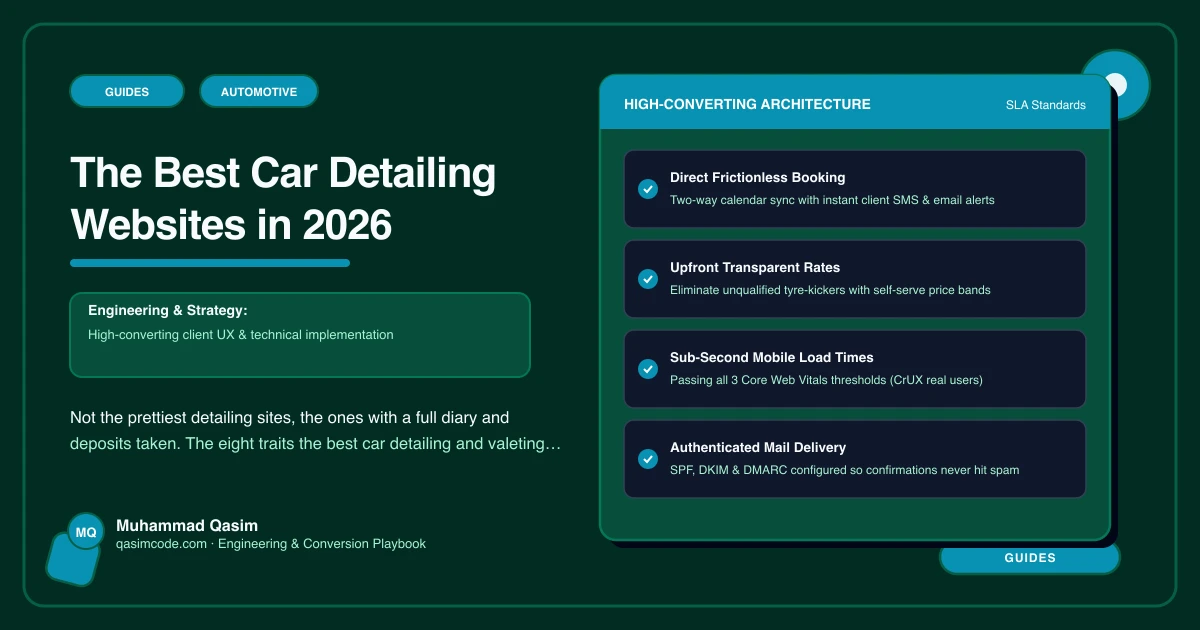
Best means booked, with a deposit taken
The best detailing websites are not the most designed. They are the ones where somebody with a filthy seven-seater can find their price, see what the result looks like, and pay a deposit at eleven at night without messaging anybody. Here is what they share.
1. A price grid, not a "from" price
Package levels down one axis, vehicle sizes across the other, real numbers in every cell. Small, medium, large, van, with example models beside each so a visitor can place their own car in two seconds.
Then one honest line about what changes it: heavy soiling, pet hair, and what happens if the car is worse than described. The best sites price the exception rather than hiding it.
2. Before-and-after pairs, not glamour shots
A photograph of a clean car sells nothing. The pairing sells everything.
Same angle before and after, grouped by service, with at least one close-up per job: the swirls gone under light, the seat that was written off, the wheel arch nobody expected to come clean. Ten jobs shot to that standard beat a hundred sunset shots of finished paint.
3. Under two seconds on a phone, despite the photographs
The hard one, and the best sites manage it. Correctly sized images in modern formats, real thumbnails, lazy-loading below the fold, no slider, no chat widget, and no booking script until the button is tapped.
A slow gallery is worse than no gallery, because the visitor leaves before the proof loads.
4. A deposit taken at booking
Twenty or twenty-five per cent, with the cancellation terms in plain words beside the button. It is the single change that makes a weekend diary hold, and the best sites treat it as normal rather than apologising for it.
5. Add-ons offered at booking
Engine bay, pet hair removal, headlight restoration, seat extraction, ceramic top-up. Priced, listed on the package page, and selectable in the booking flow. Offered on the drive they get declined; offered in advance they get taken.
6. Mobile and drop-off answered separately
Mobile pages that state the coverage area and the real conditions: somewhere to work, access to power and water or not, weather, and any minimum spend at distance. Unit pages that state the address, the parking and how long the car will be there.
The good sites do not make one page serve both.
7. Coating and correction pages with honest durability
Real durability by product, the maintenance required to achieve it, and what the warranty actually covers. Not "lifetime protection".
Customers spending four figures on a coating read carefully and compare claims. The honest page wins them, and it is also the page that avoids an argument in year two.
8. A page per area that is genuinely a page
Four to eight real area pages with local detail and the travel conditions, rather than forty generated pages with a town name swapped. Google stopped rewarding the second kind, and customers never did.
What the best ones do not share
They do not share a look. Some are dark and product-led, some are bright and simple. What none of them use is stock photography: it is their own work, their own van, their own unit, and a visitor can tell instantly.
They are also short. The visitor wants a price and a picture, and the best sites give both above the fold.
Test your own, on your phone
Price a large estate on a full valet. Find a before-and-after of an interior as bad as yours. Book a Saturday slot and see whether a deposit is taken. Time all three. Anything over a minute is on your list.
Where this sits
Our car detailing websites are built to those eight traits at a fixed price. The comparison across the wider trade is on the automotive page. None of it is expensive. It is just rarely done, which is why the detailers who do it stop answering price DMs.