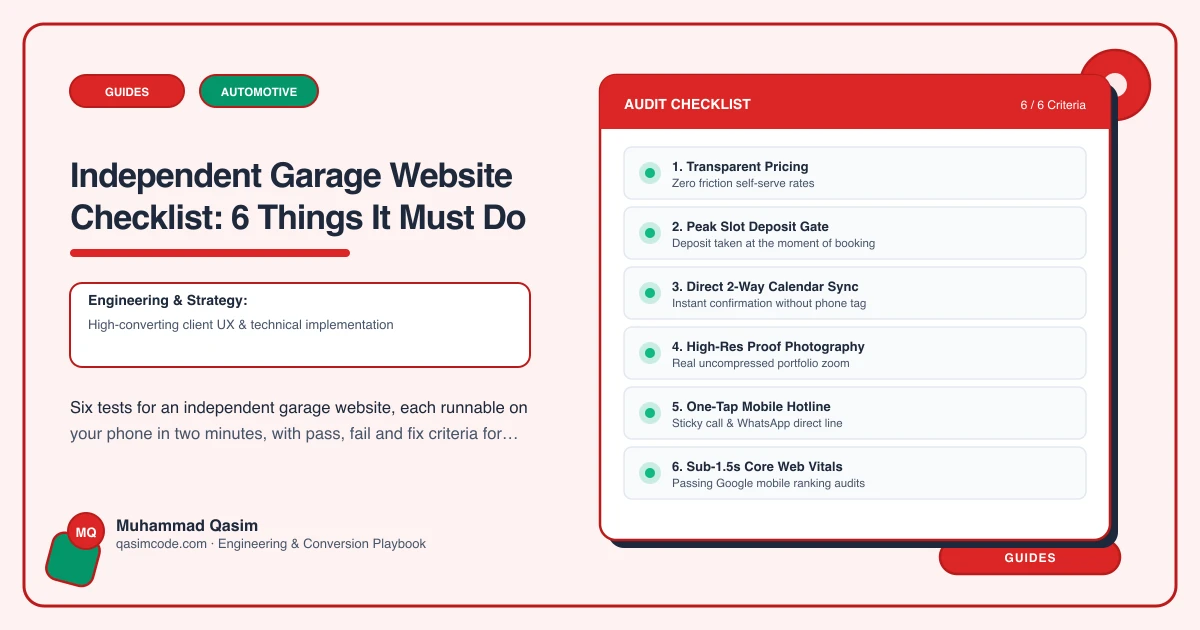
Six tests, ten minutes
A driver picking an independent garage over a dealer is weighing a saving against a fear of being overcharged. The site either settles that or it does not. Run these on a phone, on mobile data.
1. Book from a registration
The test: book an interim service for Tuesday.
Pass: the plate is looked up, the service type is chosen from a short list, and a real slot is confirmed.
Fail: a contact form, or a booking that asks for make, model, engine size, fuel and mileage by hand.
The fix: registration lookup from the software you already run — Autoflow, Garage Hive, Shopmonkey, Tekmetric and Workshop Software all support it. Phone bookings arrive when the ramps are busy; online bookings arrive whenever.
2. See a price before phoning
The test: find the cost of an interim service, an oil change, and brake pads.
Pass: fixed prices for common jobs, split by engine size where that matters, and editable by you.
Fail: no prices. The driver assumes the worst and books the fast-fit chain that published a number.
The fix: publish fixed prices for the jobs you can price. You do not have to price everything — pricing the common half removes the fear about the rest.
3. Explain how you quote and authorise
The test: look for what happens when you find something extra mid-job.
Pass: a plain page saying you photograph or explain the fault, quote it, and do not proceed until authorised.
Fail: nothing. This is the exact fear that keeps drivers at franchised dealers, and it costs one page to answer.
The fix: write it in short paragraphs, name your authorisation step, and link it beside the booking button.
4. Look like a real workshop
The test: as a stranger, decide whether this is a business or a shed.
Pass: real photographs of your bays and your team, compressed to load fast, plus accreditations displayed and linked, plus Google reviews pulled in live.
Fail: stock photography of a smiling technician holding a clipboard.
The fix: an hour with a phone camera beats any stock library. Real photographs are the cheapest trust signal available to a garage.
5. Answer the practical questions
The test: look for courtesy cars, collection and delivery, and waiting facilities.
Pass: stated on the booking page, where the decision is being made.
Fail: buried in an FAQ, or absent, so the driver books the garage that said it offered a courtesy car.
The fix: put it on the booking page. For a two-car household without a spare, this is frequently the deciding factor.
6. Appear in under two seconds
The test: on mobile data, count until the booking button is usable.
Pass: under two seconds.
Fail: a slider of workshop photos, a chat widget, or a booking script loading on every page.
The fix: one compressed image, chat off, booking deferred until tapped. Then set service and test reminders in your software so last year's customers come back without being re-bought.
Scoring
Six passes and the site is doing its job. Four or five, fix in order. Three or fewer and the issue is the booking flow and the missing prices — the two things a dealer does better and an independent can do better still.
Where this sits
Our independent garage websites are built to pass all six at a fixed price. The wider trade version is on the automotive page. Garage licensing and consumer rules differ by country, which the country pages cover.