Areas are the unit of cost
Most trades price a website by page count. This one prices by radius.
"Do you cover my area?" is the question a mobile mechanic answers all day, and the only thing that stops it is a page for each town worth being found in, plus an area check inside the booking so nobody reaches a confirmation screen from forty minutes outside your patch. Three towns is a small site. A whole county with four vans is not. That gap is where the money goes — not into design.
One van, a handful of towns
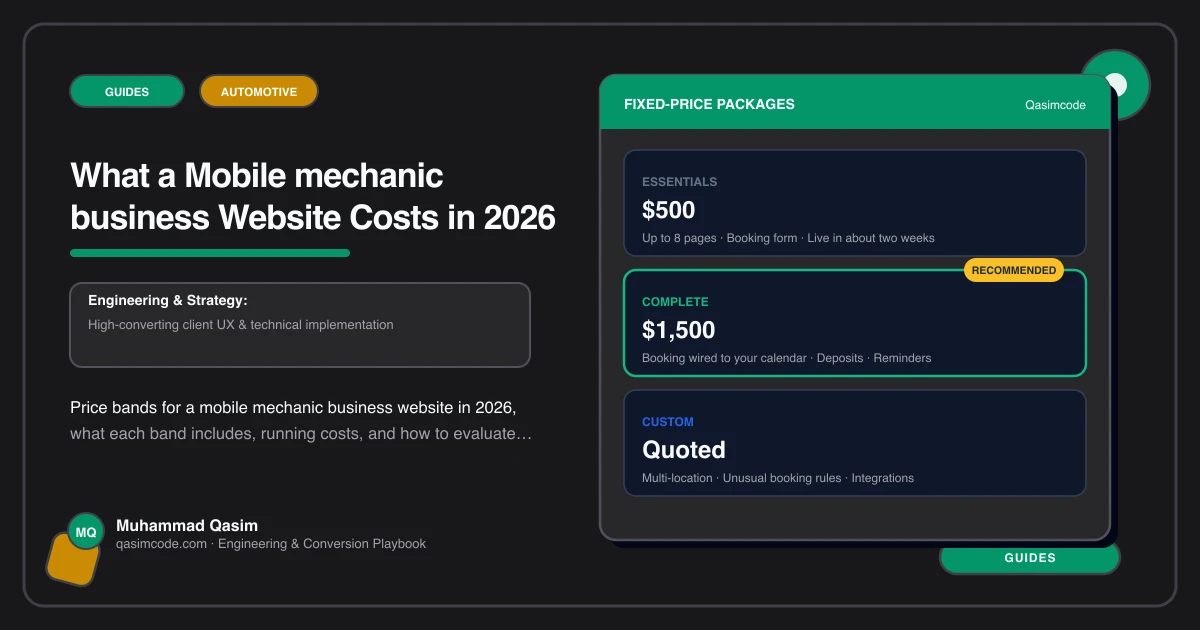
The Essentials package, $500, covers this properly. Eight pages, live in roughly a fortnight, two rounds of changes. Spent well, those eight pages are:
- A first screen naming the towns you cover
- The driveway-services list: what genuinely can be done on a drive, and what cannot
- Job prices with the call-out already inside the number
- A fault form for noises, warning lights and leaks
- Qualifications, insurance and reviews together on one page
- Contact
The services list is the one people leave out, and it is the one that pays for itself fastest. Turning up to a clutch that needs a ramp costs the slot, the fuel and the customer. Saying so on the site stops the booking being made at all.
Several vans, or a radius worth defending
Complete, $1,500, runs to twenty pages over about four weeks with four rounds of changes, and it is the version where bookings land in the diary instead of an inbox. On a mobile job the extra pages earn their place like this:
- One page per town instead of a list, because each town is its own search
- A booking flow taking registration, job, address and parking access, with the area checked before confirmation
- A price list you can edit yourself the week parts go up
- A page per common job, so brake pads on a driveway is a page rather than a bullet point
Wiring the diary
Booking setup rides along with a Complete build: the system picked around how you actually work, connected to your calendar, travel buffers set so two jobs across town cannot collide, and the confirmation emails tested to make sure they land. Bolting booking onto a site that already exists is quoted inside a day and typically takes a week.
Your job software is billed to you directly and sits outside all of this. Jobber, ServiceM8, Housecall Pro and Tradify each hold the address, the access notes and the travel time.
When there is already a site
Find out whether it is worth keeping before spending on it. A Diagnosis costs $299 and the report lands in three days — what is broken in plain English, the cost of each fix, and a straight answer on repair versus replace. Diagnosis and fix is $799, usually a fortnight.
The monthly side
- The domain, renewed yearly, registered to you
- Job software, paid straight to Jobber, ServiceM8, Housecall Pro or Tradify
- Hosting
- Optionally a care plan so price changes, backups and repairs are handled: Basic $99/mo, or Growth $249/mo which includes four hours of changes
Five things that change the number
For this trade, in rough order of impact:
- How many towns get their own page
- Whether one price menu works, or prices shift by vehicle and distance
- Whether the fault form needs photo uploads
- How many mechanics need a separate diary
- How long the honest driveway-services list actually runs
Notice what is absent: nothing about how the site looks. A quote weighted toward visual complexity is measuring something that will not bring you a single extra job.
Where this sits
We build mobile mechanic websites around that structure at a fixed price. The wider trade view is on the automotive page, and the conversion checklist is why your automotive website is not getting bookings.