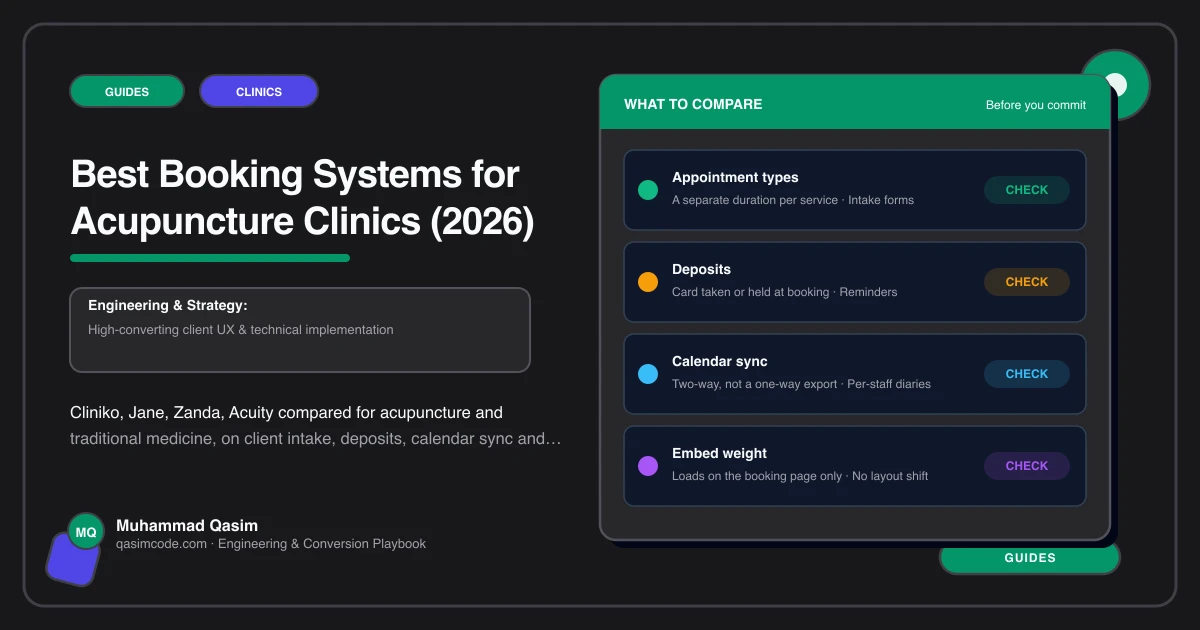
What the six already have in common
Cliniko, Jane, Zanda, Acuity, Power Diary and Fresha are the systems acupuncture clinics run. All six already cover what an acupuncture diary needs structurally: initial consultation and return visit as different appointment types, so the long first session is not the same slot as the shorter one after it; intake forms sent ahead of the visit; and reminders nobody has to remember to send.
Because that baseline is shared, capability rarely decides this. Fit at your size does, plus what reception touches daily and how the thing behaves inside a web page.
Why there is no ranking here
A league table of clinic software helps one clinic very little. What suits a sole practitioner who also dispenses herbs is not what suits a four-practitioner traditional medicine clinic running cupping and moxibustion lists, and neither cares what settles it for a physiotherapy group.
So instead: the questions that separate these six for this trade. Ask them on a trial, with your own appointment types loaded.
Can the first consultation be its own length and price?
Load a real week: initial consultation at whatever you genuinely need, return visit shorter, then book both as a patient. Watch for two failures — a system that quietly pads every slot to the longest, and one that lets a new patient book the short return type by accident.
When does the intake form actually go out?
An intake form is only useful if it is read before the patient is on the couch. Check the trigger — on booking, or a set number of hours before. Check it can be finished on a phone without an account, since plenty of first-timers book at night on a small screen. Then check whether you write your own questions or inherit a template drafted for another profession.
Can a course of treatment exist as one thing?
Acupuncture is rarely a single appointment, and this is where the six diverge most. Ask whether the system holds a block of visits, a recall, or a series a patient can rebook from — and if you sell packages, whether it tracks what has been used without a spreadsheet running alongside.
Can a patient pick the person and the service?
Where more than one practitioner works, patients want a name, not a slot. Check that availability narrows to one practitioner, that each carries their own types and durations, and that a direct link opens on that person — a profile page needs exactly that link. Same for services: if a herbal consultation, cupping or moxibustion is separately bookable, each wants its own type and link.
Can it take a deposit, and what does that cost?
Do not assume the six behave alike here. Ask whether a deposit can be required on the initial consultation only, whether the card is charged or merely held, and what the processor takes on top. Get it from the pricing page of the system you are trialling, not a comparison article: those numbers change and articles do not.
Where do the records live, and can you get them out?
Two answers worth having before a migration, not after. Ask which country patient data is stored in, because those rules differ by market; the country rules for acupuncture sites cover what applies where you practise. Then ask what an export contains: patients, notes, documents, appointment history. A clinic that cannot leave its software ends up shaping its website around that software's limits.
What it does to the page it sits on
Booking widgets are guests on a page you paid to make fast. Some arrive as a heavy script that pushes content down while it lands; some are awkward under one thumb. Put each candidate on a real handset, on cellular data, and watch the page settle. If the button moves as somebody reaches for it, a nervous first-timer is already back in the search results. Keep it on the page where appointments are taken, not on all twenty.
Where this sits
Every acupuncture clinic website we build embeds whichever of the six you already run, wired to your calendar, at a fixed price. To audit what you have now, run the six phone tests, or read why your acupuncture website gets no bookings.