The range, and what actually changes the number
A teaching business website costs from nothing to several thousand. The price is driven by three things: how many subjects or instruments you teach, whether trials convert into recurring enrolments through a booking tool, and how much reassurance parents need before they hand over a child. A solo tutor with one subject and a Calendly link is a different build from a language school with levels, placement testing and term enrolment.
Here are the bands, what each buys, and how to judge a quote.
The free option, and what it costs you
You get: discovery, a booking flow, and a payment rail.
You do not get: your own name in search results, control of your fees, a page per subject that ranks, teacher profiles laid out the way you want, or a relationship the platform cannot end.
Right for: a tutor starting out who wants students before they want a website.
A template site
A theme with your logo, an about page and a contact form.
You get: a presence with your name on it and somewhere to send people.
Usually missing: a page per subject or instrument, teacher profiles with qualifications and vetting, fees stated per lesson and per term, trial booking wired to a real tool, a timetable, and an online lessons page. Speed on a phone is usually poor, and parents browse in the evening on a phone.
Right for: a teacher whose diary fills by word of mouth and school noticeboards.
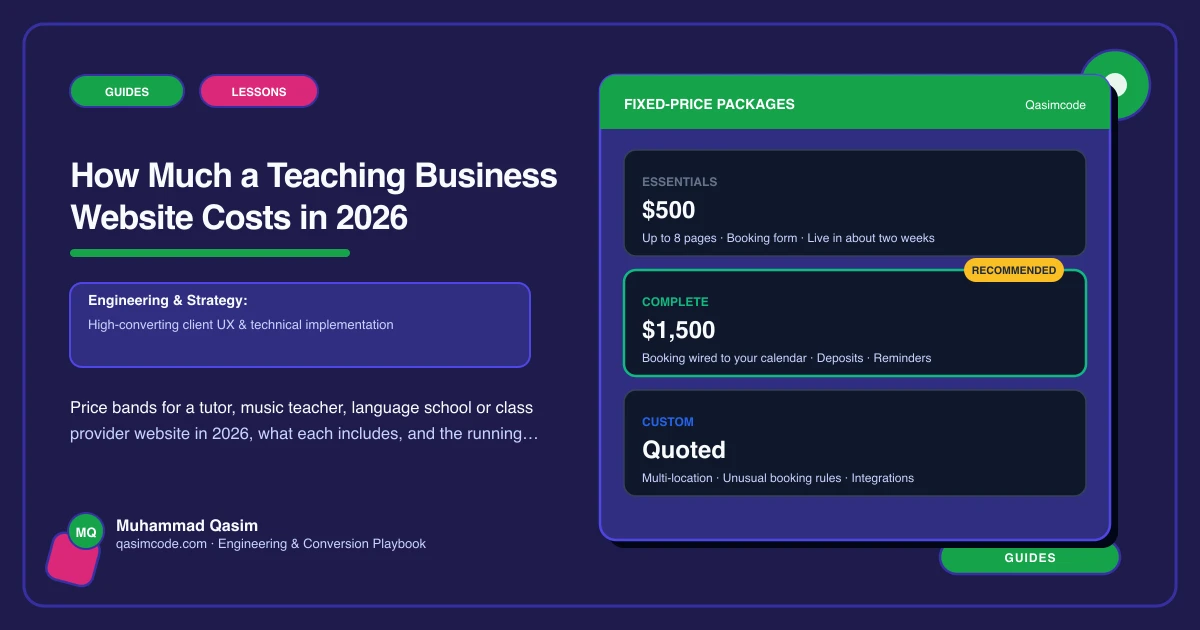
What we build: Essentials at $500, Complete at $1,500
Built around how a family or an adult learner actually chooses. Home, subjects or instruments, our teachers, fees, book a trial, timetable, online lessons, exams and progression, contact. That is nine pages and it maps to the nine decisions a prospective student makes.
You get: a page per subject that ranks for the specific search, profiles carrying qualifications and vetting, fees per lesson and per term so enquiries arrive informed, a trial booked online that your tool converts into a recurring slot, a timetable pulled from your platform, and tracking that tells you which subject page produced the trial.
Not usually included: photography, ongoing ads, or the booking tool subscription itself.
Right for: almost every tutor, music teacher, language school, test prep provider, coding club, art studio or cookery school that wants to grow past referral.
When it goes past that: Custom, quoted after a call — schools and centres
Several teachers, several sites, a full timetable, placement testing, exam entries, and integration with a school management platform. Language schools taking exam and visa students, grading centres publishing session calendars and taking entries, and multi-branch tutoring centres sit here.
After launch
- Hosting: managed hosting in the tens per month, in your name.
- Domain: small, annual, yours.
- Booking or school management software: Acuity, TutorBird, My Music Staff, TeamUp, ClassForKids or Arlo, priced per teacher or per active student. Whatever you pay now, the website does not add to it.
- Maintenance: a care plan monthly, or hourly when something breaks.
Where the money goes
- A page per subject or instrument, each a separate search. "Grade 5 piano lessons" and "GCSE maths tutor" are not the same reader.
- Teacher profiles with qualifications, vetting and teaching approach, written plainly.
- Fees stated per lesson, per term and per course, so you stop fielding the fee email.
- Trial booking, deep-linked from every subject page, converting to a recurring weekly slot with payment collected each term or month.
- A timetable for group providers, published from the platform rather than retyped.
- An online lessons page covering the platform, the requirements and how a session runs.
- Speed, because the browsing happens on a phone in the evening.
- Tracking, so you know which subject page and which teacher profile produced the trial.
Judging a quote
Ask six questions. Is there a page per subject or instrument, or one Services page? Where do fees appear? Which booking tool are you wiring in, and does the trial convert to a recurring slot inside it? How do qualifications and vetting appear on a profile? Is the timetable pulled from the platform or typed by hand? What gets tracked?
A quote that answers "a Services page and a contact form" is band 2 however it is presented. That is fine if band 2 is what you need, but it will not fill a term.
The comparison that matters
The useful sum is not the website price against another website price. It is the website price against the value of a student. A weekly lesson held for three terms is worth a meaningful multiple of most that standard builds. Two or three extra enrolments that would otherwise have gone to the school with clearer fees usually cover it.
Where this sits
Our builds are built to that standard at a fixed price, and the scope is set out on the education and lessons page. The parts that cost money are the parts that fill the timetable: subject pages, teacher profiles, stated fees and a trial that books itself.