The short answer
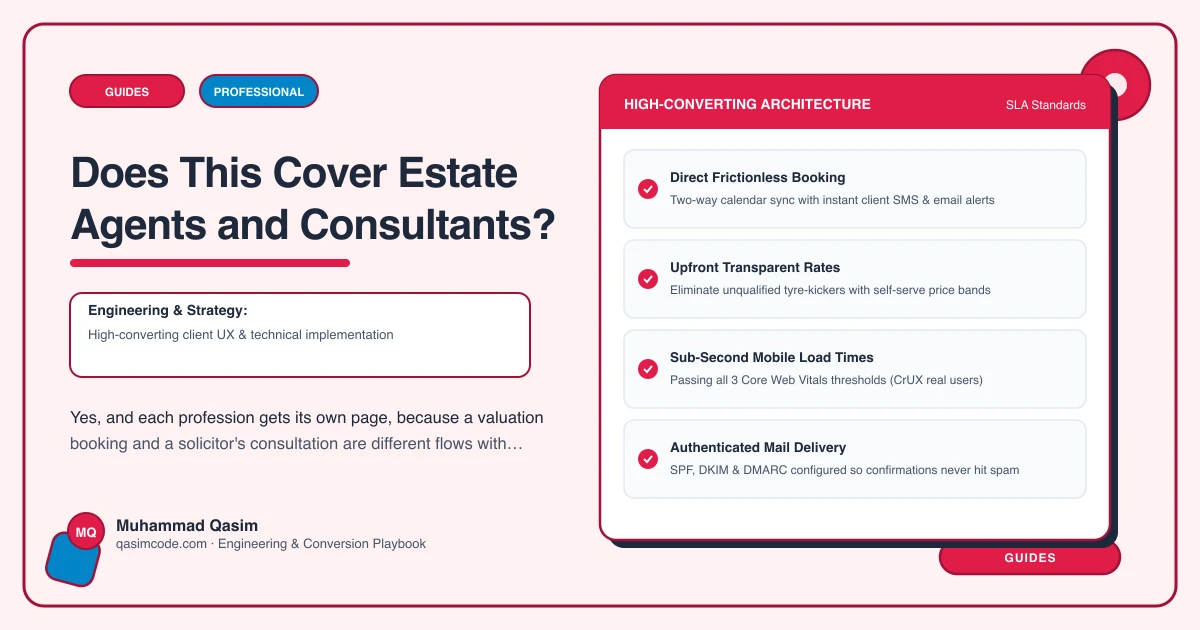
Yes. Estate agents, letting agents and consultants sit inside professional services along with accountants, law firms, brokers, advisers, notaries and translators. Each has its own sub page, because the underlying flow is genuinely different. An estate agent books a valuation. A solicitor books a consultation with a conflict check behind it. A consultant books a discovery call and has to prove a track record first. Those are three different sites wearing the same coat.
What all of them share
Every practice in this group is selling something the client cannot evaluate directly. They cannot judge your drafting, your modelling or your negotiation, so they judge the way you explain it, whether the fees are clear, whether your credentials check out and how easy it is to start. That produces the same six requirements across the group:
- Service pages in plain words, each one a search result.
- Fees stated, or the quoting process explained.
- Registration, credentials and disclosures where they are required, kept current.
- Team profiles with credentials and a booking button each.
- Consultation booking with intake, through your tool.
- Client portal or document links where you use one.
The nine page shape is the same too: home, services, fees, team, book a consultation, client portal, regulatory information, insights and contact.
Where the professions diverge
Estate and letting agents. The mechanism is a valuation booking, not a consultation. Listings need to arrive from the agency system rather than being retyped, and the site serves four audiences at once: sellers, landlords, buyers and tenants. Give each its own route from the home page instead of one page that tries to speak to all four. Fees, landlord service levels, area guides, memberships and reviews carry the trust.
Business consultants. No regulator, and that changes everything. Nothing external validates you, so the proof has to be built: problem pages that name exactly who you help, case studies with real substance, engagement models with prices or bands, consultant profiles and published thinking. Vague positioning is the failure mode, and a discovery call that goes nowhere is the symptom.
Small law firms. Practice area pages in plain English, fee transparency where the regulator expects it, regulatory disclosures, solicitor profiles with admission details, and consultation booking that connects to intake and conflict checking rather than dropping a calendar entry.
Accountants and bookkeepers. Monthly packages, a switching page that answers whether changing accountant is painful, deadlines, software and portal links, and professional body membership.
Mortgage brokers and financial advisers. Situation pages rather than product pages, how you are paid stated openly, regulatory status displayed correctly, and a short form rather than a long one.
Insurance brokers. A page per product line, a proper quote request for each rather than one generic form, a claims route that reaches the right place, and renewals.
Notaries and translators. Short, transactional, and dominated by two questions: what does it cost and what do I need to bring or send. Fees by document type, what to bring lists, and for translation a quote form that takes the document itself.
Immigration consultants. Registration displayed prominently, because clients cannot otherwise tell a regulated adviser from an unregulated one, pathway pages in plain language, and multilingual routes.
Tax preparers, architects and executive coaches each have their own page for the same reason: a season, a portfolio and a chemistry session are different mechanisms.
Which page should you read
Read your own profession's page for the specifics and the professional services overview for the shape. If your profession is not listed, the question to ask is which of the mechanisms above matches yours. Do clients book a defined first meeting, request a quote against a document, or ask for a valuation of an asset? That answers most of the build.
What this means in practice
The content model, the booking wiring, the speed work, the tracking and the compliance structure are shared. The differences show up in three places: what a service record is called and what fields it carries, which mechanism the buttons trigger, and what the regulatory layer requires. That is why a practice on the overview page and a practice on a sub page get the same underlying build at the same fixed price, with a different set of records on top.
Where this sits
The professional services page is the shape, and each profession's sub page is the detail. Estate agents and consultants are both fully covered; they simply need different things at the point where a visitor decides to start, and the sub pages exist so that neither gets a site designed around somebody else's flow.