One instruction pays for the site
A professional practice does not need many clients from its website. One conveyancing matter, one company's year-end, one mortgage case, one retainer, and the build has paid for itself. That changes the template-or-custom question. It is not "how cheaply can we look presentable" but "which version will actually convert the person who is already comparing three firms".
The template
A professional theme on Squarespace, Wix or WordPress with your logo, an About page, a Services page listing what you do, and a contact form.
Cost: hundreds to low thousands.
Good at: existing; looking credible enough that a referred client does not worry.
Weak at: everything a client who has not been referred needs. One Services page instead of a page per service, so nothing ranks for the specific search. No fees and no explanation of how you quote, so the enquiry is "how much" rather than a booking. Regulatory details in an image or hard-coded in the footer, so they go stale. Team profiles without qualifications and without a booking button. A contact form instead of a diary. Hosting in the builder's name.
The custom build
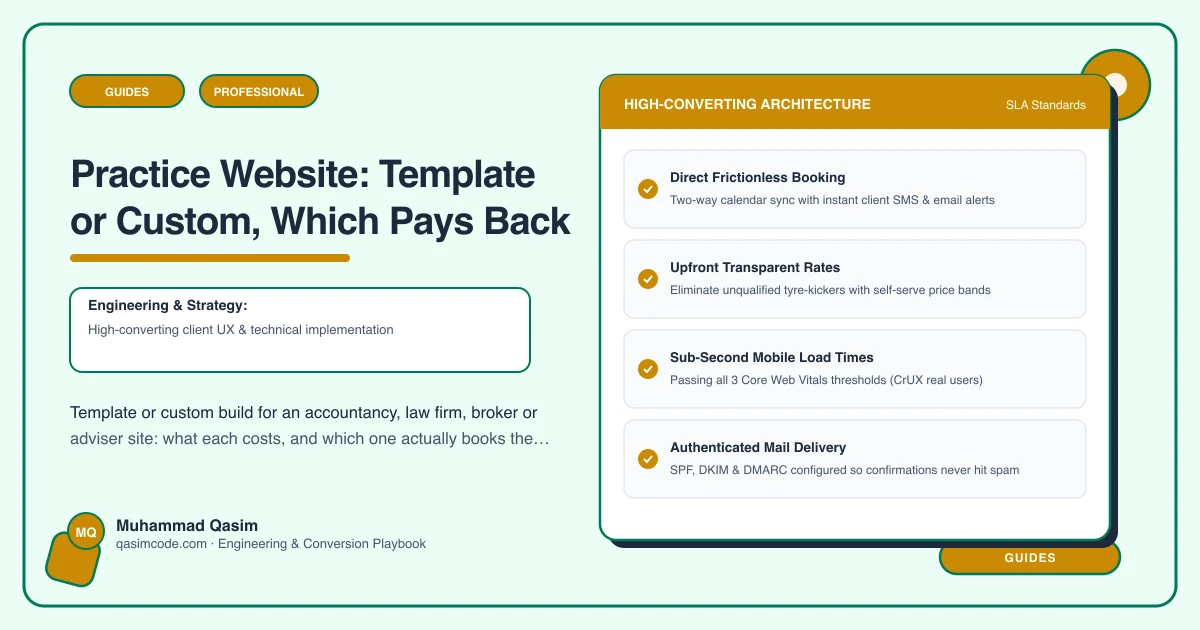
Built around how a client chooses a professional: a page per service in plain words with what happens, roughly what it costs and how to start; fees stated where you can and the quoting process explained where you cannot; regulator registration and disclosures placed correctly and editable by a non-technical person; team profiles with credentials, specialisms and a booking button each; consultation booking with an intake form through Calendly, Acuity, Microsoft Bookings, Clio Grow, Karbon or Intelliflo; client portal links; insights; speed on a phone; tracking on every route; everything in your name.
Cost: mid four figures, fixed.
Good at: being found for the specific work, answering the fee question before it is asked, and putting a prepared client in the diary.
Weak at: the invoice, and two to three weeks of partner time on service copy and compliance review.
Where the difference shows up
The search is the service, not the firm. People search "probate solicitor [town]", "limited company accountant [city]", "first time buyer mortgage broker", "commercial insurance broker [county]". A page per service can rank for each. One Services page ranks for none of them. This is the single biggest gap, and it compounds every month.
The fee question. Clients treat "contact us for a quote" as a warning. A firm that states fixed fees, hourly ranges or simply how it quotes gets the enquiry from the client who has decided they can afford you. Accountants with monthly packages by business type and notaries with a fee per document type see this most clearly.
Regulatory information that stays current. Registration numbers, professional body membership, complaints routes and required statements are not decoration; they are conditions of practising and, for many clients, the check they run before enquiring. On a template they get pasted into a footer nobody can safely edit. Built properly, they live in maintained records that appear where they should.
The first meeting. A contact form starts a phone tag loop. Booking with intake starts a meeting where you already know the client's situation. For law firms and financial advisers, that intake is also the beginning of a conflict check and a suitability conversation.
Specialist mechanics. An estate agent needs a live listings feed and valuation booking. A translator needs a secure upload with the quote form. An immigration consultant needs multilingual pages with correct hreflang. No template does these.
The arithmetic
Count the enquiries the practice took last year and the share that came from the website rather than referral. Then work out the average value of one new client over the first year of the relationship, which for a retained accountancy or advice client is usually a multiple of the whole build. If a page per service and a fee page would move the website's share by even a couple of clients, the custom build pays back in the first quarter.
When the template is right
- A brand-new sole practice testing whether it will have a website at all.
- A firm at capacity, taking no new clients, needing only a credible presence.
- A practice about to merge, where the site will be rebuilt under a new name anyway.
When the template is a leak
- One Services page covering six distinct practice areas.
- No fees and no explanation of how you quote.
- Regulator details in an image, out of date, or missing on the pages your body expects.
- A contact form where a booking should be.
- Team profiles with a photo and one line.
- Three seconds or more to load on mobile data.
- The site on a builder's hosting in someone else's account.
Deciding
Three tests. Search the exact phrase a client would type for your most profitable service, and see whether one of your pages answers it. Ask a friend outside the profession to find your fees in thirty seconds. Ask whoever handles the phone how many callers say "I couldn't tell from the site". If any of those fails, the custom build is not a luxury; it is the fix.
Where this sits
Our professional services website builds are custom at a fixed price, with a page per service, fees or the quoting process, maintained regulatory information and consultation booking included, because that is the version that turns a search into a first meeting.