Two customers, one shop, and that is the whole problem
A repair business almost always serves two people who want completely different things.
One has a cracked screen or a dead washing machine. They want a price, a turnaround, and somewhere to drop it off. The other runs an office with fifteen machines and wants a response time, a support plan and someone to invoice monthly. Sell to both from the same page and you convince neither — the consumer thinks you are too corporate, the business buyer thinks you are a kiosk.
Getting those two routes separated is where most of the money in this build goes, and it is why a repair site is rarely the smallest kind of site.
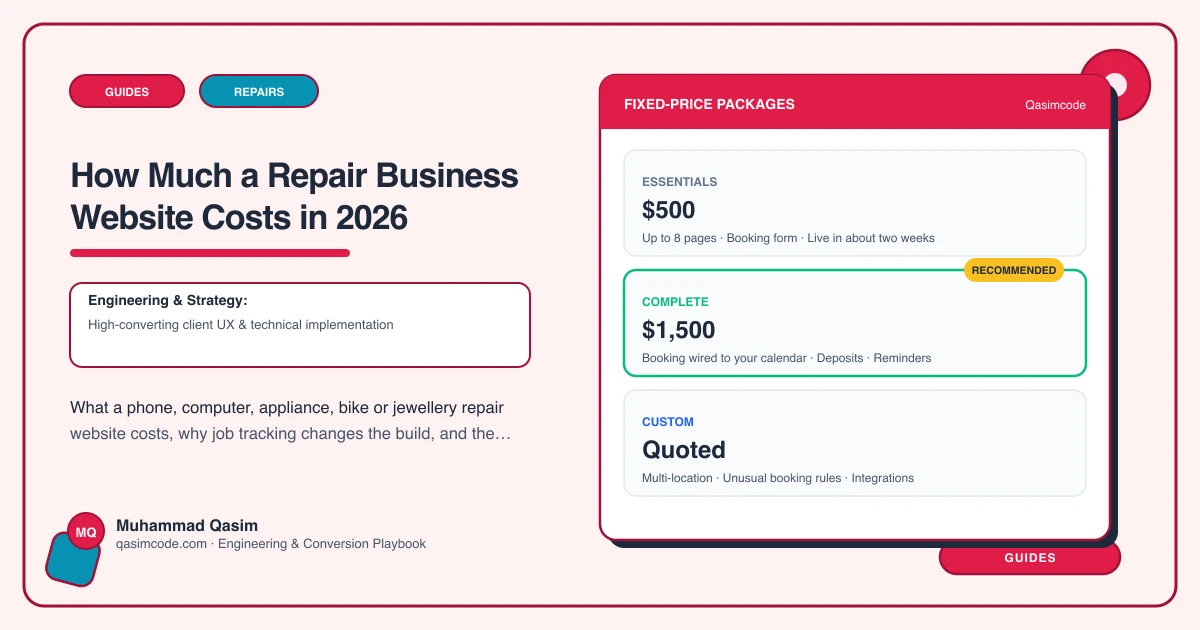
What we build: Essentials at $500, Complete at $1,500
Essentials, at $500 and about two weeks, works for a single shop serving walk-in customers only. Eight pages: price tables by device or item, the brands you handle, warranty and turnaround, booking with fault capture, and contact.
Complete, at $1,500 and about four weeks, is the version most repair businesses actually need, because it has room for:
- Price tables by device, item or service level rather than one flat list
- A separate business support route with plans, response times and its own enquiry form
- Job tracking, so a customer can check status without ringing
- A warranty and parts page
- A page per repair type, because "iPhone screen replacement" and "laptop won't boot" are different searches
Job tracking is the feature that stops the phone ringing
This is the difference between a repair site and every other trade site.
Your customers do not just ring to book. They ring to ask whether it is ready. RepairDesk, RepairShopr, Housecall Pro, Jobber and Acuity can all publish a status a customer can check themselves, and most shops never surface it on the website at all.
Wiring that up is a small piece of work with a disproportionate effect: it removes the highest-volume, lowest-value call your counter staff take all week.
Prices published, or prices lost
The other call is "how much to fix a…". Repair pricing feels risky to publish because condition varies, but the customer is comparing you against a kiosk in a shopping centre that has a laminated sign.
A price table for common repairs — with a plain line about what changes it — gets you into that comparison. Leaving it off does not protect your margin; it removes you from the shortlist before margin is ever discussed.
The free option, and what it costs you
A Google Business Profile plus your repair software's public booking page is genuinely enough to start. It is free, it works, and it takes bookings.
What it will not do is rank for "appliance repair" plus your town, hold a price table, separate your business customers from your consumer ones, or show a warranty policy. It is a starting point, not a shop front.
If a site already exists
A Diagnosis is $299 with a report in three days: what is broken, what each fix costs, and whether it is worth repairing or replacing. Diagnosis and fix is $799 over about two weeks.
After launch
- Hosting and the domain, both in your name
- Your repair software, billed to you as now
- A care plan from $99/mo, which for a repair shop is mostly keeping price tables current as parts costs move
- Photography: the bench, the workshop and the staff, because a customer handing over a £900 phone is deciding whether to trust a room
Where this sits
We build repair and technical services websites with both routes and job tracking wired in, at a fixed price. Sub-types differ: phone and computer repair leans on price tables, while IT support is almost entirely the business route.