What you are actually buying
A club site has a narrower job than a nursery site. A working parent lands on it in February with a half term to cover and a shift pattern that does not bend. They need to see the programme for that week, book the specific days they need, know the fee and whether you take their voucher or funding, and hand over consent and pick-up details once. If the site does those four things the week fills. If it does not, you get emails.
The free option, and what it costs you
ClassForKids, Sawyer, iPAL and Bookeo all give you a bookable page carrying your club name.
You get: a way to take a booking and a place to send parents.
You do not get: a domain of your own ranking for holiday club plus your town, a programme page per week and age group that a parent can read before they commit, a plain statement of which voucher and funding schemes you accept, or anyone to call in the last week of July when the page will not load.
Right for: a first summer, filling from the school gate and a local parents group.
A template site
A children's activity theme with your colours, a gallery, and a link out to the booking platform.
You get: something presentable with your name on it.
Usually missing: speed on a phone at seven in the morning; a programme held as editable records rather than a PDF you re-upload each holiday; booking embedded rather than linked away; funding and voucher information anywhere a parent can find it; arrival and pick-up detail; hosting in your name.
Right for: a club that is full on word of mouth and wants a business card.
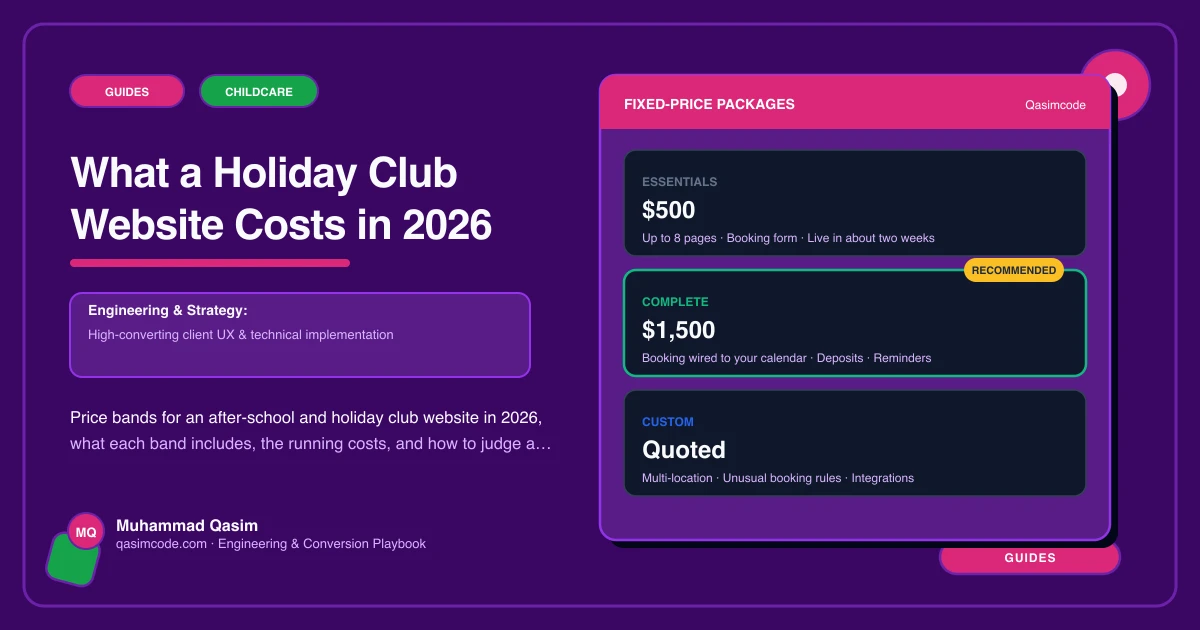
What we build: Complete at $1,500
Built around how a parent books childcare around work. The programme published as pages by week and age group, editable by you in an afternoon, with each day bookable from the page it is described on. Booking from ClassForKids, Sawyer, iPAL or Bookeo embedded and deep-linked per week, with registration and consent captured once and reused. A fees and funding page that names the schemes you accept and says how to pay with them. Arrival, pick-up and late collection stated. Staff, ratios and safeguarding shown. Reviews from parents near the buttons. Fast on a phone, structured data, tracking of booking clicks by page, everything in your name.
You get: a site that turns up in local search in the fortnight parents are planning, answers the fee and funding question before the email, and books a week with the paperwork already done.
Not usually included: photography and copy unless the quote says so.
Right for: an established club running multiple holidays a year, or after-school provision across several schools.
When it goes past that: Custom at quoted after a call — multi-site and franchise
Several venues with separate capacities and staff, a franchise network with local pages, or a club attached to a wider childcare business where the site has to sell term-time and holiday provision to the same family.
After launch
- Hosting and the domain, in your name.
- Your booking platform, unchanged.
- A care plan from $99/mo. For a club that is the programme itself: every holiday brings a new timetable, and a site advertising February's activities in July does not fill.
- Photography. A session in progress with permission in place, showing the space and the staff ratio rather than a stock classroom.
Where the money goes
- The programme as structured records, so a week has days, each day has activities, an age band and a price, and you can edit it yourself in March.
- Booking deep-linked per week and per day, tested on a phone including the in-app browser inside Facebook and Instagram.
- Registration and consent collected once, with medical, allergy, photo permission and authorised collector details stored against the child and reused next holiday.
- The fees and funding page, naming the schemes you take and giving the steps to pay with each.
- Arrival, pick-up and what to bring, which is where most of your inbox comes from.
- Speed, local search foundation and tracking of booking clicks and enquiries by page.
Judging a quote
Ask six questions. Can I publish a new holiday programme myself without sending anyone a PDF. Is booking embedded and deep-linked per week, or is it a button that leaves my site. Are registration and consent collected once and reused. Does the fee and funding information have a page of its own. Are the photos of my club. Whose name are the domain and hosting in. A quote that cannot answer those is a template quote whatever the figure at the bottom says.
Where this sits
Our after-school and holiday club websites are built to that standard at a fixed price, with programme pages, day and session booking, registration collected once and a funding page included, and the wider approach is on the childcare and family page. If your is a template or a booking-platform page and you spend the first week of every holiday answering the same three emails, the number worth weighing against a rebuild is how many of those parents booked and how many went to the club that had the answer on the page.