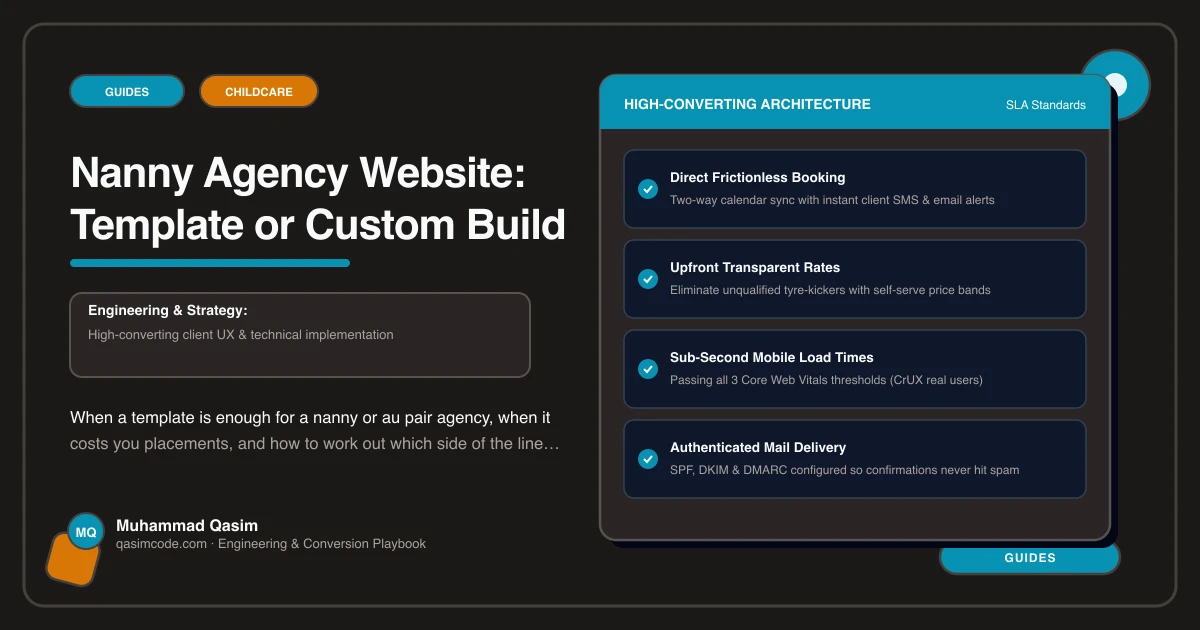
The honest version of the question
Nobody wants a custom build for its own sake. The real question is narrower: does your agency lose placements because of things a template cannot do, and is the value of those placements larger than the difference in build cost.
For a lot of small businesses the answer is no, and a template is the right call. Nanny agencies are one of the trades where the answer flips earlier than most, and it flips for one structural reason. A nanny agency site serves two audiences with opposite needs on the same domain, and templates are built for one.
What templates do well
A modern Squarespace, Wix or WordPress theme gives you a clean layout, decent typography, mobile behaviour that mostly works, hosting, an SSL certificate and a form. That is genuinely a lot for the money, and an agency in its first year placing from a personal network is well served by it.
Take a template if you are in that first year, if referrals fill your book, if you have one consultant, and if you are still working out what you charge and how you describe your process.
Where a template starts costing you
The split at the front door. Families and candidates want different things and speak different languages. A template home page has one hero, one message and one button. Every visitor who has to work out which half of the site is for them is a visitor you are taxing. Two routes on the first screen, each with its own pages and its own form, is the single biggest structural difference between agency sites that convert and ones that do not.
The vetting page. This is the page that justifies your fee against a marketplace where a family finds someone themselves. It needs to walk through identity, references taken up and actually spoken to, background checking named accurately for the country you operate in, qualifications, paediatric first aid and interview, in order, in your own words, framed as what your agency does rather than as legal advice. A template will happily hold that text. What it will not do is hold it as records so that each stage carries the same wording everywhere it appears, or keep it from drifting out of date as your process changes.
The family enquiry form. Template forms take a name, an email and a message. A useful family enquiry takes children and ages, hours and days, live-in or live-out, location, start date, budget band and the household details a consultant would ask about. It needs conditional sections so a family looking for an after-school nanny is not asked live-in questions. Then it needs to land in your CRM as a record rather than in a mailbox as an email.
Candidate registration with CV upload. A CV arriving as an attachment in a shared inbox is a candidate you will lose track of by Thursday. Registration should create a record with availability, areas, qualifications and first aid attached.
Fees. Placement fee basis, what is included, replacement or ongoing terms. Held as editable records, not typed into a paragraph you will be afraid to touch.
Role types. Live-in, live-out, full-time, part-time, after-school, temporary, maternity, au pair. Each is a different search and a different page, and each is a family with a different worry. A template gives you a blog and hopes.
The middle route
There is a real option between the two. A well chosen theme, restructured properly: two routes built into the navigation and the home page, a vetting page written from scratch, a custom family enquiry form wired into the CRM, and fees held as records. You accept the theme's visual language and spend the money on the four things that decide whether a family enquires.
That is often the best value for an agency with two or three consultants, and it is where a lot of good agency sites actually sit.
How to decide, with numbers you have
Work out what one placement is worth to you in fee terms. Then look at your enquiry log for a quarter and count how many family enquiries arrived with enough detail to act on without a follow-up call, and how many candidate registrations you had to chase for a CV.
If the answer is that most enquiries need a call before they are usable, your form is costing you consultant hours every week. Multiply those hours across a year and compare against the gap between a template build and a purpose-built one. For most agencies with more than one consultant, the gap closes inside a year.
If you place one or two nannies a month from people who already know you, stay on the template and spend the money on your vetting page instead.
What not to base it on
Not on how the site looks to you. Not on a competitor's animation. Not on a redesign because the colours feel tired. A family choosing an agency is making an anxious decision about who is alone in their house with their children. They are reading, not admiring. Structure, plain language and a form that asks sensible questions beat a new palette every time.
Where this sits
The two routes, the vetting page, stated fees, the detailed family enquiry and candidate registration with CV upload are what we build into a nanny and au pair agency website, and the same decision runs through our other childcare and family websites. What each package covers is on pricing. If a template gets you there, take the template. Most agencies past their first year find it does not.