One patient is ten years of appointments
A new hygiene patient is not one sale. Someone on a six-month interval is two visits a year, sometimes three, for as long as they stay in your area. That changes the maths on a website completely. The question is not what the build costs. It is how many patients start an interval because of it, against a cost you pay once.
Hold that number in your head while you read the two options.
The template
A dental or clinic theme with your logo, a stock photograph of a smile, a services list and a link out to booking.
Cost: hundreds to low thousands.
Good at: existing, looking tidy, going live in a week.
Weak at: the specific things a hygiene clinic needs. There is nowhere obvious to say that a patient can come without a referral, because the theme was designed for a practice where a dentist sees everyone first. The price list is a paragraph rather than a record you can edit. Booking is a link out rather than an embed. Recalls are nobody's job. Hosting stays with whoever sold it to you.
The custom build
Built around the sequence a patient actually follows: find a hygienist, work out whether they are allowed to see them directly, check the price, decide the room looks competent, book.
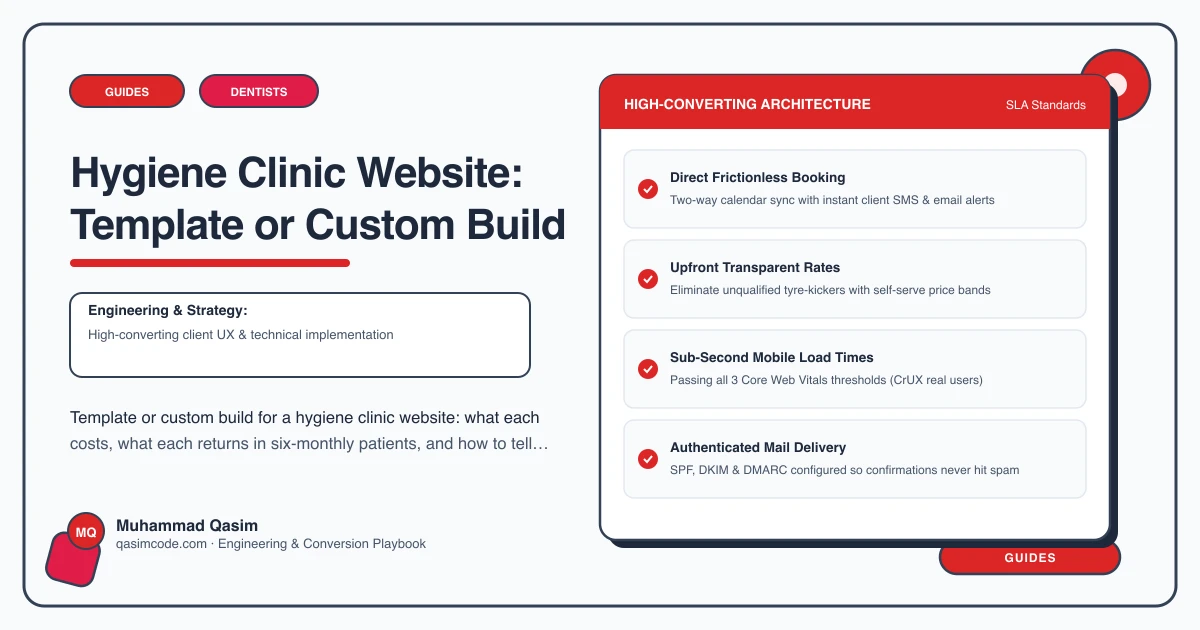
Direct-access messaging on the first screen where it applies, with the referral or recent examination collected in the flow where it does not. A price per visit type and per plan as editable records. Booking from Dentally, Software of Excellence, Cliniko, Jane, Acuity or Square Appointments embedded and deep-linked, with reminders before and recalls after at your interval. A what-happens page. Plans explained plainly with sign-up through your payment tool. Registration details presented the way your regulator expects. Real photography. Fast on a phone, tracking, everything in your name.
Cost: mid four figures, fixed.
Good at: being found for hygienist searches in your town, removing the referral doubt before anyone phones, and turning a first visit into an interval.
Weak at: the invoice, and two or three weeks of your attention.
Where the extra patients come from
The referral question. This is the one that separates a hygiene site from a dental site. Most patients assume they need a dentist to send them. If your first screen does not settle it, a share of your visitors leave believing they are not allowed to book. A template has no slot for that sentence, so it never gets written.
The price. A hygiene visit is a known quantity, unlike most dental work, so patients expect a number and are suspicious when there is not one. A published price per visit type turns a phone call into a booking.
The what-happens page. Someone who has only ever been sent to a hygienist by their dentist does not know how long it takes, what it feels like afterwards, or what to bring. Answering that in plain language converts the hesitant.
Recalls. A template site ends at the booking. A build wired to your tool's recall at your interval turns one visit into a habit, which is where the money in hygiene actually is.
Plans. A monthly plan covering two visits a year and a discount on extras only sells if it is explained in a paragraph a patient can follow, with a sign-up button next to it.
The arithmetic
A template site pulling 250 visits a month, converting three percent to an enquiry and half of those to a first appointment, produces roughly four new patients a month.
A build that ranks for hygienist searches in your town, settles the referral question on the first screen, publishes prices and books in one tap can reasonably reach 450 visits at a much better conversion rate. Even at a modest uplift, the extra patients gained in the first quarter, each one worth years of six-monthly appointments, clear the difference between the two builds well inside a year. Run those numbers with your own visit price rather than mine.
When the template is right
- You are fully booked and have no capacity to add patients.
- You are about to move, merge or join a practice.
- You are in your first few months and still working out your prices and your intervals.
When the custom build is right
- You have capacity in the diary and your recall list is thinner than it should be.
- You take price and referral questions on the phone every week.
- You want to sell a plan and have nowhere good to explain it.
- Your site takes more than three seconds on a phone, which is where most of your traffic is.
A third option
If the current site is structurally sound and just missing the hygiene-specific parts, the honest answer is often not a rebuild. A diagnosis tells you what is wrong, what fixing each thing costs, and whether the bones are worth keeping. Plenty of clinics end up adding direct-access messaging, a price list and proper recalls to a site they already own.
Where this sits
The custom build described here is what a dental hygienist website means when we build one, at a fixed price, and the same decision plays out slightly differently for a whole dental practice where a dentist sees everyone first. The deciding question is not taste. It is whether the site is currently allowed to start an interval, or only to exist.