What you are actually buying
An orthodontic website has a narrower job than a general dental site. Nobody lands on it in pain at seven in the morning. They land on it on a Sunday evening: a parent comparing three practices after a school dental check, or an adult who has thought about straightening their teeth for a decade and has finally opened a browser.
Both are holding four questions. What does it cost. How long does it take. Can I pay monthly. And can I book without ringing anyone. A site that answers those four and puts a free consultation button in reach gets the visit.
The free option, and what it costs you
Most practice systems give you a public booking page with your practice name at the top, and Squarespace or Wix will give you a template with a stock photo of a teenager in braces.
You get: a way to take an appointment and a phone number.
You do not get: a domain of your own ranking for your town plus "orthodontist" or "Invisalign", a page for each treatment you provide, a from-price, a finance figure, a consent-managed gallery, or anyone to call when the form stops sending.
Right for: a new practice in its first six months, filling the book from referrals.
A template site
A dental theme with your logo dropped in, a treatments page listing everything in one scroll, and a Contact Us form.
Usually missing: a separate page per treatment and per aligner brand, so the practice never appears for the brand searches that actually happen; any price at all; finance wording that carries the representative example your regulator expects; booking embedded rather than linked out; speed on a mid-range phone; hosting and domain in your own name.
Right for: a practice full from referral that wants a business card online.
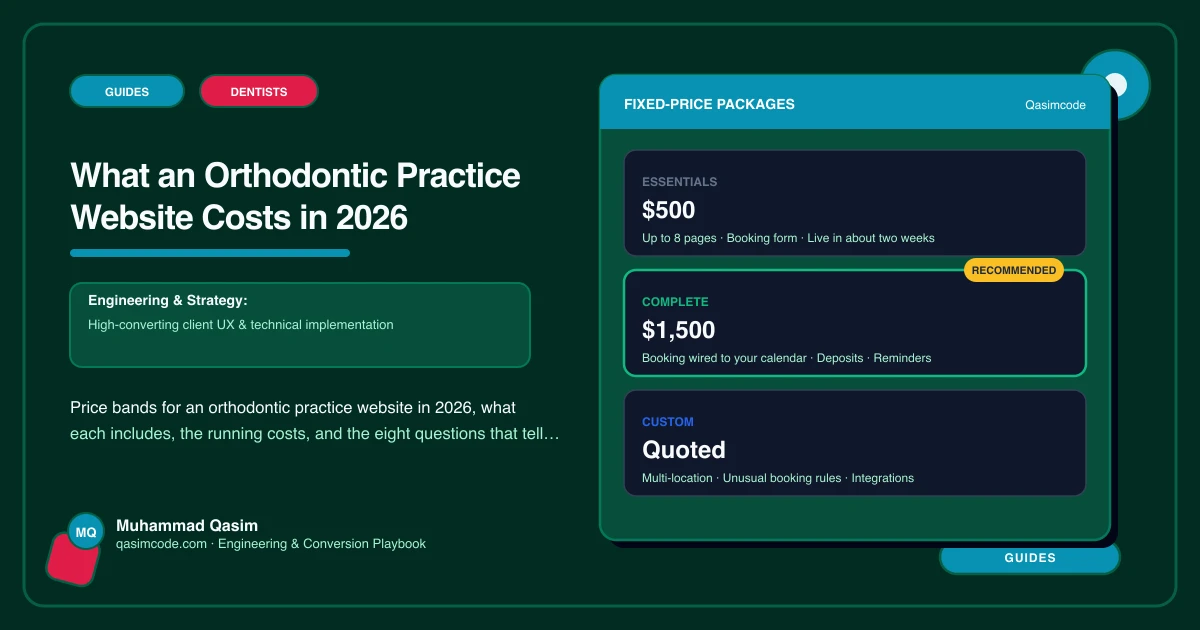
What we build: Essentials at $500, Complete at $1,500
Built around the comparison a patient is actually running. A page for fixed braces, ceramic, lingual, each aligner brand you provide, retainers and adult treatment, each with a from-price and a monthly figure. Free consultation booking as the main button on every page, landing in the practice diary with the new-patient form attached to the confirmation. A treatment-journey page covering the consultation, the fit, adjustments and what to do when a bracket comes loose. An emergency guidance page. A before-and-after gallery with consent recorded per image, or no gallery where the rules where you practise say so.
You get: a site that shows up for treatment and brand searches in your area, answers the price question before reception picks up, and books consultations overnight.
Not usually included: photography and written copy, unless the quote names them.
When it goes past that: Custom, quoted after a call — groups and multi-site practices
Two or more locations with separate diaries and separate opening hours, referral portals for the general dental practices that send you cases, and often a second language.
After launch
- Hosting: managed WordPress at roughly $20 to $50 a month, or often nothing on a framework host. In your name either way.
- Domain: small, annual, and it should be registered to the practice and not the agency.
- Practice software: whatever you already pay Dentally, Software of Excellence, Cloud 4 Ortho, Dolphin, Curve or Jane.
- Maintenance: a care plan at a modest monthly figure, which is where prices, finance examples and team changes get kept current.
- Photography: half a day in the practice. Your chairs, your team, your waiting room. Stock images of white teeth are worth nothing to a nervous fourteen year old's mother.
Where the money goes
- A page per treatment and per aligner brand, because people search Invisalign or Spark by name rather than "clear aligners".
- From-prices held as editable records, so a fee change in January is a ten minute job for your practice manager rather than a developer ticket.
- The finance block, with the monthly figure and the representative example your credit partner supplies, in the same place on every treatment page.
- Consultation booking, deep-linked per treatment, tested on a real phone including the Instagram in-app browser.
- The intake form sent with the confirmation, so the consultation starts with a conversation rather than a clipboard.
- The gallery with consent recorded per image, and the switch to turn it off entirely where your regulator prohibits it.
- Speed, local search foundations, and tracking of booking clicks and call taps by page.
Judging a quote
Ask eight things. Does each treatment and each aligner brand get its own page. Can I edit a from-price myself. Where does the finance representative example live and who keeps it current. Is consultation booking embedded and diary-connected, or a link out. Is the intake form sent automatically. How is consent recorded against gallery images, and can the gallery be switched off. What is the mobile speed target on a mid-range phone. Whose name are the domain and hosting in.
A quote that cannot answer those is a template quote, whatever number is printed on it.
Where this sits
Our orthodontic practice websites are built to that standard at a fixed price, with the treatment pages, consultation booking, finance block and consent-managed gallery included, and the wider approach is on the dental practice websites page. If your current site is a template or a booking-platform page and reception still spends the morning quoting braces down the phone, the number worth weighing against a rebuild is how many of those callers booked.