The number turns on one question
Ask what a driving school site costs and the question underneath is whether you sell hours or sell courses. An independent instructor filling a diary around one town needs a rate, a face and a way to be booked. A school running four cars, block discounts, intensive courses and three test centres sells several products to several searches, each with its own price and booking route. That gap moves a quote further than page count or styling does.
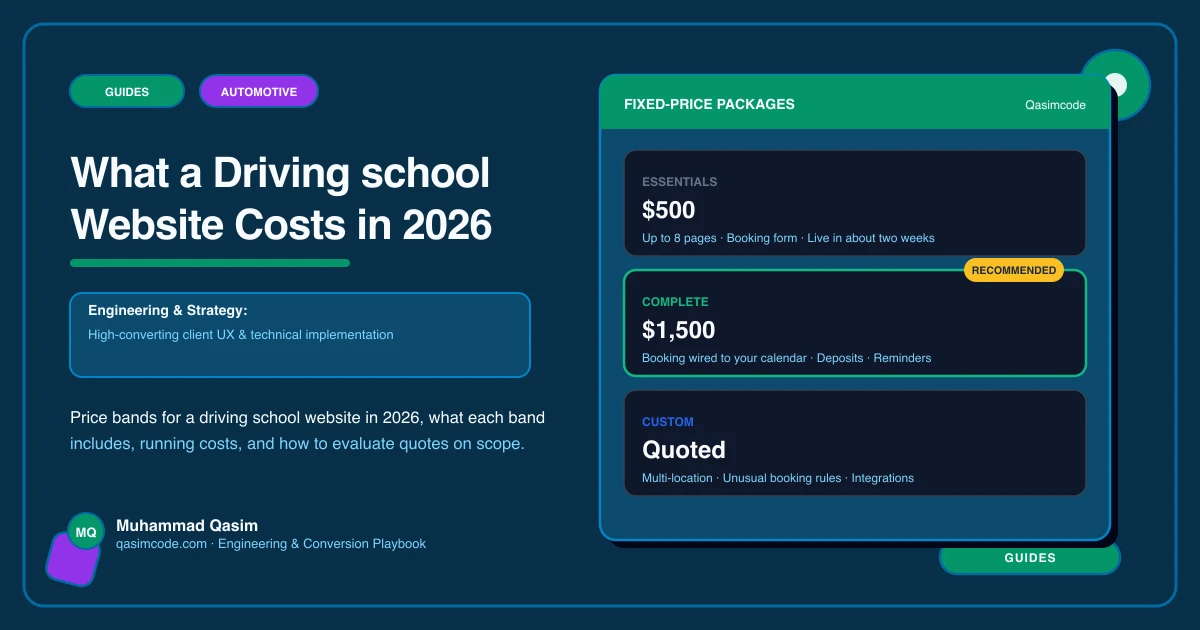
One instructor selling hours: Essentials, $500
For a single instructor, Essentials is the honest recommendation: eight pages, two rounds of changes, live in roughly a fortnight. Eight is more than it sounds here:
- A first screen carrying the area you cover and the hourly rate
- A price page: the hour, the block, and what the block saves
- A page on how a first lesson runs, pickup to sign-off
- Your own page: qualifications, the car you teach in, how long you have taught
- One area or test centre page for the patch that feeds you
- Reviews and a page of theory practice links
- A booking page
- Contact
The record for this trade says the same in fewer words: quick online booking, a stated price menu, and pages that earn a nervous parent's trust. Buying twenty pages before there is a second instructor is buying pages nobody writes.
A team with intensive courses: Complete, $1,500
Complete is up to twenty pages, four rounds of changes, live in about four weeks, with booking wired into the diary you keep rather than an inbox. The extra pages have obvious homes:
- A page per instructor, each one bookable on its own
- A page for each area and test centre you genuinely teach around
- An intensive course page per course length, priced apart from hourly lessons
- A package table you can edit yourself the week you put rates up
- Refresher, motorway and automatic lessons as pages, if you sell them
Booking, and the subscription behind it
On a new Complete build the booking setup sits inside the price: the system chosen for how you run, joined to your Google or Outlook calendar, deposits through Stripe, reminders before the lesson, and confirmation emails tested so they reach a seventeen-year-old rather than a spam folder. Bolting booking onto a site you already own is quoted in a day, usually a week of work.
The lesson software is a separate line you pay directly: Total Drive, myDriveTime, DriveTech, Acuity and Square Appointments all bill you, not us.
If there is already a site
The first spend is finding out whether it is worth keeping. Diagnosis is $299, report back in three days: what is broken in plain language, the cost of each fix, and a straight answer on fix or rebuild. Diagnosis and fix is $799, usually two weeks. A rebuild is quoted after that report, never before it.
The monthly side
- The domain, renewed each year in your own name
- Your booking software subscription
- Hosting
- A care plan, if updates and fixes should be somebody's job: Basic $99/mo, Growth $249/mo with four hours of changes, Scale $499/mo
The care plan earns its place here because this content ages fast: rates rise, instructors leave, courses sell out. A price page untouched for a year does more damage than none.
Five things that move the quote
- How many instructors need a page and a bookable diary of their own
- How many areas and test centres you teach around, since each real one is a page and a separate search
- Whether intensive courses are part of the offer, since a course is a product with a price, not a calendar slot
- Whether blocks are paid up front and counted down, or only reserved
- Whether the school books everyone centrally, or each instructor keeps their own hours, car and rate
Not on that list: how the site looks. A quote weighted toward design is pricing the four seconds before a learner goes looking for your hourly rate.
Where this sits
Our driving school websites are built to that shape at a fixed price. If the site you have is the problem rather than the plan, start with why your driving school website gets no bookings, or run the six phone tests on it first.